By Rita Chen 文/陳竹筠
Hakka, written 客家, means guest families. The meaning was assigned rather than claimed, and Hakka communities have carried it across southern China, through Southeast Asia, and over the Pacific.
In February a storefront opened inside Vancouver’s Chinatown Plaza, called Hakka House.
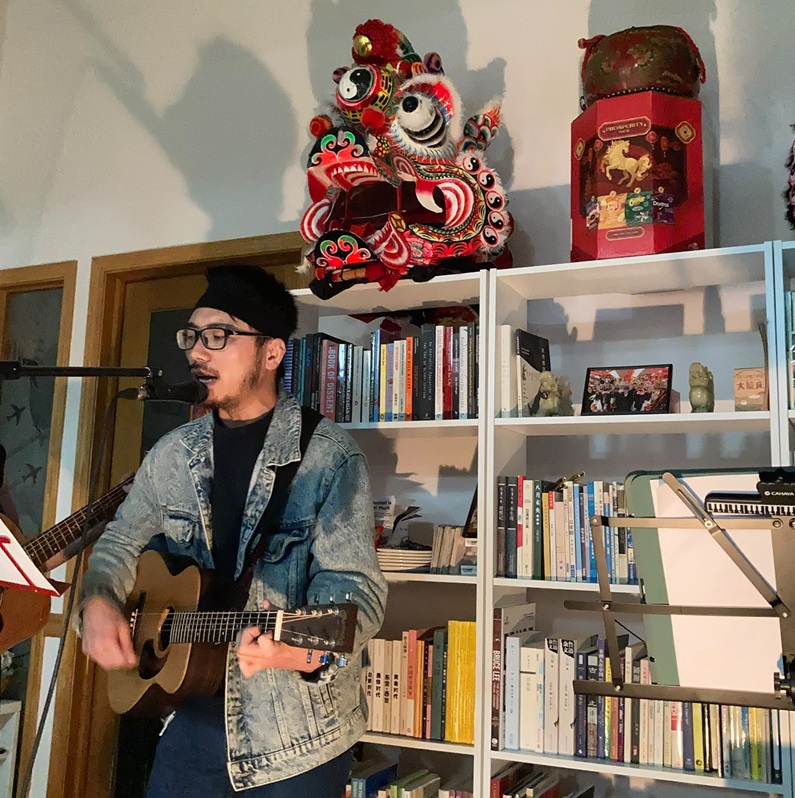
It sits at 103A-180 Keefer Street, and its own description of itself stays loose: possibly a mini library, a music hall, a research institute, or simply a place where people sit and talk, depending on who comes through the door that afternoon. It has hosted mahjong, film screenings and photography exhibitions, and it is where a Kirin troupe practises.
One of its founders is Yao Xiao (they/them/their), who grew up in a Hakka family in the Karst terrain of inland Guangdong. Xiao teaches and researches social justice and diversity education in UBC’s Department of Educational Studies and The Social Justice Institute. They sit on the boards of the Critical Alternatives Society and the Youth Collaborative for Chinatown.
Asked how they would describe Hakka House to someone meeting them for the first time, Xiao does not begin with culture. They begin with what is disappearing. Hakka are a people few in North America know much about, and this is Chinatown, where the city changes outside the door daily: luxury towers driving up land values until locals can no longer stay; the Chinese library next door, where the books go unborrowed; more English on the street, and less Cantonese, Mandarin, and Hakka.
“You walk outside now, and to a lot of people it feels less and less like Chinatown.”

Why a storefront and not a paper
From studying the neighbourhood to renting a room in it, Xiao spent a decade in Chinatown before there was a lease with their name on it. The reasoning was plain: a paper, once written, stays on paper; at most people download it and take a look, and whether anyone acts on it is anyone’s guess.
Xiao and Hakka House co-founder Melody Yun Ya Ma were strangers two years ago, brought together by two things happening on the same few blocks. One was opposition to luxury development. The other was a Hakka Kirin troupe that a friend pulled Xiao into. Protests, petitions, appeals had all been tried, and no matter how much was said, nobody could see it.
“So we thought, why not just make one, and let people see what kind of Chinatown we actually want.”
Not long after Hakka House opened, people did see it. An older woman walked in expecting the travel agency that used to occupy the unit. She had run a tailor shop next door for close to thirty years before retiring. Xiao explained what the room was now, and she stood there a moment taking it in.
“The beginning is always hard,” the woman said. “You have to keep going. I’ll support you.”
Another Hakka Elder auntie drops in from time to time was more practical about it, saying she had no other support to offer, so she would offer action instead, and buy Xiao lunch.
A room shows you what books cannot do, such as how an identity moves from something hard to say out loud into something a person can claim. That process, Xiao says, is one a book will never teach you. Which is also why they do not serve Hakka culture up as something to be preserved untouched. Hakka culture is not perfect.
Xiao is referring to the gender inequities they grew up around, including Hakka daughters given away to other families. The Kirin troupe they dance with now is made up of women and gender-diverse people, where traditionally only men performed.
What they are after is a Hakka culture defined by Hakka people and recognized as such, rather than one that stops counting the moment it departs from an established template.

We are guests, and we know whose land this is
Someone once walked in and asked Xiao: everyone here is Chinese, so why does there need to be a Hakka place?
The question has to do with the power dynamics in this neighbourhood. The Chinese culture that runs Vancouver’s Chinatown came from the Sze Yup counties—Taishan, Kaiping, Enping and Xinhui—of the Pearl River Delta. Hakka culture has been largely left out.
Xiao’s answer pulls in two directions at once. One is acknowledgment. Hakka House’s land acknowledgment names the unceded territories of the xʷməθkʷəy̓əm (Musqueam), Sḵwx̱wú7mesh (Squamish) and səlilwətaɬ (Tsleil-Waututh) Nations.
“We are guests, of course. This is Indigenous land. That’s certain.”
The other is a refusal of the move that would flatten everything else: if everyone is a guest, isn’t everyone Hakka? Xiao does not think so. Hakka remains a very particular people, particular in language, food, and architecture, and in a history of being moved along. The Punti-Hakka Clan Wars of the Qing era produced a distinctly Hakka diaspora. Being a guest on this coast cancels none of that.
The language they were not taught
Xiao’s family did not teach them Hakka. English, Mandarin and Cantonese were what got spoken.
Nobody stated the reason, but the assumption was clear: out in the world, are you going to use Hakka? What Xiao wonders now is whether something else sat underneath it, a sense that Hakka identity was marginal, or not much use.
For a long time they did not mention where they were from: a village in inland Guangdong, where Han Chinese were not the majority and Yao communities lived alongside them. That history went unspoken for years, because it never felt like a good identity to have.
The turn came with the Kirin troupe, and not because of the dance. It was the people dancing alongside them: Hakka from Brunei, Malaysia, India, Meizhou, Taiwan, and Hong Kong.
“I’m not the only one,” Xiao says.
In the space now, Hakka, Cantonese, Mandarin, and English turn up in a single afternoon, and Xiao does not see anything that needs solving. Chinatown has always been multilingual; there was never a period when everyone spoke only English. What changed is that people stopped noticing. What Xiao does push back on is the assumption that everyone present has to follow all of it. Someone speaks Cantonese, someone speaks Hakka, and an English speaker does not have to catch every word.
“Being able to accept not understanding everything—I think that’s a very important attitude.”

On the traces Chinese people have left on this land
Some traces get told often: the labour, the railway, the descendants who carried the culture forward, the paper trail of the Chinese Exclusion Act. Others are true and nobody wants to touch them. Xiao calls these “inconvenient truths”, and offers one. Through the twenty-four years of the Exclusion Act, Chinatown’s Chinese residents and the Japanese Canadian community next door were neighbours, some of them in business together, and the relationship was not always smooth. Whether those traces get raised and discussed, in Xiao’s view, decides whether a deeper reconciliation is possible now.
Another kind of trace was never recorded at all. Many of the men who came in those years stayed bachelors, kept that way by racial discrimination and a badly skewed gender structure. Some had wives on the far side of the Pacific, some got out before the Act took effect, very few left descendants, and many lived thirty or forty years in B.C. without ever holding Canadian status.
“Whoever they were, they should be remembered,” Xiao insists. “But what I’m saying is that all of this is only part of the traces.”
Xiao has recently been part of a project working toward heritage recognition for Chinese cemeteries, recovering inscriptions worn past reading: the Chinese name, the home village, the dates of birth and death. Government records kept only fragments, usually just an English name, and the aim is to create a database later that researchers can use.
“The European ones had stories, as a person; they went to this event, they did this thing,” Xiao declares. “The Chinese ones were like a number in a file. An English name at most, often an incomplete transliteration, and then nothing. So why can’t Chinese Canadians also keep a whole person’s story?
“Coming back to your question about traces, we’re hoping these gravestones can recover some of those possibilities.”
An equal exchange
Asked what they would say to young people who have come late to their own cultural roots, Xiao holds back, unwilling to hand out advice. They offer one experience instead.
They recall an Afrodiasporic Black Canadian professor from their graduate school years. Xiao had been citing Black theory and Black social movement history in class, and the professor told them it had to run both ways: “I want to learn from you too. Does your own culture have something worth sharing?”
Xiao can list plenty of Black social movement theory, they say, but it did not grow out of their own culture, and they had been borrowing all along. Real respect for another culture means bringing your own.
“If you spend an hour learning about someone else’s culture, spend an hour learning about your own,” Xiao states. “Then one day you can share yours with others, and that’s an equal exchange, rather than always leading with a quotation from some scholar.”
To learn more about Hakka House, visit the website. Follow Pancouver on X @PancouverMedia and Bluesky @pancouver.bsky.social. The publication is also on Instagram @PancouverMedia.