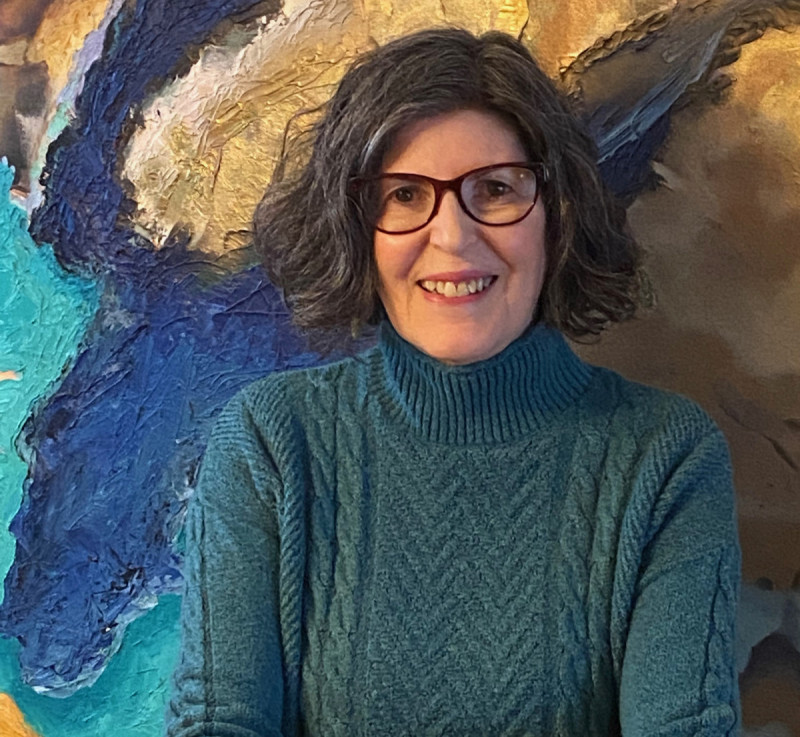
In A Storm Unleashed, Winnipeg writer Carol Matas wanted to show how dehumanizing language can portend calamitous events. The gripping novel revolves around a 12-year-old girl named Mia living in Berlin from 1933 to 1935. Her father is a Jewish veterinarian and her non-Jewish mother died shortly after Mia was born.
A Storm Unleashed opens with a girl in the Hitler Youth declaring that she wants to seize Mia’s precious German shepherd named Max. Mia flees with her dog, hopping on a train for her maternal grandparents’ farm. But that offers only a brief respite. The sinister presence of Nazis and their enablers repeatedly force Mia and her father to rely on their wits and their actions to survive. It’s at times both terrifying and inspiring.
“I felt like I wanted to explore fascism and describe it to young people, almost like an immunization,” Matas tells Pancouver over Zoom from her home in Manitoba.
“If you can get young people to think about what it means to live in a dictatorship or an autocracy, then maybe they won’t be so keen to go there,” she continues. “Maybe they will also, as they grow older, see the signs when they are developing.”
The novel also addresses antisemitism, a topic that Matas has written about in many other books. In A Storm Unleashed, she writes about how teachers and others in Nazi Germany became so swept up by Hitler’s rhetoric and lies that they embraced these ideas as their own, stigmatizing Jewish children like Mia.
According to Matas, it’s the only novel in Manitoba’s new Grade 6 Holocaust curriculum. A Storm Unleashed is targeted at readers from ages 9 to 12.
Matas addresses origins of Jew hatred
Early in the book, the Jewish owner of a hardware store is assaulted. A Jewish star is painted on the window of a Jewish-owned sweet shop. Mia sees these things and recognizes that she, too, is vulnerable to persecution on the basis of her lineage.
At one point, Mia’s Nazi-admiring teacher forces her to ask classmates who reminds them most strongly of Jesus—by his love of the people and his self-sacrifice. They call out, “Herr Hitler.”
Then Mia is forced to ask who killed Jesus. The other students reply, “The Jews killed Jesus.” Mia must also shout this answer even though she knows it is false.

Matas thinks that “Jew hatred” is a better term than antisemitism. In the book, she writes about its origins.
“After all, Jesus was a Jew himself,” Mia observes at one point. “He gained such a large following that the Romans, who were the rulers in those days, killed him. That was a very long time ago, but as Opa explained to me, Jesus’s apostles decided that they could not blame the Romans because they had to live under Roman rule. Instead, they blamed the Jews, and that has resulted in people hating Jews for two thousand years.”
Through literary techniques such as this, Matas helps young readers understand antisemitism’s deep roots in western civilization. This reflects Matas’s firm belief that Holocaust education in schools can’t only be about the horrors of what happened.
“It needs to be about the ‘why did it happen?’ And how can we prevent it happening?” Matas declares. “If we understand why and how, then we can prevent it again.”
She points out in A Storm Unleashed that one of Hitler’s first moves as chancellor was to introduce sweeping tariffs. This attracted negative media coverage abroad and alienated German’s long-time trading partners. The central character, Mia, points out that the Nazis were blaming the Jews for the poor economy in the wake of Hitler’s trade war.
Echoes of history
In her writing, Matas has focused on enablers who ensure that dehumanizing and domineering dictators and authoritarians get their way. In this regard, she is influenced by Daniel Goldhagen, author of Hitler’s Willing Executioners: Ordinary Germans and the Holocaust. Matas also admires U.S. author and essayist Dara Horn, author of People Love Dead Jews: Reports from a Haunted Present, which explored the roots of Jew hatred. And Matas points out that British historian Martin Gilbert’s work has informed her research, along with many others.
Moreover, Matas acknowledges that she was inspired by today’s times to write A Storm Unleashed. And she emphasizes that dehumanization of those deemed to be different occurs in many countries around the world.
“I think it’s just really important to recognize the ‘othering’,” says Matas. “In India, it’s going to be a different target. In China, there’s not enough talk about what’s done to the Uyghurs.”
Then, there are the Rohingya, a stateless and mostly Muslim Indo-Aryan ethnic group facing intense persecution in Myanmar. More than half of the country’s 1.4 million Rohingya fled to Bangladesh to escape genocidal killings.
“These are all instances of the scapegoating,” Matas says. “And in the U.S., we can see it in terms of immigrants. [Trump] has just taken the immigrants and othered them.”

Over her career, Matas’s works have been translated into more than a dozen languages and she has received more than 100 awards and honours. Her most recent book is Kai and the Golem, which is aimed at children from six to nine years of age.
The storybook features illustrations by Elisa Vavouri and is about a child who thinks an entity is wrecking his day for no good reason. Kai eventually befriends this entity, names him Pete, and is better able to cope as a result.
“In Kai and the Golem, the golem gets smaller when Kai is happy and bigger when Kai is afraid,” Matas says.
Event details
The 41st annual Cherie Smith JCC Jewish Book Festival runs from February 21 to 26. The festival and PJ Library will present Carol Matas discussing Kai and the Golem at 10 a.m. on Sunday (February 22). It’s a hybrid format (in-person and on Zoom). Pre-register through Showpass. Then on May 5, Matas will speak about A Storm Unleashed at VTT. For more information on the festival, visit the website. Follow Pancouver on X @PancouverMedia and Instagram @PancouverMedia.