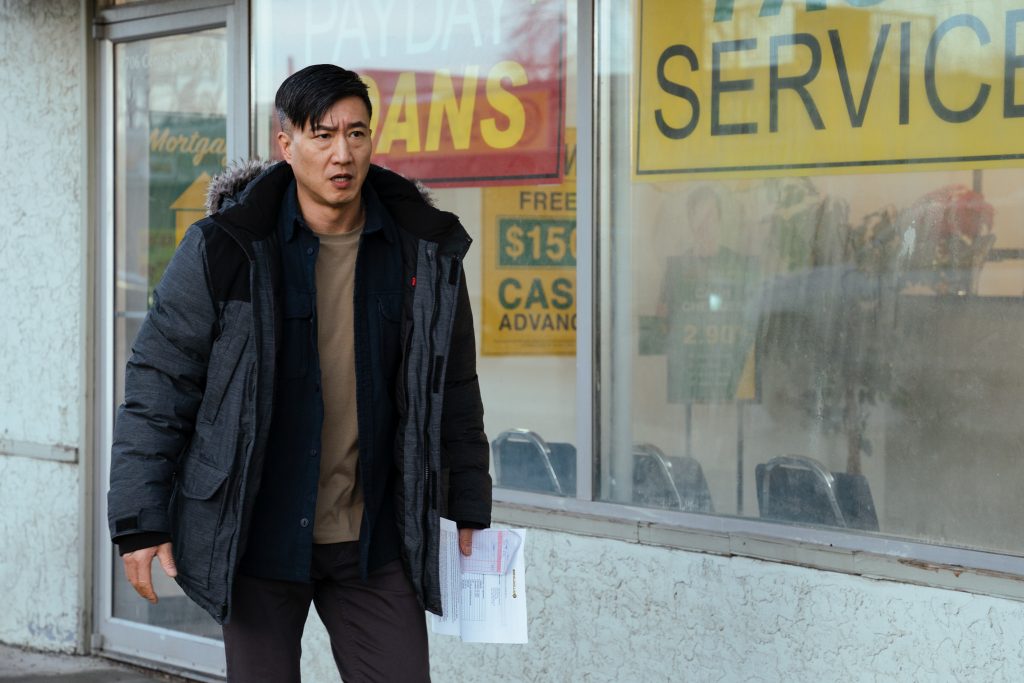
Vancouver actor Terry Chen (Almost Famous, Sight) says that he felt an immediate connection to the script for Lucky Star. Written and directed by Gillian McKercher (Circle of Steel), it’s an indie film about a reformed gambler named Lucky, played by Chen. At the beginning, Lucky is living comfortably with his wife and two kids in Calgary.
“At one point in his life, his wife Noel—played by Olivia Cheng (Marco Polo)—and him were probably the cool kids in school,” Chen says of his character. “He’s well past his prime now. And he falls victim to a tax scam that ultimately brings him back to his gambling past.”
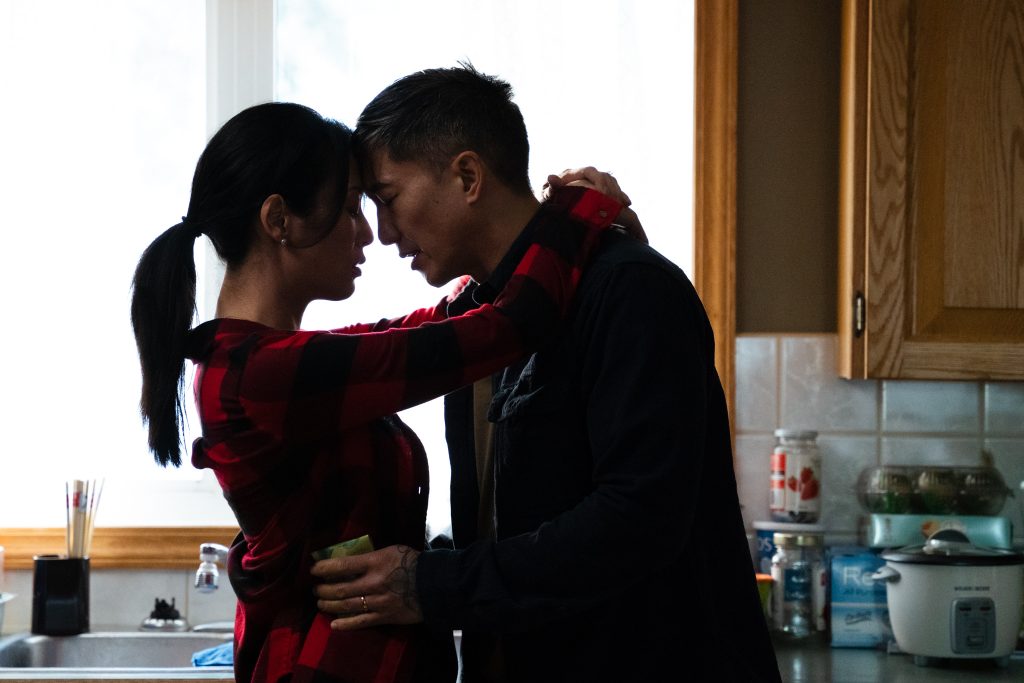
Noel senses that Lucky isn’t being straight about the family’s finances, which leads to raw on-screen moments with her husband. As a result, the couple’s older daughter Grace (Conni Mui) and her younger sister Jenny (Summer Ly) feel the effects of growing tension in the household.
As an actor, Chen wanted the audience to feel empathy for Lucky, even as he was making some bad decisions.
“You find the characters of this piece all having their own little secrets—and all are just striving for some little slice of hope in their lives,” Chen states.
Andrew Phung, best known for comedy parts in Kim’s Convenience and Run the Burbs, takes on a dramatic role as Lucky’s accountant. Chen, Cheng, Mui, and Phung are all originally from Alberta.
Lucky Star won the audience award at the Calgary International Film Festival. And on May 13, it will become available through video-on-demand platforms. It’s also being shown in Canadian cinema houses this month, including on May 15 at TIFF Lightbox in Toronto.
Gambling not glamorized in Lucky Star
Chen points out that there are distinct differences between Lucky Star and other films with gambling themes, including the crime dramas Hard Eight and Rounders. In Lucky Star, McKercher made a point of not glorifying or romanticizing poker games.
“Gambling scenes are found in back rooms, basements, janitors’ closets—anywhere that people can have a game,” Chen says. “And it’s not glamorous.”
He notes that the poker players come from a diversity of ethnic, cultural, and economic backgrounds. However, they all have the same goal: winning the jackpot.
“I think we show a very different side of cinema gambling.”
Moreover, unlike other Canadian films revolving around families of Asian Canadians, Lucky Star does not focus a great deal of attention on identity or ethnicity. Rather, the film is driven by the plot and interactions between characters.
“The cultural aspect is not heavy-handed,” Chen says. “It’s not something that we wanted to put on the forefront.”
It’s a Canadian story centered on Canadian-born characters of Asian ancestry. Later in the interview, the actor adds: “Lucky’s family is Asian, but they could easily be another ethnicity as well.”
Chen shares an executive producer credit with Cheng and producer Sidney Chiu.
“It’s very important for me as an artist to support homegrown talent and homegrown production,” Chen emphasizes.
Chen spoke Mandarin in British miniseries
Chen’s parents immigrated to Canada from Taipei in 1974, landing in Edmonton. They were sponsored by his dad’s sister, who was married to an executive with Occidental Petroleum’s Canadian subsidiary. Chen was born the following year in Edmonton and the family settled in Calgary when he was young. His dad was a travelling salesman.
“Growing up in Alberta as a young Taiwanese kid, there was a constant crisis of identity,” Chen acknowledges. “We moved around quite a bit when I was growing up, so I spent time growing up on the West Coast in Vancouver as well. I would be one kid over there and then when we moved back to Calgary, I’d be wearing cowboy boots, trying to fit in.”
He sought solace in film and the arts. He feels that this kept him connected to his authentic self.
“I wanted to tell stories,” Chen declares, “and I had a problem figuring out who I was because I was being told who I was all the time. That’s another part of my story.”
Chen says that French is his second language but he also speaks conversational Mandarin. In 2019, he even spoke Mandarin in a miniseries called Chimerica for Channel 4 in the United Kingdom. His character, Zhang Lin (Tank man), was one of the leads.
“The story offers a perspective to one of the great mysteries of the world, which is what happened to the ‘Tank man’ from the Tiananmen Square massacre,” Chen reveals. “It was hard working phonetically, especially for a character who had never left Beijing. But I’m proud of the work. It was very challenging material. I worked closely with a dialect coach on that one.”
Watch the trailer for Sight, which earned Terry Chen a Bronze Crown Award.
Chen played real journalist, doctor, and prosecutor
He has a lengthy list of film and TV credits, including his current role as Chief Patrick Li on the CBC police procedural Wild Cards. Chen is thrilled that CBC recently renewed the series for seasons three and four.
One of his best-known movie roles came as Rolling Stone journalist Ben Fong-Torres in Almost Famous.
“I’m actually still very good friends with him after 20 years,” Chen reveals. “That’s a wonderful relationship that I’m grateful for.”
The Almost Famous cast included the late Philip Seymour Hoffman, whose work has inspired Chen for years. More recently, Chen played prosecutor (and future B.C. police complaint commissioner) Stan Lowe in Under the Bridge. This 2024 miniseries on CBC Gem is based on the 1997 murder of teenager Reena Virk in a suburb of Victoria.
Meanwhile, one of Chen’s most memorable roles was playing a renowned eye surgeon, Dr. Ming Wang, in Sight opposite Greg Kinnear. It earned Chen a Bronze Crown at the 2022 ICVM Crown Awards. In addition, Chen had a meaty role alongside Oscar-nominated actor Viggo Mortensen, Lance Henriksen, and Laura Linney in the indie film Falling, which Mortenson also directed and wrote.
Chen, who is exceedingly gracious, tells Pancouver that he appreciates being interviewed by the media for Lucky Star.
“Every auteur director that I work with has the same hardship, which is getting eyes on the film so that audiences can see it,” Chen says. “So, outlets like yours and various other interviews I’ve done are very important to bring to the public awareness [of] films like this that may not get a mainstream-wide distribution.”
Watch the trailer (above) for Lucky Star.
Lucky Star details
Lucky Star will be released on video-on-demand platforms on May 13. In addition, it’s being screened at the Globe Cinema in Calgary from May 9 to 11 and from May 14 and 15. TIFF Lightbox will present the film in Toronto on May 15. Then, the Rio Theatre will screen it in Vancouver on May 28. Follow Charlie Smith on Bluesky @charliesmithvcr.bsky.social. Also, follow Pancouver on Instagram @PancouverMedia and on Bluesky @pancouver.