One of the most gratifying feelings of elementary school life in the 2000s was when a teacher would roll in the school’s only TV and throw on a movie. A short respite from the wrist-breaking annotations of notes from a white board always came with high expectations. Whether it was Bill Nye the science guy explaining the secrets of our universe or Wynton Marsalis breaking down the building blocks of jazz, the TV being rolled into class was no joke.
There were also the Heritage Minutes which would transport students back to important moments in Canadian history and immerse us into cinematic landscapes of the past. The shot of James Naismith on a ladder taking down a leather ball from a literal basket is embedded in my brain every time a player in the NBA makes a basket.
For a long time, those were just memories relegated to the abyss of nostalgia that seems to be stimulated more and more by Hollywood lately. Reboot after reboot of pre-existing IP tends to be the safe lane that many in the entertainment industry seem to strive for, but I digress. Rehashing the past tends to be a vapid and blatant plan to mine moments from our collective nostalgia in the pursuit of profit.
However, there is a distinct difference between the trend we’re seeing on the silver screen and what Historica Canada is doing with the Heritage Minutes. After combing through the YouTube library of Heritage Minutes and being invited on set to observe the shooting of the latest shorts, I was left feeling inspired to learn and write about this. It was a pure form of nostalgia that didn’t feel like a Hollywood cash grab.
After reflecting on the interviews with Historica Canada’s coordinator, Ophelia Espinosa, and its CEO, Tony Wilson-Smith, my instincts were definitely correct. The team is committed to evoking a passion to learn from our country’s influential past. To instill and embolden Canadians that learning from our history can enlighten our future.
On set with Historica Canada and Scopitone Films
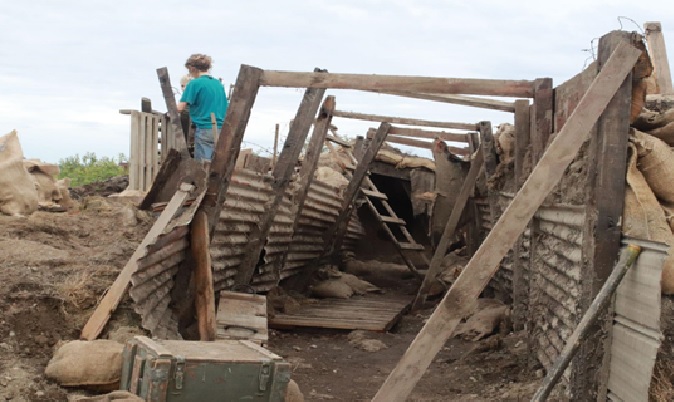
Driving across an old wooden bridge, next to a river, tucked behind vast acreage and farm houses, a narrow walkway had been transformed into a European battlefield, complete with a realistic WW1 bunker. To add a level of authenticity, we were told that the bunker had been a poppy field that was dug up and designed to resemble a trench from the desolate landscape of the First World War.
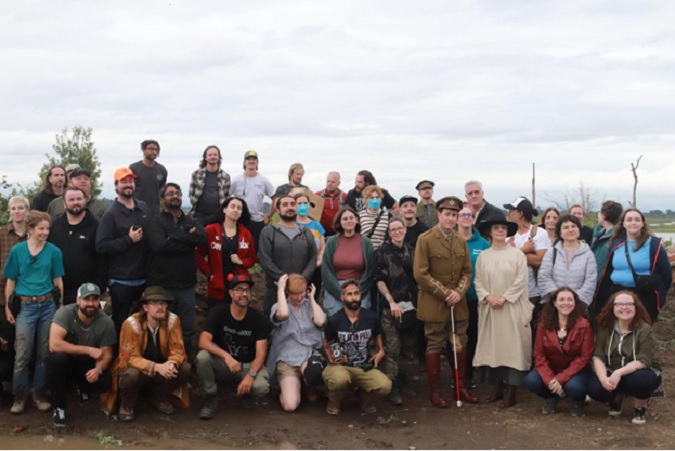
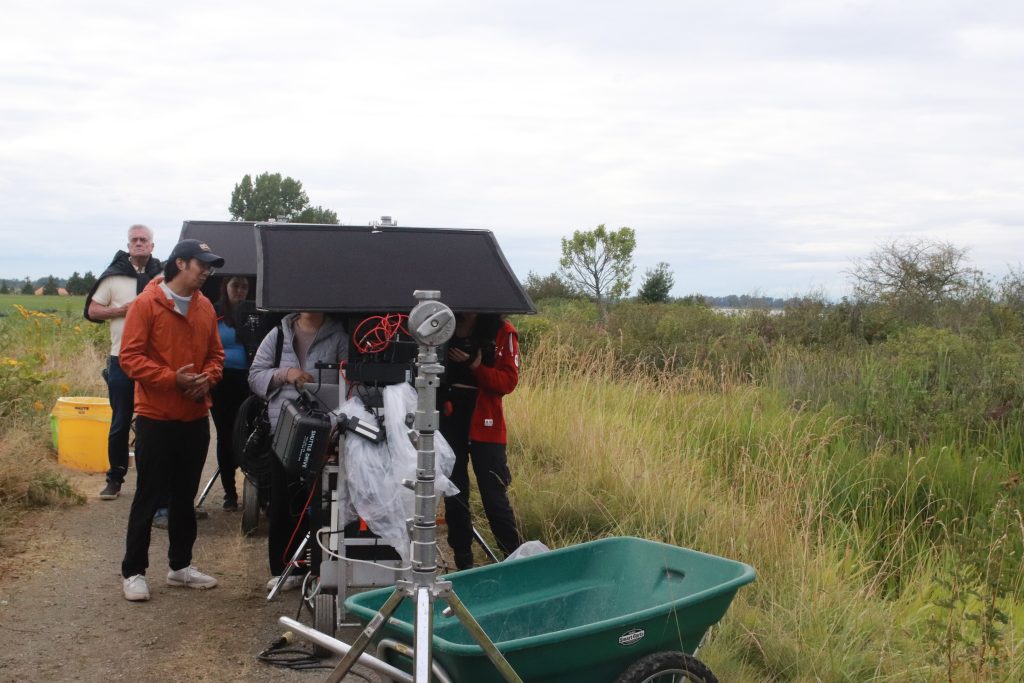
Upon arriving, my photographer and I were greeted by Espinosa and her colleague Katharine Mcnevin, who escorted us to the active set. The crew was filming a shot with Megan Follows from Anne of Green Gables as seen in the picture below.

We were given the rundown of the projects that were being filmed here in Delta and a brief summary of the stories being focused on forthat day’s shoot. Espinosa explained that their team was set for a three-day shoot in total for two Heritage Minutes.
“The first was about Edwin Baker, a co-founder of the Canadian National Institute for the Blind,” she said. “The second and what we’re filming right now is on Mary Riter Hamilton, a female war artist who went to battle fields after World War I and courageously painted the landscapes devastated by the war.”
After sitting down with Wilson-Smith, he noted that nobody would fund Mary Riter Hamilton.
“She was a good painter but she wasn’t well known yet,” he continued. “She finally talked to the War Amps Association for funding and was given the go-ahead to travel to Europe at her own peril.”
Not only that, Riter Hamilton had to deal with “disease, bodies buried, unexploded mines, marauding crews, and bandits”.
“She lives a couple years that way. She’s almost forgotten about for the next four years,” Wilson-Smith said. “By doing what she did, she ruined her health doing it. She put herself on the line for it. It’s only in recent years that she’s become more popular.”
Without spoiling the entirety of shorts that are being filmed, the bottom line is that Historica Canada selected two outstanding stories of Canadians with almost forgotten but influential lives.
The Historica Canada team on set consisted of three members who work on the Heritage team. Their roles are to take the ideas and suggestions from the public and discuss internally to determine which shorts they plan on highlighting. From there, the team puts out an RFP (request for production) to Canadian production companies to see who will get the opportunity to collaborate on the latest shorts.
This time it was Scopitone Films, a Vancouver-based production company, that was at the helm of the latest Heritage Minutes. In addition to Megan Follows, the crew was working with Bruce Horak, the Calgary-born actor known for his role as Hemmer on Star Trek: Strange New Worlds.
It’s safe to say that there was no shortage of talent on-set for these shorts. The team gets to collaborate with different production companies around Canada and travel all over the country to bring life to these amazing tales of Canadian citizens.
The history of Historica Canada
It’s worth noting that Heritage Minutes were not being made from 2006 to 2011. Then, in 2012, Wilson-Smith was approached to pave the way for a new generation of Heritage Minutes that were more modern and had higher production values.
The earlier versions were largely paid for and conceived by philanthropist Charles Bronfman, who practically funded the early Heritage Minutes independently. I was inquisitive about the hiatus and dug deeper with Wilson-Smith to understand more.
“They [Heritage Minutes] were expensive and the government said it’s someone else’s turn. No one really stepped up for about six or seven years,” Wilson-Smith said. “Then, in 2012, the government gave money to do a new minute on the War of 1812 because it was the 100-year anniversary of the war. Successive governments, Conservative and Liberal, have funded Historica Canada since.”
The fact that the Heritage Minutes have continued to be filmed is a testament to their importance for the next generation of Canadians. It’s a non-partisan project that transcends politics and personal opinions. As the old adage goes, “A picture is worth a thousand words,” and in this context it can be surmised that these shorts are worth hundreds of thousands of words. The dedication I saw from the team felt like a history book had opened up. It was inviting me to step into a moment in our colourful history.
It was also extremely stirring to hear from both Wilson-Smith and Espinosa that there has been a concerted effort to include communities they are doing their shorts about into the conversation of each of their endeavours.
“When we cover people in certain communities, we try to generally look for someone who helps not only their own community, but all Canadians,” Wilson-Smith says. “We hope that audiences will say ‘Oh here’s what we gained by having people with different backgrounds.’ ”
Why Heritage Minutes are important
It feels appropriate to quote another memory from my childhood, but this one is less specific to my elementary school experience. In the 2006 Pixar film, Cars, the affably loveable side character Tow-Mater shows off his skills driving backward. His justification for his unorthodox driving was that “Ain’t no need to watch where I’m going. Just need to know where I’ve been.”
Although the former part of the statement doesn’t ring true entirely, the argument can be made that the sentiment from the film is akin to the importance of the Heritage Minutes.
These shorts are ways for Canadians to know where we’ve come from—the hardships that we’ve endured and the spirit of Canadian perseverance to innovate, push boundaries, and help the world grow. Even our governing parties, which are divided most of the time, come together and agree that these stories are important and deserve the funding they receive. By preserving the legacy of great Canadians, we not only learn about our past but inspire others to live better futures.
When wrapping up my interview with Wilson-Smith, he eloquently summed it up:
“You can never learn everything you need to learn on a subject in one minute. Our hope is that someone will watch these shorts and say ‘Oh that’s so cool, I had no idea about that. How can I find out more? I want to find out more about them or about female war artists or even World War 1.’ It sort of turns a light on and ignites a passion to find things.
“To a large extent Canadians feel pretty beat up these days, [with] high prices on things like the price of houses, [and] lots of things going on in the world,” he adds. “It teaches you that there were hard times before that people went through as well. And that’s why we tell their stories.”
There has been hardship throughout Canada’s history, but like a lone poppy that stands alone atop a war-torn landscape, life perseveres. It is up to each one of us to rise up and work together to stand up against the difficulties we face. And take these Heritage Minutes and ingest them as fuel to push ourselves to build a better future. The work that Historica Canada and the Scopitone team did is important for Canadians.
Check out the latest Heritage Minutes on YouTube. Historica Canada is a registered charity. For more information, visit its website. Jorelle Almeda is a Vancouver writer, comedian, and storyboard artist with a keen interest in history. Follow Pancouver on Instagram @PancouverMedia.