Burnaby artist Karen Zalamea has fond memories of performing traditional Filipino folk dances as a child. Though she may have been too young to appreciate the cultural significance, it still connected her to her heritage.
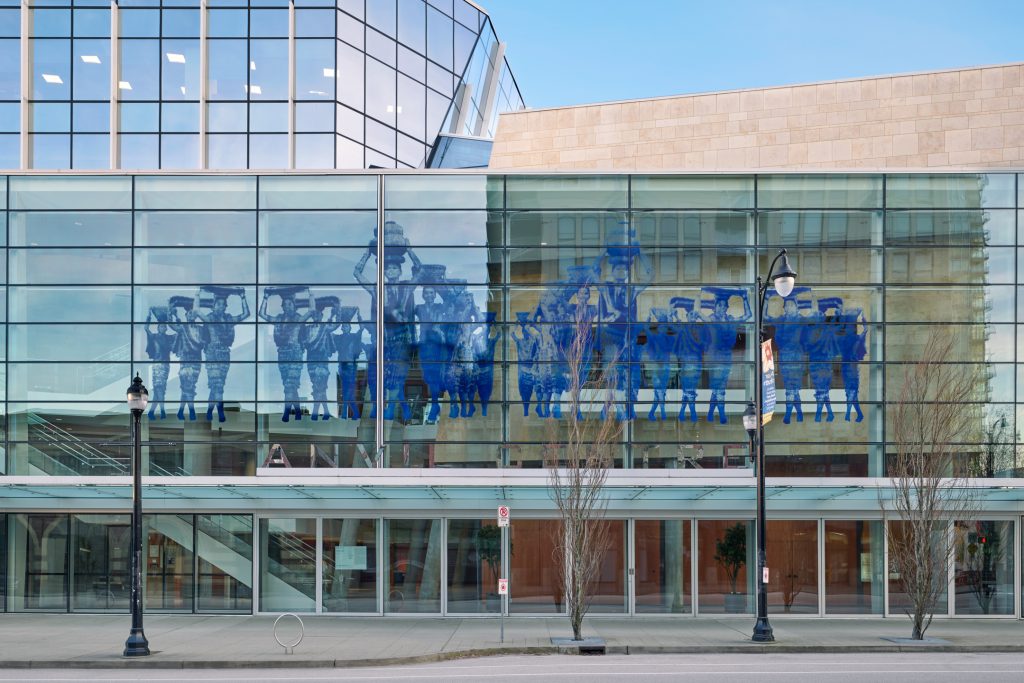
Now, the lens-based creator is bringing the culture of the Philippines to a broader audience through a large installation in New Westminster. Ensemble shows dancers performing a traditional Kalinga dance in blue and white tones, carrying water pots and baskets on their heads. Members of the Ramon Obusan Folkloric Group appear in V-shaped choreographic formations as a result Zalamea’s imaginative treatment of a newspaper photograph.
Ensemble is on the front of the Anvil Centre from April 10 to March 1, 2025.
“I wanted to find a meaningful way into this project,” Zalamea tells Pancouver by phone. “That was in learning about the sister city relationship between the City of New Westminster and Quezon City in the Philippines, which is my matrilineal home.
“It’s where my mom is from,” Zalamea continues. “Our ancestral house is still there and it’s still inhabited by our family.”
She stayed in the house in the Philippines for a month in 2020 shortly before the pandemic. Moreover, this visit had a significant impact on her artistic practice. Since then, Zalamea has embarked on extensive investigations of her diasporic identity and ideas around intergenerational and collective memory.
“I wanted to see, first of all, if there was any evidence of the Filipino-Canadian community in the New Westminster archives, which is in the Anvil Centre. And there is none,” Zalamea says.

Zalamea examined newspaper clippings
Ensemble is one of the Capture Photography Festival’s signature public art projects. And it came about after considerable research.
From an online newspaper article, Zalamea discovered that a now-deceased local community leader, Tomas Pagalilauan, had watched the Ramon Obusan Folkloric Group perform at Expo 86. He later spearheaded the pursuit of the sister city relationship with Quezon City. This led to a memorandum of agreement in 1991.
Zalamea was fascinated to learn that a performing-arts experience was the catalyst for this connection between New Westminster and her mother’s hometown. Then, the artist wondered if any physical evidence existed of the Ramon Obusan Folkloric Group being at Expo 86.
Fortunately, the Vancouver Public Library has an extensive section of newspaper clippings. Amid folders about Expo 86, she discovered an article and a small photo of the dancers in the Province.
“I started with a digital file of the newspaper clipping image,” Zalamea says.
She knew that if she blew it up into a large installation, it would look like it came from a newspaper. That’s because half-tone ink blots would be very exaggerated.
“I started by digitally isolating the dancers, then I mirrored and multiplied them,” the artist explains.
That conveyed the impression of a much larger dance troupe than existed in the original newspaper image.
Experimenting with presentation
Next, she made a negative of the composition on transparency. She placed this onto a piece of paper coated with a light-sensitive iron-salt solution to create a cyanotype. She then exposed the paper to an ultraviolet lamp for 20 minutes before washing and rinsing it in water.
“The resulting image is a range of Prussian blue to white tones,” Zalamea says.
Cyanotypes are an early form of photography.
“Overall, I was reflecting on the framework of the sister city and this language of kinship, not limited to family ties, but more expansively around our social kinships and expressions of community,” Zalamea states. “The Filipino core value ‘kapwa’ refers to the collective and a sense of connectedness with one another. Ensemble aims to make visible a sense of connection.”
Zalamea’s interdisciplinary practice is rooted in photography. She has a bachelor’s in fine arts in photography from Emily Carr University of Art + Design and a master’s of fine arts in photography from Concordia University.
“There are so many different ways that I engage with the medium, whether it’s using different types of cameras, experimenting with the camera and lenses, or experimenting with different modes of presentation,” Zalamea says.

Census reveals Filipino diversity in New West
She’s been involved with the Capture Photography Festival in previous years with solo and group showings. The Joyce-Collingwood Food Hub artwork, which was her work in the Pendulum Gallery last year, is returning to this year’s festival. It’s part of the Prevailing Landscapes exhibition at the Gordon Smith Gallery of Canadian Art in North Vancouver from April 12 to June 22.
However, Zalamea has never produced anything for the festival as large as Ensemble. Furthermore, it offers a reminder that the Filipino community has a multiplicity of identities.
The 2021 census for New Westminster provides ample proof of that. It reveals that there were 3,270 residents who identified Tagalog as their mother tongue. But there were many other mother tongues from the Philippines cited in the city. They include Ilocano (175), Cebuano (129), Hilagaynon (80), Bisaya (45), Kapampangan and Pampango (45), Pangasinan (30), Kankanaeu (20), Bikol (15), Kinaray-a (5), and Waray-Waray (5).
“With Ensemble, I hope the artwork speaks to the diversity of Filipino culture and celebrates the thriving Filipino-Canadian community,” Zalamea states. “More broadly, it speaks to a need to prioritize the recording and preservation of diasporic communities’ histories and legacies.”
Karen Zalamea will speak about Ensemble in conversation with Capture Photography chief curator and executive director Emmy Lee Wall on Sunday (April 14). The discussion will take place from 3 to 4:30 p.m. at the Anvil Centre Theatre (777 Columbia Street) in New Westminster. It will also be available on Zoom. For more information, visit the Capture Photography Festival website.
To learn more about Karen Zalamea, visit her website or follow her on Instagram @karenzalamea. Follow Pancouver on Twitter @PancouverMedia and on Instagram @PancouverMedia.