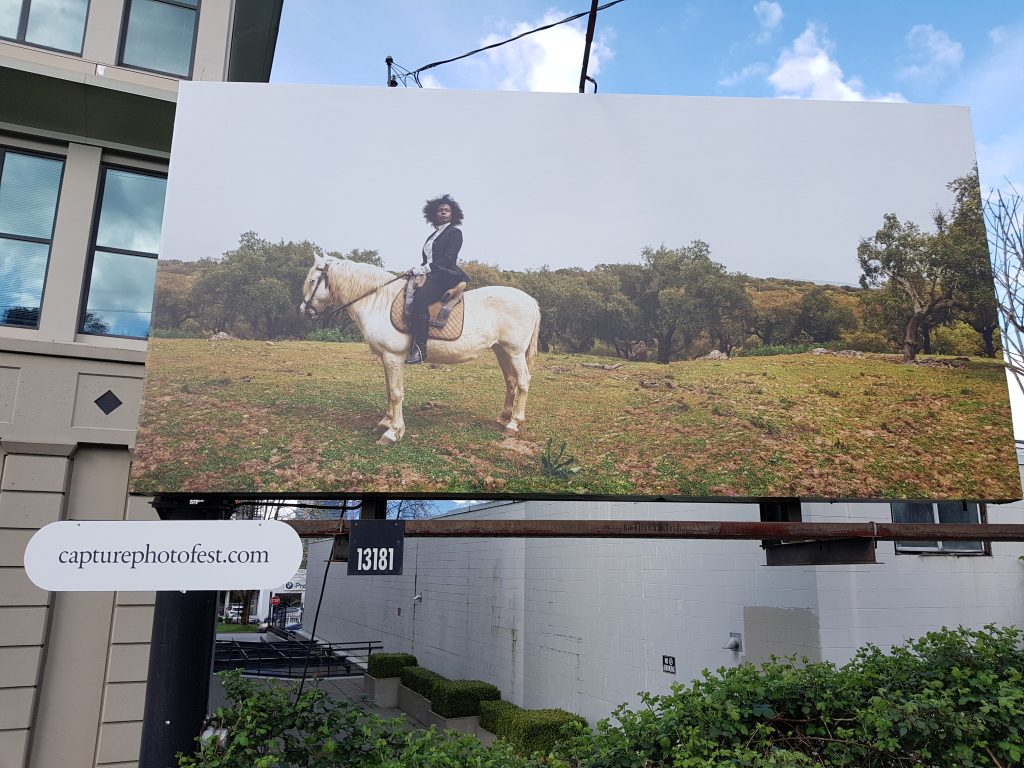
Cyclists and pedestrians can enjoy a photographic treat along the Arbutus Greenway until May 25. Between Fir and Burrard streets, the Capture Photography Festival is presenting seven billboards showcasing lens-based art by Mónica de Miranda. She is an internationally renowned Portuguese visual artist, photographer, and filmmaker of Angolan ancestry.
British cultural historian Mark Sealy curated this exhibition, entitled Grounding, which has been launched in partnership with the City of Vancouver. In a powerful essay on the festival’s website, Sealy compares colonialism to a vampire that “draws the lifeblood out of creativity and eats at the soul”. He also maintains that de Miranda’s work “disrupts the industrial colonial norm” by inviting viewers into “unfamiliar and beautiful places”.
“Mónica de Miranda offers us an image repertoire of uplifting escape routes from underneath the weight of history, the burdens and the shackles of colonial time and all its tyrannical, bone-crushing metropolitan rhythms that form the dark arts of human enlightenment,” Sealy writes.
He notes that de Miranda “is not preoccupied with borders and passports because land and atmosphere have a memory that must be heard, acknowledged, and respected”.
Her images have been exhibited at Biennales in Lubumbashi, Berlin, Dakar, Casablanca, Bamako, and Venice. In addition, the Houston FotoFest and many galleries and museums have presented de Miranda’s images.
“Across de Miranda’s works, reflection is an ever-present now seen in the face of the Other, the place where responsibility is permanent,” Sealy writes. “Here, the self can be seen, heard, felt, and shared. The stoic nature of this work does not cause fright; there is no screaming.”

Curator applauds de Miranda
The Capture Photography Festival is showing de Miranda’s photographs at a time of growing artistic interest in Portuguese colonialism. As one example of this, the artist-run Mercer Union in Toronto is presenting An Impossible Address by Brooklyn-based Indian-American artist Suneil Sanzgiri. He has explored the impact of Portuguese colonialism on Angola and the Indian state of Goa through his films and art.
In addition to Angola, Portugal’s African colonies included Mozambique, Guinea-Bissau, Cape Verde (now known as Cabo Verde), and São Tomé and Príncipe. The Portuguese empire also created Estado da Índia seven years after explorer Vasco de Gama discovered a sea route from Europe to the Indian subcontinent in 1498. Decades later, the colonizers began an Inquisition in Goa to force Goan residents to convert to Catholicism.
Portugal also established a colony near Hong Kong in Macau. The colonizers returned the city to China in 1999.

The Capture Photography Festival will present Grounding in partnership with the City of Vancouver until May 25. Pattison Outdoor is sponsoring the exhibition on the Arbutus Greenway between Fir and Burrard streets. Tara and Christopher Poseley generously supported this exhibition. For more information, visit the website.
Follow Pancouver on X @PancouverMedia and Bluesky @pancouver.bsky.social. Also find Pancouver on Instagram @PancouverMedia. Follow Charlie Smith on Bluesky @charliesmithvcr.bsky.social.