
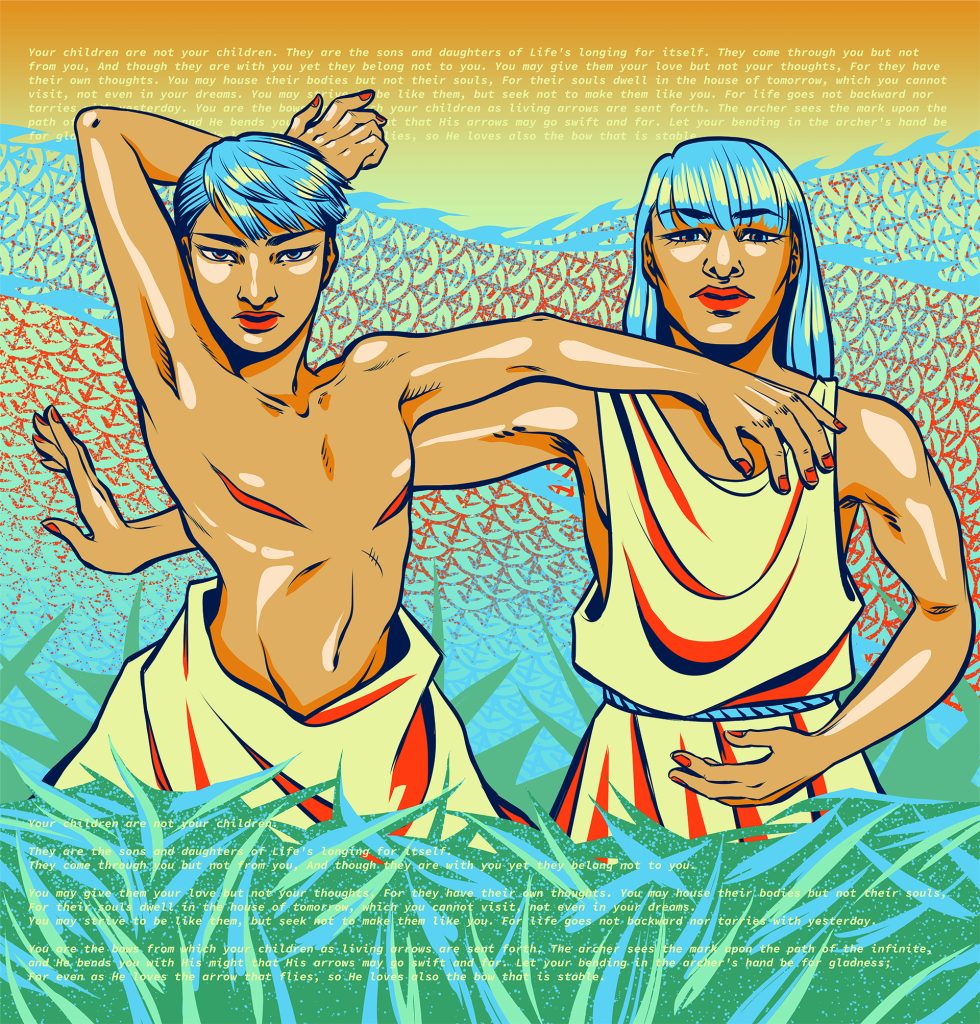
Vancouver illustrator and printmaker Tajliya Jamal was very intrigued by the theme of this year’s Lantern City exhibitions. Organizers chose the phrase “Born to Be Free”. And last year, they contacted Jamal seeking a design for one of the large Lunar New Year lanterns that will be displayed at Granville Island.
“It’s a very striking phrase,” Jamal tells Pancouver over Zoom. “It made me think a lot about how everyone in the world should be born to be free.”
However, the Emily Carr University of Art + Design graduate points out that existing constraints haven’t permitted universal freedom.
“We’re seeing that directly with the Palestinians in Gaza right now, with trans rights being taken away from people in North America, and just the intensity of the economic crisis going on,” Jamal says.
Jamal is queer and prefers the pronouns they and them. The articulate artist has thought a great about rising right-wing rhetoric around “saving the children”. In particular, it’s been swirling around sexual orientation and gender identity (SOGI) initiatives in schools.
These SOGI initiatives make classrooms and extracurricular activities more welcoming to those, like Jamal, who identify as lesbian, gay, bisexual, transgender, queer, or two-spirit.
So, in designing Towards Alternate Landscapes for the lantern, Jamal included Khalil (sometimes spelled Kahlil) Gibran’s famous poem, “On Children”. It appeared in The Prophet, which was published in 1923.
“Your children are not your children,” Gibran wrote over a century ago. “They are the sons and daughters of Life’s longing for itself. They come through you but not from you. And though they are with you yet they belong not to you.”

Jamal draws on Muslim and Chinese heritage
Jamal reveals that The Prophet was a favourite book of their father, an Ismaili Muslim immigrant from Nairobi. He traces his ancestral roots to the western Indian state of Gujarat. And this poem reflects the perspectives of Jamal’s father and Hong Kong–born mother on raising children.
“Whatever your opinion—or what you say or think is best for them—may not really be what they need,” Jamal emphasizes. “So, I just thought that was such a beautiful way to look at things, in particular with what’s going on with backlash against trans youth and children.”
According to Jamal, Towards Alternative Landscapes draws on the vibrancy of art from South Asia, as well as Indian sensibilities. This helps explain why the artist presents the two androgynous central characters in such bold colours.
Meanwhile, in ancient cosmology in East Asia, there were five elements: metal, wood, water, fire, and earth. This Lunar New Year will herald the beginning of the Year of the Wood Dragon. Jamal was eager to incorporate this aspect, as well.
“The dragon is part of the masculinity of yin-yang and then the wood aspect is talking about vitality, new beginnings, and growth,” the artist says.
The dragon is represented behind the two characters.
“I was looking at the scale patterning in historical Chinese paintings,” Jamal continues. “I thought it might be kind of fun to throw the trans symbol in the scales. I’m not really a fan of symbols in isolation, but I think when they’re integrated as part of a larger visual, then there’s something to that.”

Illustrating Viola Desmond
There are very few mixed-race Ismaili Muslim-Chinese people in Metro Vancouver. Jamal draws upon traditional Islamic art’s emphasis on integrating patterns and text within a space. However, Jamal also creates figurative art, which is not part of Islamic traditions.
“I do really like having a play between a central figure and patterning.”
Then with a laugh, Jamal adds that they also want to draw “a lot more hot, attractive, brown-skinned Asians”.
“There’s a lot of oversexualized imagery of particularly light-skinned East Asian people. Don’t forget about the brown Asians!” the artist declares. “I’m being cheeky, but I really do want my drawings to be reminders of how powerful and gorgeous brown and queer people are.”
Jamal points to Emily Carr University of Art + Design interim vice president, academic, and provost Diyan Achjadi as an important mentor. Jamal feels privileged to have assisted her on her year-long Vancouver public-art project, Coming Soon!.
“She’s been a really, really positive influence, especially because she’s also mixed-race and has a similar approach to how she integrates cultural influences from Indonesia in her own work,” Jamal says.
Another career highlight came when Jamal illustrated the 2022 graphic history book No Reason to Apologize: The Resilient Legacy of Viola Desmond. Desmond, who’s now on the Canadian $10 bill, was arrested, charged, and convicted in court after refusing to sit in the Black-only area of a Nova Scotia movie theatre in 1946.
More recently, Jamal had the pleasure of designing the poster for last year’s Indian Summer Festival. Now, Jamal can celebrate their Hong Kong ancestry through another work of art at The Lantern City’s Granville Island exhibitions.
“I’m actually feeling quite a lot of things to be directly participating in events that are linked to my communities and cultures that I’m from,” Jamal says. “So, this year is a first for both of those.”
Event details
Towards Alternate Landscapes will be featured at The Lantern City exhibition called Forever Young. It’s at Granville Island’s Ocean Artworks from February 9 to 26. This piece will appear with lanterns designed by artists Anita Ho, Sara Khan, Seeroro, and Weiwei Xu, and Studio 101/Eastside Arts Society.
To learn more about lantern exhibitions, visit The Lantern City website. Follow Tajliya Jamal on Instagram @tajliyaj.
Follow Pancouver on Twitter @PancouverMedia and on Instagram @PancouverMedia.


