
When the artistic director of Hung Dance conceives a new work, he often begins by jotting down words and related paragraphs. In a Zoom interview with Pancouver, Lai Hung-chung reveals that as he pulls these phrases together, they can emerge as an unrestrained prophecy.
“There is no logic to it,” the Taiwanese Hakka choreographer emphasizes.
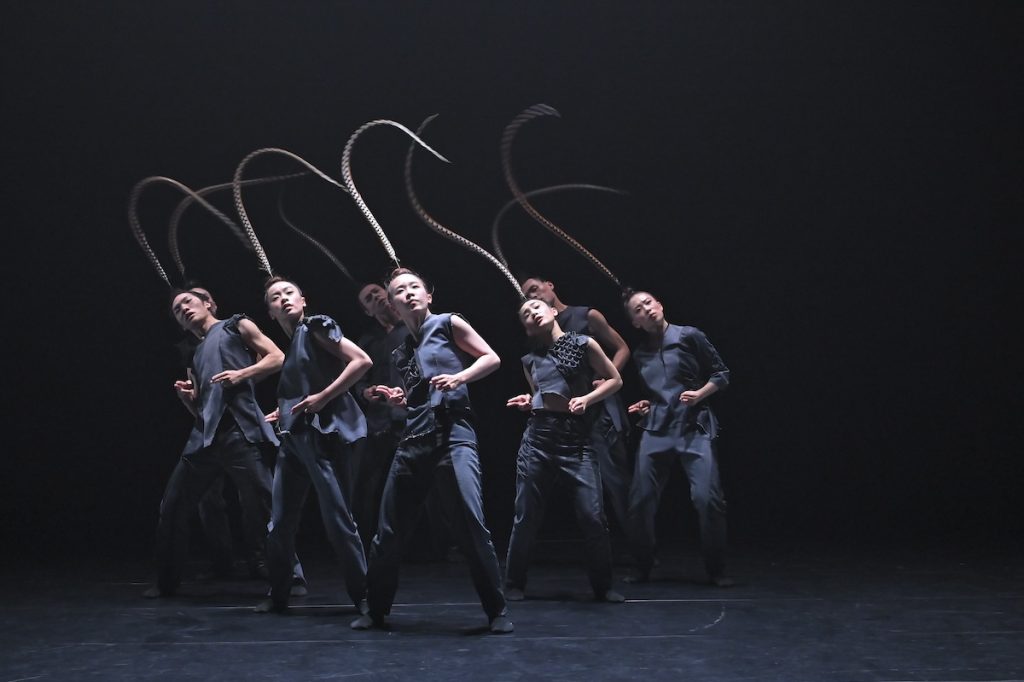
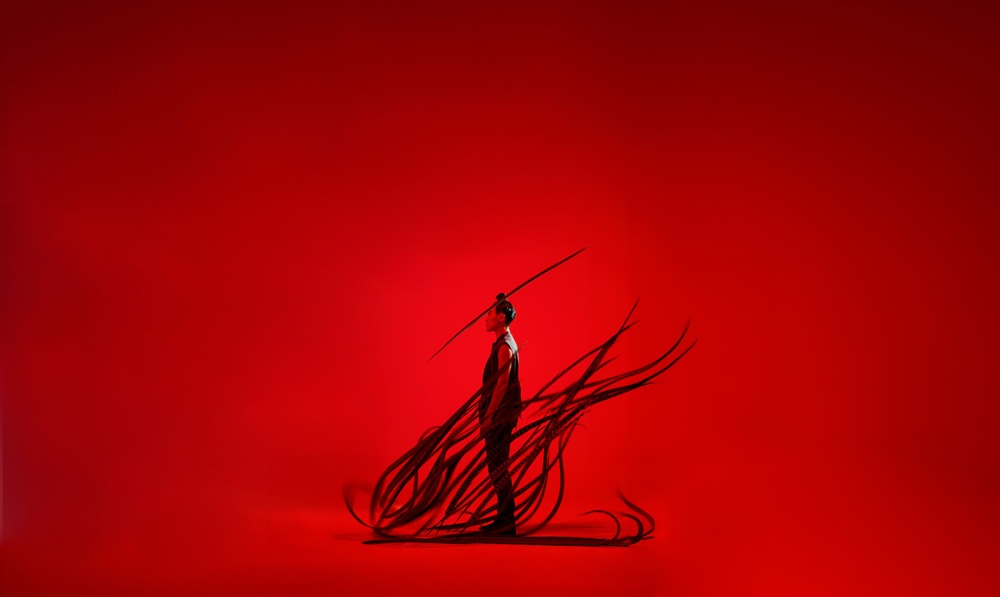
An example is Hung Dance’s innovative and visually stunning Birdy, which Dance House will present at the Vancouver Playhouse next Friday (November 28) and Saturday (November 29). The cheerful and imaginative Lai decided that in this production, dancers would wear four-foot pheasant tails as headpieces. These “Ling Zi”, as they’re called in Chinese opera, bob up and down and from side to side in a performance that blends Tai-chi with contemporary dance.
In Taiwan, he says, characters will wear these headpieces during opera performances in the streets to celebrate the birthdates of deities.
“Some deities themselves also wear Ling Zi,” Lai says. “Some generals in temples will also wear Ling Zi. This is something you can see in daily life.”
As Lai was creating Birdy, he thought about the god Odin from Norse mythology. According to legend, Odin has two ravens on his shoulders. They serve as his eyes and ears as they gather information from the world and bring it back to him. Through this story, Lai reflected on how hearing different voices can cause one to hesitate.
“It’s kind of like the feeling of angels and demons,” Lai states, “where one side might tell you good things and the other side might tell you bad things.”
Hung Dance leader draws lessons from birds
When asked about the creative spark behind Birdy, Lai immediately mentions Alan Parker’s film Birdy. Starring Matthew Modine in the title role, it’s about a teenager who imagines flying around as a bird. Others in the film question his sanity.
“This movie gave me two inspirations,” Lai says. “One is about perseverance, and the other is that it made me care about friends who are experiencing mental health issues.”
In addition, Lai acknowledges being influenced by the Irish-born British artist Francis Bacon, who referred to birds in several major paintings. Bacon often blurred the line between humans and animals—and Lai appears to be doing something similar with Birdy.
In fact, Lai sees parallels between birds migrating to warmer locales in winter and human beings’ desire to gravitate toward comfort and freedom.
“Maybe birds don’t have the intelligence to know everything in the way we see the world,” Lai notes. “But there’s a certain quality about birds that makes it seem like they can capture our psychology.”
Moreover, he points out that when birds are learning to fly, they are also learning how to land. This is something that he—as a choreographer—must also consider with his company’s dancers.
“To put it simply, if I want to fly, I’ll first think about how to land,” Lai states. “Whenever I do something, I think about the next step first.”
Then, there’s the experience of simply watching birds fly, whether they are nearby or far away.
“As we follow their movement, I think it can actually bring a sense of peace,” Lai comments.
Dance artist reflects Taiwan’s cultures
Lai was born into a Hakka family without much money in the southern Taiwanese city of Kaohsiung.
“Growing up like that actually instilled in me a strong sense of determination to strive and overcome those limitations,” he states.
One of the most admired Hakka artistic figures from Kaohsiung is Lin Sheng-xiang, who blends Hakka music with rock and folk. Lai tells Pancouver that Lin’s song, “Feng Shen 125” (lyrics by Zhong Yong-feng) certainly left an impression on him.
The song addresses the difficulty of migrating from a Hakka village to a big city in search of success. It’s something that the Taipei-based Lai can appreciate today.
“Young people go to the city to work hard—and their elders say, ‘Just persevere, persevere! Keep working like an ox, and you will succeed!’ ” Lai says with a chuckle. “It’s amazing that my mother also told me this. Although there are Hakka people from different areas, they all share the same spirit.”
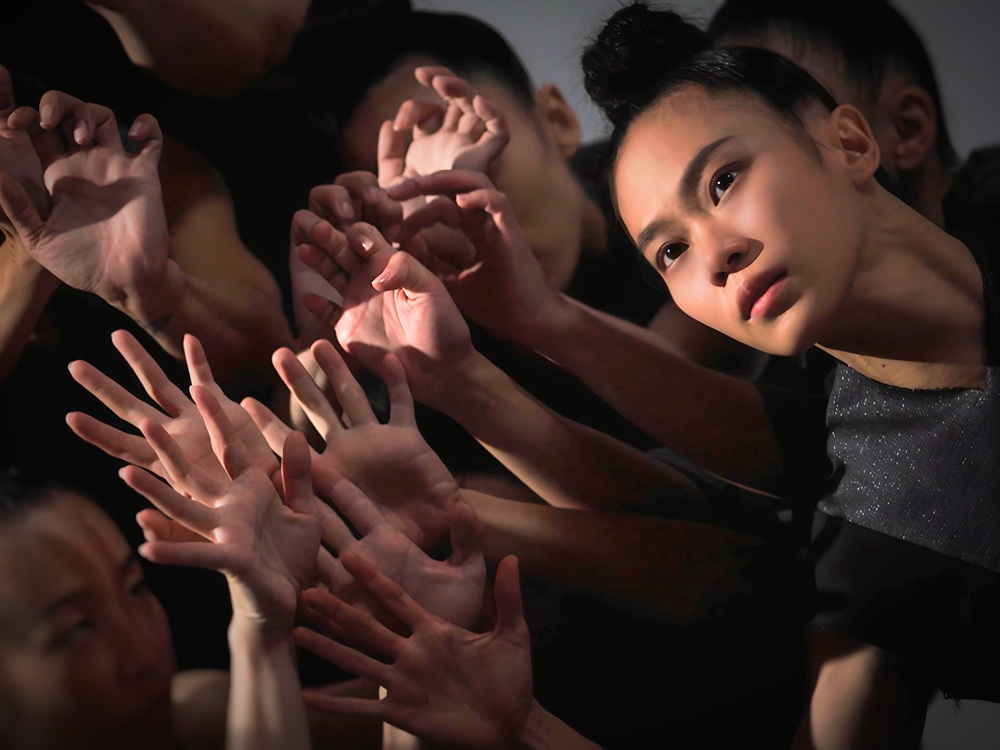
He has created works in the past reflecting Hakka culture. But nowadays, his choreography draws upon other cultures from the island nation, and none of Birdy’s dancers is Hakka. They hail from as far north as Keelung and as far south as Pingtung.
“Taiwan’s achievements and development are intertwined with the interactions between Indigenous peoples and those who came to Taiwan from Spain or the Netherlands for missionary work, as well as later with people from China,” Lai observes. “These factors are all interconnected.
“I want to incorporate the perspectives of Taiwan’s Indigenous peoples into my work,” he adds. “So actually, I don’t create works based on which ethnic group I belong to.”
Pancouver associate editor becky tu translated Lai’s responses in Mandarin into English.
Watch a trailer (above) for Birdy.
Event details
DanceHouse will present Hung Dance’s Birdy at the Vancouver Playhouse on Friday (November 28) and Saturday (November 29) with its community partner, the Asian-Canadian Special Events Association. Artistic director and choreographer Lai Hung-chung will join Gateway Theatre community engagement producer Yanting Qiu for a pre-show talk in the Upper Lobby at 7:15 before the 8 p.m. Friday performance. On Saturday, the co-artistic director of Chimerik (似不像), Sammy Chien, will host the pre-show talk with Lai at 7:15 before the 8 p.m. performance. There will also be a post-show social in the Salon. For tickets and more information, visit the DanceHouse website.
Follow Pancouver on X @PancouverMedia and Bluesky @pancouver.bsky.social. The publication is also on Instagram @PancouverMedia.




