

Kenji Horigome wasn’t always fascinated with Taiwanese tile designs. A certified first-class architect in Japan, Horigome spent a great deal of time observing buildings and urban landscapes when he first came to Taiwan in the 1970s. He even wrote a book in 1980 on this topic called Taiwan Towns and Life.
“I have always been deeply interested in urban spaces, and in Taiwan, I was particularly drawn to the rich and flexible ways people make use of outdoor spaces,” Horigome tells Pancouver. “For example, temple courtyards, spaces under large banyan trees, alleyways, and the courtyards of the traditional siheyuan (quadrangle houses) are all naturally integrated into daily life. In Japan, due to the historical absence of plazas, the richness of urban outdoor life is not as pronounced.”
Horigome has a PhD in engineering from the University of Tokyo. And because tiles were mostly associated with toilets and bathrooms, he originally had no interest in them. However, Horigome’s life turned in a new direction in the early 1990s after a trip to an antique shop. There, he came across tiles that had been used in Taiwanese architecture
“On the back, I discovered the words ‘Made in Japan’ along with a trademark,” Horigome reveals. “At that moment, I felt that exploring the history of these ‘Majolica Tiles’—a subject that had hardly been studied—was precisely the mission I should take on, as someone who lives between Taiwan and Japan.”
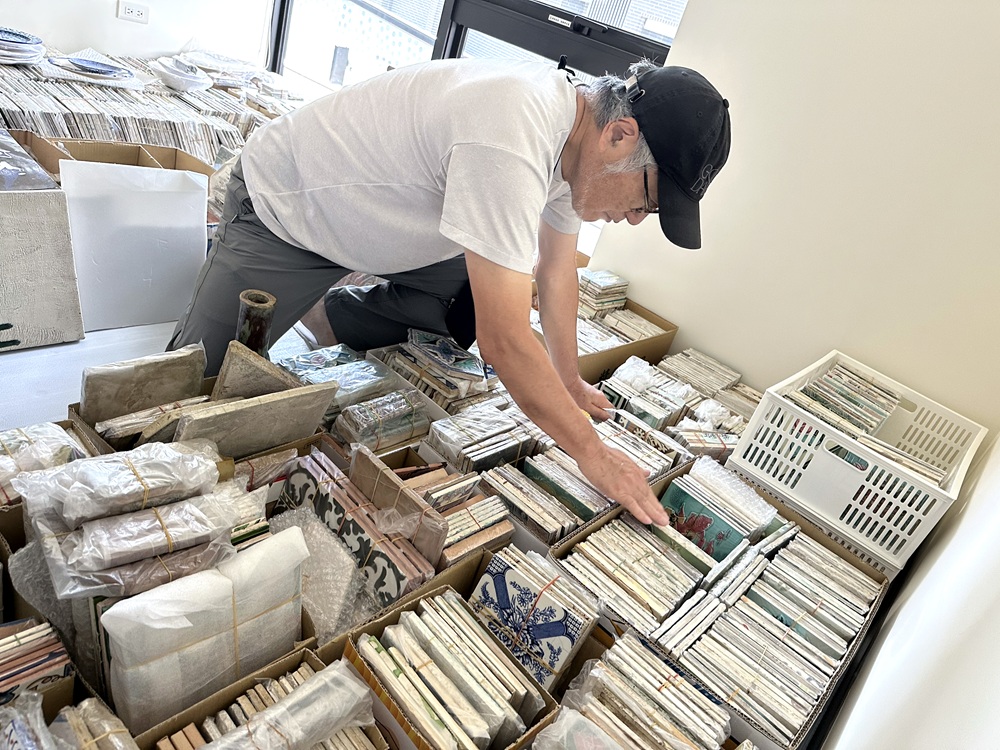
Decorative tiles carry meaning
He later learned that Japanese-made Majolica Tiles accounted for more than 90 percent of the decorative tiles used in Taiwan. Horigome shared his deep insights in his 2024 book, The Genealogy of Tiles in Taiwan (Yuan-Liou Publishing).
It’s worth noting that Japan gained control over Taiwan in 1895 and held it until the end of the Second World War in 1945.
“Beyond beautifying buildings, some of these decorative tiles carry meanings such as warding off evil, inviting good fortune, and bringing blessings,” Horigome says. “For example, dragon motifs are meant to repel evil; fruit designs such as peaches symbolize auspiciousness; and certain Arabesque patterns imitate the shape of ancient coins, representing the wish for wealth.”
Vancouver TAIWANfest will present a free exhibition in the 600 block of Granville Street of 14 selected sets of tiles from Horigome’s vast collection. Where the Tiles Took Me includes stories behind each set and runs from noon to 6 p.m. on August 30 to September 1. In addition, Horigome will deliver two free talks titled Tiled Memories: The Story of Taiwan in Ceramics. The first is in English and Mandarin at 6:30 p.m. on August 28 at the Vancouver Central Library in the Montalbano Family Theatre, Level 8. The second is in Japanese at 1:30 p.m. on August 31 at UBC Robson Square.
Horigome points out that one common tile design in Taiwan depicts a Dutch coastal scene of a mother and two children standing peacefully by the sea. He emphasizes that while a single tile may be small, a group of tiles can generate layers of meaning that develop into something far greater.
“In Taiwanese traditional architecture, these tiles were often used as a simplified substitute for traditional decorative methods such as carvings, jian nian (cut-and-paste porcelain art), paintings, and murals,” Horigome says. “At the same time, because their style differed from traditional ornamentation, they were also loved for the modern and fashionable effect they brought.”

Architecture, lifestyle, and religion come together
Horigome has boundless curiosity and likes seizing on overlooked subjects. He has taught courses on architecture, urban landscapes, cultural heritage preservation, and even feng shui at different universities in Taiwan.
“In addition, I have a particular interest in the forms of belief and Taoist deities found in Taiwanese temples—especially the Earth God temples (土地公) and the many small shrines scattered throughout cities—which led me to think about their relationship with the surrounding land and environment,” Horigome acknowledges.
According to him, the desire to create beautiful buildings has, over time, “blended architectural styles, lifestyles, and religious beliefs from around the world, resulting in the colourful patterns we see on tiles”.
“Though each tile is small, behind it lies a wealth of meaning, carrying the cultural essence and traditional motifs of different countries.”
Vancouver TAIWANfest will present Where the Tiles Took Me in the 600 block of Granville Street from noon to 6 p.m. from August 30 to September 1. In addition, Kenji Horigome will deliver two free talks titled Tiled Memories: The Story of Taiwan in Ceramics. The first is in English and Mandarin at 6:30 p.m. on August 28 at the Vancouver Central Library in the Montalbano Family Theatre, Level 8. The second is in Japanese at 1:30 p.m. on August 31 at UBC Robson Square. For more information on Vancouver TAIWANfest, visit the website.
Follow Pancouver on X @PancouverMedia, Bluesky @pancouver.bsky.social, and Instagram @PancouverMedia.




