
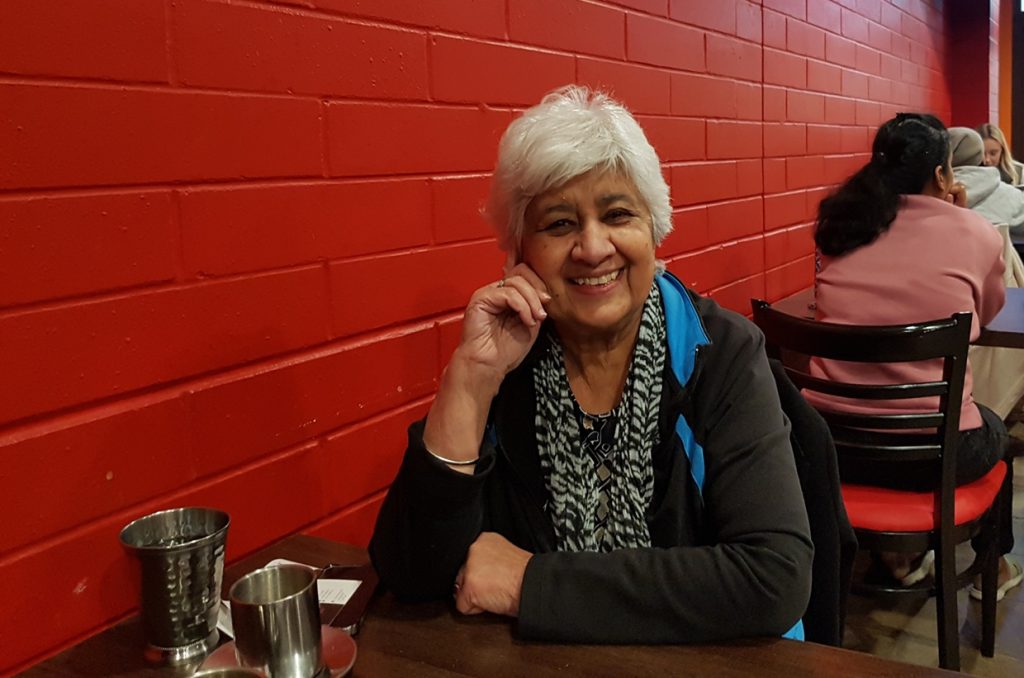
Spice Radio CEO Shushma Datt invited Pancouver editor Charlie Smith to speak about the media at her station’s 11th annual Raise Your Hands Against Racism event on March 30. Here are his speaking notes, which formed the basis of his speech.
Shushma Datt asked me to speak about diversity in the media. So, I hope you can indulge on old white guy pontificating on this issue.
In January, the Canadian Association of Journalists released its annual survey on diversity. It compiled responses from 5,806 journalists in 270 newsrooms.
Even though people of Asian ancestry make up 17.5 percent of the population, only 8.7 percent of journalists self-identified as Asian. That’s less than one in 10!
Supervisory and leadership roles were disproportionately held by white managers—83.4 percent.
Indigenous and racialized journalists outnumbered whites in only one category—you probably guessed it—“interns”.
Most troubling, there was a declining proportion of Asian and Indigenous journalists in newsrooms from 2021 to 2024.
I won’t get into the reasons here.
I’ll just say that the Canadian mainstream media is still very whitewashed, particularly in the opinion pages of major newspapers.
But I believe that this Canadian Association of Journalists survey fails to address something important.
When it comes to surveys about representation, racialized people are sometimes lumped into one big bucket: “people of colour”.
Nobel Prize winner Amartya Sen points out that we have a multiplicity of identities. But for decades in Canada, too many newsroom managers looked upon diversity through the lens of skin colour as opposed to lived experiences.
Setting an example for media
Let’s talk about two famous Vancouver broadcasters. There’s the lived experience of Shushma-ji. She’s a multilingual, racialized immigrant from a Hindu family who has lived on four continents. This is vastly different than, say, the lived experience of Simi Sara. Simi was born and raised in Surrey and educated in Canada. She sees the world from the vantage point of someone who has spent her career in B.C.
Yet in the eyes of the broadcast regulator, these two accomplished women are the same. They check off the same box.
Similarly, here at Spice Radio, the lived experiences of the co-hosts of the Morning Buzz, Mankiran Aujla and Natasha Mendes, are vastly different. Each brings her own perspective to the programming, providing a diversity of views, spiritual backgrounds, and language capabilities. They learn from each other.

I appreciate how Spice Radio represents so many different lived experiences—from Richard Lai, the son of Taiwanese immigrants who has a show about K-pop, to Gurpreet Singh, who immigrated to Canada as a fully formed hard-news journalist. This is Canada.
However, I worry that Canadian newsrooms, by and large, do not reflect these nuances. Traditionally, diversity consisted of mainly hiring racialized middle-class, Canadian-born, and Canadian-educated people who went to Canadian journalism schools. They may speak a second or third language. They may have some insights into their parents’ or grandparents’ homeland. But they don’t have lived experience as immigrants. They don’t have to worry about accent discrimination. They swim comfortably in mainstream waters.
In recent times, CBC News in Vancouver has started hiring journalists with more diverse lived experiences.
According to the 2021 census, 23 percent of Canadians were born in other countries. That’s far higher than in the United States. Shushma-ji, Natasha, and Gurpreet Singh mirror the lived experiences common to nearly a quarter of the population.
Yet the lived experiences of immigrants are not even close to being embedded in the vast majority of Canadian newsrooms. It’s why diversity must go beyond being a check mark dealing solely with skin colour and ancestry.
Canada is a multilingual country
When I was editing the Georgia Straight, I tried to include the voices of people who had moved to Canada as adults. Ng Weng Hoong, Carlito Pablo, and Gurpreet Singh brought breathtakingly original perspectives. At times, they blew my mind with their observations. They cracked open the Overton Window for much broader discussions on a wide range of topics.
The 1.5- or second-generation immigrants are better represented in newsrooms—and their stories are important in the fabric of Canada. But I feel that first-gen immigrants are being shortchanged. It’s blunting debates on important topics.
Here’s just one example: isn’t it about time that we thought of Cantonese, Mandarin, and Punjabi as Canadian languages? We’re not a bilingual country—we’re a multilingual country like the Philippines or India.
If you converse in these languages in a restaurant or on a bus, you should never be made to feel like you’re speaking a foreign language. If some Canadian-born kids of immigrant parents understood that their heritage languages are Canadian languages, they might be more eager to embrace this aspect of their identity at a younger age. That would create stronger intergenerational bonds.
Through its programming, I feel that Spice Radio is helping shatter linguistic silos that divide Canadian-born children from their immigrant parents and grandparents. This promotes intergenerational understanding. This is a form of interculturalism that often goes under the radar of journalism professors, broadcast regulators, and newsroom managers. So, in closing, I want to offer a public thank you to Shushma-ji and all the staff at Spice Radio for doing your part to promote a more inclusive society.
Thank you very much.
This year, Spice Radio granted its annual Hands Against Racism awards to former city councilmember and Workers Strike Back organizer Kshama Sawant and art collector and real-estate marketer Bob Rennie, whose family donated $7.8 million to the Chinese Canadian Museum.
Follow Pancouver on X @PancouverMedia, Bluesky @pancouver.bsky.social, and Instagram @PancouverMedia. Also follow Charlie Smith on Bluesky @charliesmithvcr.bsky.social.




