Vancouver artist Katherine Duclos’s biography lists several impressive accomplishments. It notes that she has exhibited her work across the United States and Canada. It also mentions that in 2023, Duclos created a 45 square-foot abstract colour construction made of LEGO, which is at the company’s Americas headquarters in Boston. There’s even a short documentary about how Duclos discovered a new medium using LEGO bricks.
From November 14 to 17, Duclos will be one of more than 500 artists opening their studios to the public as part of the Eastside Culture Crawl. In a phone interview with Pancouver, the Pratt Institute MFA grad says that her LEGO art resulted from her son’s autistic special interest.
“My son’s need to build LEGO was really intense when he was between three and six,” Duclos says. “That’s all he wanted to do.”
There’s one other part of her biography that sets her apart from most other artists: Duclos discloses that she is “a gifted and disabled neurodivergent woman”.
She tells Pancouver that she and her two children have a specific type of autism known as Pathological Demand Avoidance.
“It’s not even diagnosed formally in Canada,” Duclos says. “I did not know I was autistic until parenting started deviating from expectations.”
She was misdiagnosed in her late 20s as having bipolar II disorder. Duclos only realized that she was autistic after her kids were diagnosed. She’s certain that there’s a genetic component. Now, she feels that she can easily spot it within certain members of her family tree.

Duclos sheds light on mysterious disorder
She explains that PDA is a disability of the nervous system. Basically, the nervous system perceives things that are not dangerous to be threats.
“It’s called Pathological Demand Avoidance because demands or expectations are one of the things that we perceive as threats,” Duclos states. “So, if somebody asks us to do something, our nervous system will respond with fight, flight, freeze or fawn.”
Most people comprehend what fight, flight, or freeze means. Fawning, on the other hand, is less understood. According to Duclos, it’s a pleasing response in the presence of a dangerous predator. For people with PDA, she says that it can manifest itself in pleasing people to avoid being perceived as a threat.
“A lot of kids who internalize PDA will become people who please,” Duclos says. “Then, it only really shows up when they reach burnout and can’t please anymore.”
According to the autism.org.uk website, British psychologist Elisabeth Newson developed the PDA term in the 1980s. It first showed up in a published research paper in 2003.
“It was used to describe a group of children who did not fit into the stereotypical presentation of autism recognised at that time but who shared certain characteristics with each other, the key one being a persistent and marked resistance to demands,” the website states.
Watch a short documentary (above) about Katherine Duclos’s LEGO art.
Succeeding with PDA
Duclos adds that when people with PDA are pushed too fast or too hard too many times, it drains their capacity for meeting these expectations.
“When that battery runs out, it’s out,” she declares.
Yet she also has an explanation for how she was able to graduate with a master’s degree and succeed as an artist even though she has PDA.
“I overachieved my whole life,” she says. “So, if a demand was placed in front of me, I would not fight it. I would look at it and say, ‘I can do better than that. I can do something different than that. I’m not going to do exactly what you ask. I’m going to twist it and make it my own, somehow.’ So, that’s one way it can manifest.”
Prior to doing her master’s in fine art, Duclos studied creative writing for her first degree. Therefore, she’s adept at communicating through language and visual art. These gifts enable her to convey the complexity of PDA to parents and educators of children with this disorder.
“I think it has put me in a unique position to advocate for our disability because I can articulate in a lot of ways that children can’t,” she states.
She also has to parent very differently. For instance, because her children are so driven by autonomy, they choose what they participate in and how they respond to those around them.
According to Duclos, if parents don’t accommodate their children’s PDA, it will lead to “a lot of shoving down of emotions”. As the pressure builds, it can cause explosions.
Unfortunately, she says that only a handful of practitioners recognize PDA in their assessment reports. As a result, she maintains that there is a large number of undiagnosed people.
“There is a lot of potential for this neurotype to cause harm if it’s not supported well,” Duclos insists.

Duclos finds harmony through colours
She feels that PDA is indivisible from her artistic practice.
When she lived in New York, she often painted stones on yupo sheets. After moving to Vancouver in 2017, Duclos realized that she was essentially painting a rock collection because she didn’t have much access to rocks in New York.
“There are so many rocks here,” she says. “We literally have a drawer for rocks in our house. And I stopped painting them because I suddenly had access to them but I didn’t have access to colours.”
In 2020, Duclos began creating art related to breastfeeding in response to her daughter. The following year, she started making LEGO art due to her son’s special interest.
“Those two bodies of work were created in tandem over the next two years,” she states. “It was really kind of figuring out what I wanted to say as an artist. And I couldn’t separate my role as a parent from that. It’s all so entwined.”
When she’s out in the world, Duclos notices every glimmer of light and speck of colour. She mentions that she feels a desire to re-arrange the colours as an expression of her autonomy.
“My brain can’t stop thinking about thoughts when it’s out and about,” Duclos continues. “Then when I get into the studio, in order to calm myself and regulate, I think I have to put colour in order. It’s really about finding harmony in this kind of overwhelm that I experience.”
No autonomy in following instructions
Her neurodivergence illustrates why her LEGO art revolves around colours rather than creating structures.
Her son, on the other hand, maintained a fascination for building things with LEGO bricks. He would get frustrated with his mom when she made mistakes as his assistant.
But one day, her son arranged four pieces together and handed them to her. He told her that she might like the colours.
“It was like this big light-bulb moment because I realized LEGO didn’t have to be a 3-D representational toy,” Duclos says. “It could be an abstract, modular-colour toy.”
Moreover, she could express her autonomy because she wasn’t replicating structures that had already been built.
“There is no autonomy in following somebody else’s instructions,” the artist states. “I’m interested pretty much only in autonomous creation.”
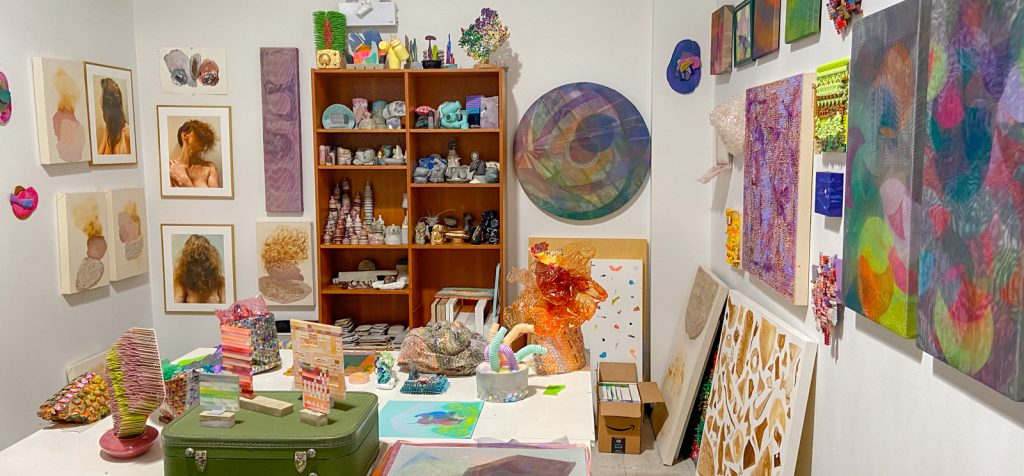
The same applies to her work with concrete-cement-fidget material, which she converts into desktop sculptures. In fact, Duclos loves working with tactile substances, including bubble wrap and fibreglass window screens. When people visit her studio, she encourages them to touch the art.
“Tactility is so important to artists and yet we deny tactility to viewers because of capitalist interests, really,” Duclos observes. “And I’m not really a capitalist. It’s very hard for me to embrace that model of art selling.
“I would much rather people experience my art and have it affect them than to just sell it,” she adds. “And so, there is a lot of things to play with and touch.”
More than 500 artists, including Katherine Duclos, will invite visitors into their studios as part of the Eastside Culture Crawl. Duclos is in Studio 30L on level LG of the Sun Wah Centre (268 Keefer Street). For more information, visit the Eastside Culture Crawl website. Learn more about Katherine Duclos from her website. Follow Pancouver on Twitter @PancouverMedia and on Instagram @PancouverMedia.