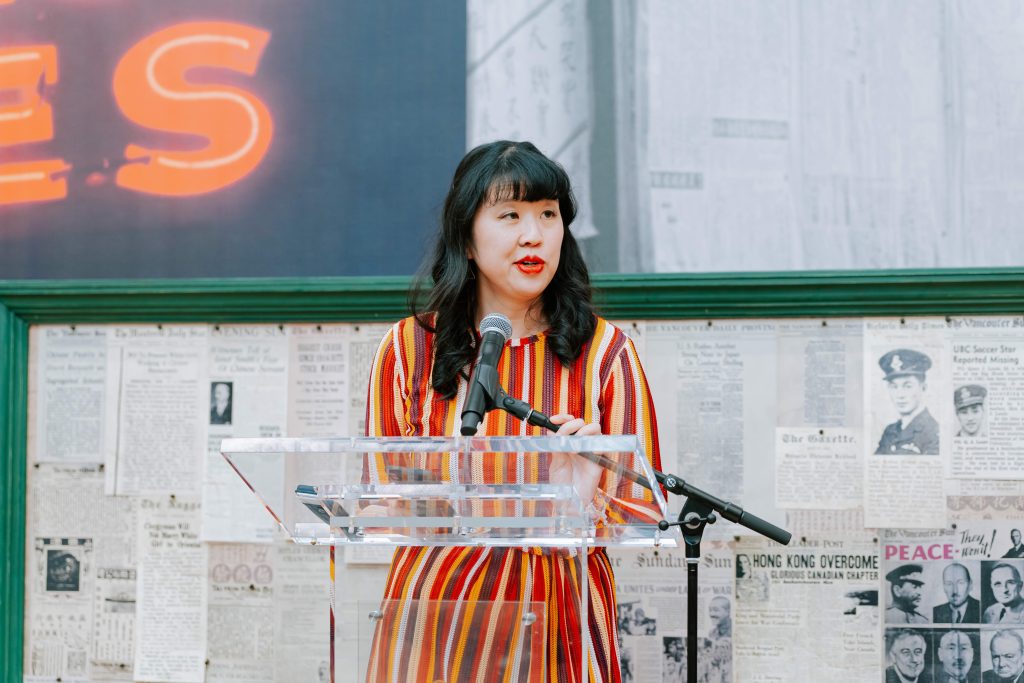
Toronto neo-soul musician Eunice Keitan says that she doesn’t fit into a traditional Asian narrative in North America. In an incisive Jade Music Fest artist talk, she relied on storytelling, original music, videos, and photographs to explain why.
Early in her November 6 presentation at the Museum of Vancouver, Keitan mentioned that her mom was born in Hong Kong and her Chinese dad is from Malaysia. They met in Canada. And because they spoke different Chinese languages, they communicated with each other in English.
“So, it was really interesting because I grew up in an English-speaking household even though there were three different dialects that were spoken in my home,” Keitan said.
“Imagine how crazy family reunions were because my grandfather would speak to my dad in Hokkien,” she continued. “My dad would speak to my grandma in Hokchew. My grandmother would speak to my mom in Cantonese. I understood all of the dialects; I just couldn’t really speak any of them. And if we wanted to communicate as a group, we all had to speak in English, so it was definitely not that straightforward.”
The Jade Music Fest supports musicians who choose to perform in their heritage Chinese languages. The festival’s title for Keitan’s presentation was Reckoning with My Roots. And what a reckoning it has been. Her story demonstrates that each person of Asian ancestry often faces their own unique journey.
“I really struggled with identity because I didn’t feel immersed in any one culture inside or outside of the home,” Keitan told the audience.
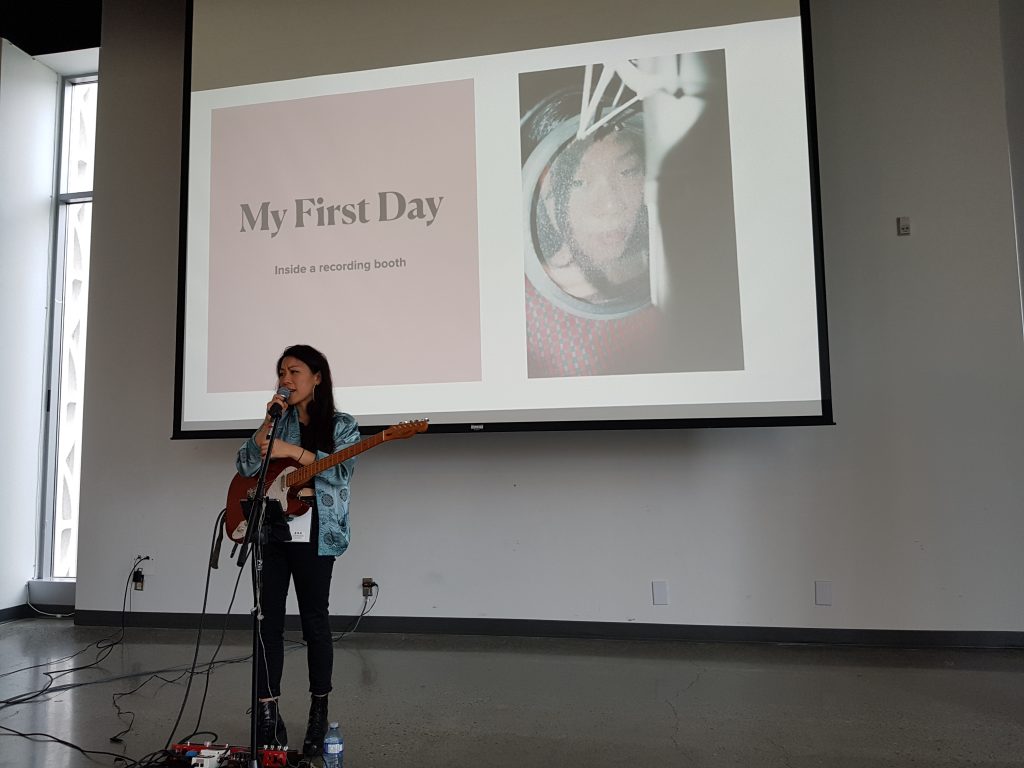
Keitan captivated by a guitar
The room included some K-12 students. To provide them with some context, Keitan pointed out that she existed in a pre-TikTok world. In her youth, billboards, magazines, films and music all showcased people with European features, white skin, and blue eyes.
“I remember when I was a kid, I used to use a clothes peg to narrow my nose,” Keitan revealed. “I always wanted to create the crease in the monolid because I was trying to achieve those same standards as what I saw in media.”
Moreover, she didn’t have the language at that time to truly understand the meaning of Asian representation.
Her life took a turn when she was helping a friend clean out his storage room. He handed her a guitar that he was planning on throwing away. Keitan was captivated by the sounds it made. And she discovered a whole new world of songwriting.
It was even more exciting when she gathered four other people in a band in a room and then played those songs at full volume.
“Music became like home to me,” Keitan said. “It was like the ultimate expression of freedom and where I felt my authentic self.”
The next step was going into a studio to create a record. Keitan was only 14 years old and knew nothing about the music business. It was thrilling, as well as a wonderful learning experience. Then one evening, someone who had been listening in the studio called her parents and requested a meeting.
Hiding her Asian identity
The next week, Keitan and her parents met a smartly dressed businessman at an upscale hotel. He ordered the most expensive item on the menu for her. Then, after some small talk, this man told Keitan that she had a really good chance to compete in the American market because she “didn’t sound Asian”.
The message was clear to the 14-year-old songwriter: “If I really want to make music and continue doing what I love, the I’ve got to hide my Asian identity.”
“When I went home that night after signing the papers, there was one line that I wrote in my journal,” Keitan said. “That was: ‘I’m about to live my dream but I don’t know if that’s really what I want.’ ”
Like other Asian musicians in those days, Keiten didn’t use her Chinese name or her last name because being Chinese wasn’t marketable. Furthermore, people at her record label or working in other parts of the music industry would advise her to “go back home to China to make a career there first”.
“That shows that they assumed that Canada was not my home and second, that every Asian is from China,” Keitan stated.
She, of course, was the Canadian-born daughter of parents from Malaysia and Hong Kong.
“So, it was definitely interesting being in that environment,” the musician added. “I wish that at 14, I knew that I didn’t have to do it on those terms to live my dream.”
At that point in her presentation, Keitan performed her soulful song, “Come Home”. It includes these lyrics: “Walking in the wrong direction / They said it would be / Better than gold/ But I’m far away / And so all alone / And I need to find home.”
Becoming more Asian, not less
Keiten then spoke about how the pandemic brought back some of those feelings. There was a rise of anti-Asian hatred across North America and she didn’t want to attract attention to her Chineseness.
“It felt like I was 14 again—and afraid to be myself,” she recalled.
Keitan began thinking about media representation and how social narratives changed her connection to her culture and how she viewed herself.
“I started to think about the fact that maybe I need to be more of myself instead of less,” she related. “Maybe I need to be more Asian because I needed to find a way to change that narrative and to challenge those harmful ideas.”
This led her to write the throbbing “Smoke and Mirrors”, which explores how media shapes people’s reality. It also addresses how to push back against polarization, according to her YouTube channel.
She performed “Smoke and Mirrors” in the midst of her talk at the Museum of Vancouver, opening with a looped pulsating beat. She also relied on looping to bring forth a newspaper hawker’s voice shouting “Extra! Extra! Read all about it!”
Keitan adds Chinese and Malaysian elements
The final section of her talk focused on how Keitan is changing the narrative around her identity as an Asian artist.
“I decided to do that in a way that was most natural to me—through music,” she said. “So, the first journey back to my roots began in my grandmother’s living room.”
That’s where she was introduced to the guzheng, a horizontal, ancient plucked instrument sometimes referred to as the Chinese zither. Keitan introduced it into her song “No More Secrets”. She played the video at the Museum of Vancouver, as well as a clip from a live version with Ontario guzheng virtuoso Lina Cao.
“That was my first attempt to put a bit of my culture into my music,” Keitan said.
But she also thought about her Malaysian roots. It brought back memories of the tropical heat, intense smells, vibrant colours, drumming, and the sound of Muslim prayers from the mosque.
There’s also a graceful traditional Malaysian dance called Zapin, which originated in Yemen. It’s accompanied by an accordion, a fiddle, and a hand drum. So, she brought that dance into her act.
Finally, there was the issue of language. Keitan wanted to reflect her diverse background, which has included living in Colombia. So she encompassed all of this.
“It features a verse written by my mom in Cantonese and a verse by my aunt in Malay and another verse written by my partner in Spanish.”
There are some in Canadian society who bristle over discussions about identity. Perhaps if they were to have witnessed Keitan’s presentation, they might be more open-minded—and consider the impact that a whitewashed culture can have on a talented 14-year-old Canadian musician of Chinese ancestry.
Event details
The Jade Music Fest will present Eunice Keitan at Showcase: Confetti at 3 p.m. on Saturday (November 9) at Performance Works on Granville Island. Register for free tickets through Showpass. The concert will also include sets by Dawn of Freedom, James Tseung, Jess Leung, and 好日HONI樂團. Follow Pancouver on Twitter @PancouverMedia and on Instagram @PancouverMedia.
This article is part of “Beyond Chinese”, a joint initiative of Pancouver and the Asian-Canadian Special Events Association. Through interviews with artists and cultural workers, Beyond Chinese offers a nuanced view of people with Chinese ancestry. Pancouver and the Asian-Canadian Special Events Association gratefully acknowledge the support of Canadian Heritage.