When Snuneymuxw artist Eliot White Hill, Kulasultun led a media tour of a Salish art exhibition last month, he chose to go in a counter-clockwise direction.
“That is kind of a traditional thing in Salish culture that my great-grandma always talked about,” said White-Hill, guest curator of Every River Has a Mouth: The Visual Languages That Connect Us.
“When we are in the longhouse, we dance around the fire counterclockwise,” White-Hill continued. “We go from right to left; that’s the flow of things. I always try to think about that in my art.”
Every River Has a Mouth features works by 11 Coast and Interior Salish artists at the Bill Reid Gallery of Northwest Coast Art (639 Hornby Street) until February 14, 2027.
White-Hill pointed to the first work, Rest at Jocko River, which was painted by Tacoma-based Bitterroot Salish artist Paige Pettibon. Then, he turned the floor over to Pettibon, who explained that the Jocko River in western Montana was important for her ancestors. The U.S. government expelled them from the valley, forcibly relocating members of the tribe to the Flathead Reservation.
“We have less territory to fish and hunt,” Pettibon stated, “and the Jocko River was a river that sustained us and provided fishing for us.”
Pettibon, who also has African heritage, decided to create a multigenerational image with an elder and a youth near a horse for Rest at Jocko River. It was based on a black-and-white photo dating back more than a century. She adjusted the aspect ratio to magnify the presence of trees and the impact of nature.
“I colourized it because I wanted to have a timeless feel to it,” Pettibon noted.

Border separates Salish peoples
Pettibon started out as a painter creating watercolours and then acrylic works. Since then, she has expanded into jewellery, silversmithing, collage, cedar and wool weaving, and artist books. Every River Has a Mouth includes some of her jewellery, which was inspired by colours from the river. She added pieces of abalone to a necklace out of respect for another Salish Nation, the Puyallup, who incorporate abalone into jewellery and regalia. Puyallup traditional territory includes Tacoma where Pettibon was born and raised.
White-Hill pointed out that the Canada-USA border has had a massive impact on many Salish people’s ability to remain in relationships with their relatives in the western United States. It’s why he felt it was important to feature works by Pettibon and Coast Salish weaver Danielle Morsette, who was also raised in Washington state.
Morsette is from the Suquamish Tribe, Stó:lo Nation, and Chippewa Cree Tribe. The North Vancouver resident created two pieces of regalia—one worn by a man and the other worn by a woman—drawing on traditional Salish weaving techniques and designs.
“Including artists from Washington state is something that hasn’t happened too often in shows here in Vancouver,” White-Hill emphasized.
He and the curator of the Bill Reid Gallery, Aliya Boubard, devised the exhibition’s title early in the planning process. White-Hill quipped that not every river actually has a mouth—some simply evaporate or run into the ground. But a phrase emphasizing the importance of rivers serves as a powerful metaphor for Salish culture.
“They provide for us; they’re always renewing themselves; they’re shifting,” White-Hill maintained. “The water is never the same water at any one point.”
Moreover, the Hul’q’umi’num’ word for “throat’ is the same as the ancestral language’s suffix for language. Therefore, the title of Every River Has a Mouth reflects that the Fraser River is the “throat” that connects many Coastal and Interior Salish people.
“It’s kind of a play on words there,” White-Hill admitted.

Rivers remain integrally connected to culture
Two pieces by Tseil-Waututh artist Ocean Hyland (ts;simtelot) reinforce another reason for calling the exhibition Every River Has a Mouth. One print is called River Man and the other is called Ocean Woman.
“When I was reading her statement here, it reminded me of teachings that came from my great grandma about how the energy of the waters is different,” White-Hill commented. “And she [Hyland] identifies that. The sea water, the salt water, is identified with feminine energy. Fresh water, the river water, is identified with male energy.
“There is meaning and significance to that,” he added. “So the estuaries are very sacred places.”
A nearby installation by Lil’wat Nation multi-disciplinary artist Sydney Pascal speaks to the importance of the Fraser River as a food source. Standing near tiq i sts̓úqwaoz̓a | the salmon have arrived, she explained that it was inspired by a massive run of more than nine million Fraser River salmon returning to spawn in 2025.
“One morning, me and my cousin were walking and people were just beaming and crying because they said the river turned black because there were so much salmon,” Pascal recalls.
She wanted to preserve the excitement and joy of this event through art. Her sculpture of tanned fish skins and netting extends up a wall in the Bill Reid Gallery. River rocks ring the base along with sculpted fish heads and eggs.
Several other pieces offer a reminder of the breadth and imagination of Salish artists. White-Hill included a mixed-media installation by Manuel Axel Strain called they/them spirit bath. It consists of a pictograph overlaying an archival photo by the artist’s father.
“Manny painted this pictograph,” White-Hill said. “The pictograph becomes a portal through which you can see a moment from Manny’s family.”

Exhibition showcases emerging Salish artists
White-Hill juxtaposed works by emerging, mid-career, and senior Salish artists in fascinating ways. For example, Every River Has a Mouth includes an ornate, colourful paddle carved by stz’uminus First Nation artist Ryza Marston, who apprenticed with her father Luke. It’s opposite a large woven sculpture by established Osoyoos Indian Band interdisciplinary artist Taylor Baptiste.
White-Hill revealed that he only started seeing Marston share her work over the past year. His favourite detail on the paddle is the handle—a wave that swirls in on itself.
“It’s so intricate and elegant,” White-Hill marvelled. “It blew my mind when I saw it. Clearly, she is at the beginning of a really exciting carving and art practice.”
Another younger interdisciplinary mixed-media artist, Grace Edwards, contributed a playful painting to the exhibition. It integrates Salish and abstract art in conveying how people sometimes exaggerate the size of a fish that they’ve caught. White-Hill loves the painterly quality, which offers up a milkiness through the artist’s choice of colours.
“It’s very evocative of the Milky Way for me—the Cosmos,” White-Hill remarked. “With our oral tradition, it’s representative of the universe, of the world around us. You can see the stars here as well in the abstract details.”
Two of the mid-career artists are Baptiste and James Nexw’Kalus-Xwalacktun Harry, whose monumental sculptures are rooted in his Squamish (Sḵwx̱wú7mesh) heritage.
Baptiste, cultural coordinator at the Nk’Mip Desert Cultural Centre, shared her large sculpture made of tule reeds and natural fibre cords. White-Hill mentioned that it was inspired by a Möbius strip. The exhibition also includes a small-scale model and photograph of Harry’s magnificent Welcome Gate sculpture in Squamish.

Curator makes space for Salish artistic giants
Every River Has a Mouth also features works by internationally acclaimed Musqueam artist Susan Point and Sḵwx̱wú7mesh and Sts’Ailes’ Nation master weaver Angela Paul.
According to White-Hill, Point was inspired to create designs on two Pendleton wool jackets in the exhibition from a trip along the Taku River more than 20 years ago. While there, she she saw a rare albino eagle.
Opposite is Point’s intricate silkscreen Discovery, which she created in 2005. White-Hill acknowledged that he has learned so much about Salish art over the years by examining Point’s wide-ranging works.
As guest curator at the Bill Reid Gallery, he is presenting Point’s contemporary garments not far from Morsette’s regalia and Paul’s traditional Salish weaving.
“That’s one way you can see how Salish art is flowing and evolving and changing over time,” he said.

Salish blanket design in final installation
White-Hill also expressed great admiration for Paul, whose installation is the final piece in the exhibition.
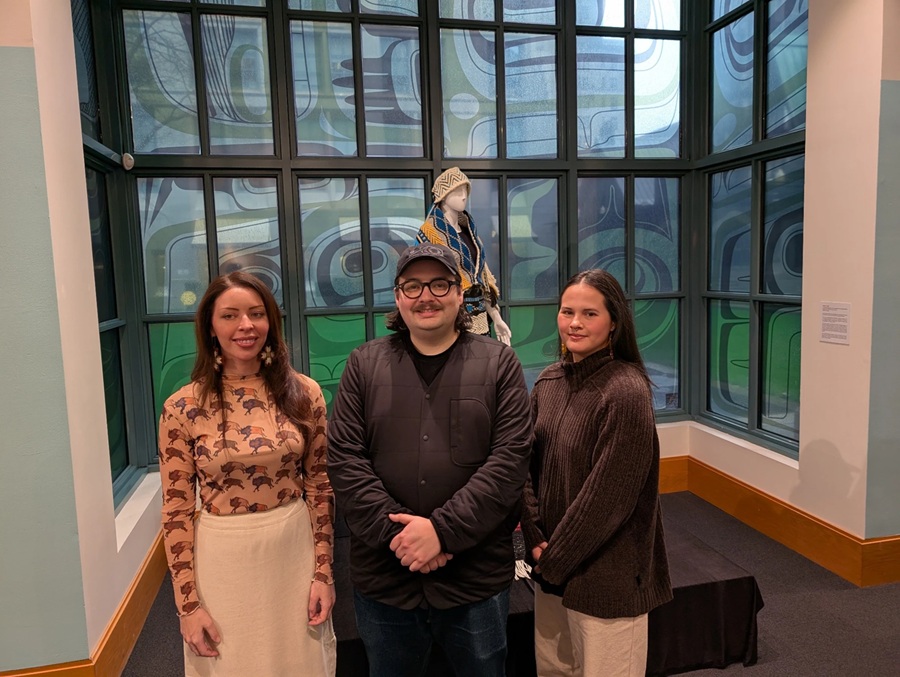
It features a series of traditional weavings on a mannequin and on the floor below it. Paul wove the shawl and her granddaughter wove the headband, which are both included in the gallery poster promoting Every River Has a Mouth. Paul’s blankets drew upon imagery of a river.
“So the colour palette, the flow, and the patterning are really beautiful instances of Salish blanket design,” White-Hill declared.
Every River Has a Mouth is part of White-Hill’s ongoing efforts to counter the long history of erasure of Salish art within Coast Salish traditional territories. During the media tour, he said that this suppression dated back to anthropologist Franz Boas’s 19th-century book on Native art in the Pacific Northwest.
“He said that Salish style was primitive, less civilized, and less developed compared to formline style,” White-Hill said on the media tour. “That kind of began this whole era of people not being interested in Salish art and disrespect of Salish art.”
Tourists to Vancouver have often sought out totem poles even though they were never traditional symbols of local Indigenous culture, according to White-Hill.
“That’s why they brought totem poles from further north to here because that’s what people wanted to see,” he added. “It created this complex history where Salish artists—if they wanted to get by—couldn’t make Salish art to make a living.”

Salish art grabs attention
It was only in the 1960s and 1970s that traditional Coast Salish art gained greater recognition. Point along with fellow artists Stan Greene, Simon Charlie, Charles Elliott, and the Salish Weavers Guild played a pivotal role.
It’s important to note that traditional Salish territories extend far beyond the Lower Mainland of B.C.
A map near the end of the exhibition points out that these lands also encompass the south coast of B.C., much of eastern Vancouver Island, the Capital Region District, the Gulf Islands, and parts of the B.C. Interior all the way to the Okanagan. The Nuxalk Nation around Bella Bella are also a Salish people. South of the border, traditional Salish territories extend through large sections of Washington and Oregon, northern Idaho, and western Montana. Within these areas, many languages were spoken.
“Where we are is one of the most linguistically diverse places on the planet,” White-Hill stated. “One of the big things I always talk about is pushing back against oversimplification of Indigenous culture.”

The Bill Reid Gallery of Northwest Coast Art (639 Hornby Street) presents the world premiere of Every River Has a Mouth until February 14, 2027. For tickets and more information, visit the gallery website.
Follow Pancouver on X @PancouverMedia, Bluesky @pancouver.bsky.social, and Instagram @PancouverMedia.