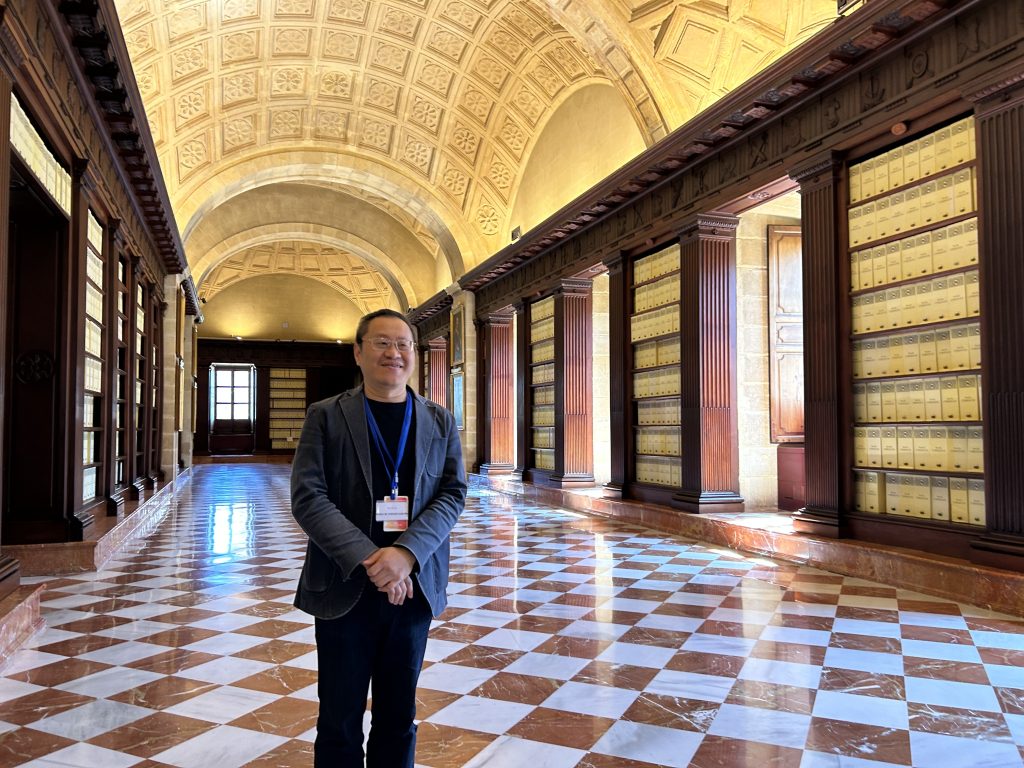
Taiwanese academic Fabio Yu-chung Lee’s developed an interested in history as a child listening to Bible stories. He attended a Catholic Church operated by Franciscans, whose predecessors had journeyed from Fujian to Taiwan to spread the faith. Little did he know that as an adult, Lee would research connections between churches and the cross-pollination of languages and cultures in Asia.
“Initially, my studies were motivated by a desire to understand the colonial history of the Dutch in Taiwan,” Lee, an associate professor of history at National Tsinghua University, told Pancouver through a translator. “I even studied Dutch for a while.
“Later, it was under the encouragement and guidance of my mentor, Academician Tsao Yung-ho, that I gained the courage to study in Spain,” he added. “I am deeply grateful for his encouragement back then, which opened up a whole new world for me that I can now see.”
Spain colonized northern Taiwan from 1626 to 1642 before being driven out by Dutch forces. But connections between Spanish colonizers and people of Chinese ancestry continued, particularly in the Philippines, which was under Spanish rule for nearly four centuries.
Chinese migrants, mostly Minnanese from Fujian Province, settled in significant numbers in Manila. In 2017, Lee and fellow researcher Jose Luis Caño Ortigosa discovered a Spanish-Chinese dictionary from the 17th century with more than 1,000 pages and about 27,000 entries. They found it in the archives of the University of Santo Tomas.
“Even more fortunately, we quickly came across an entry for ‘Keelung, Tamsui,’ with a note in Spanish stating that the land on Isla Hermosa (Taiwan) was where the Spaniards were located,” Lee said.
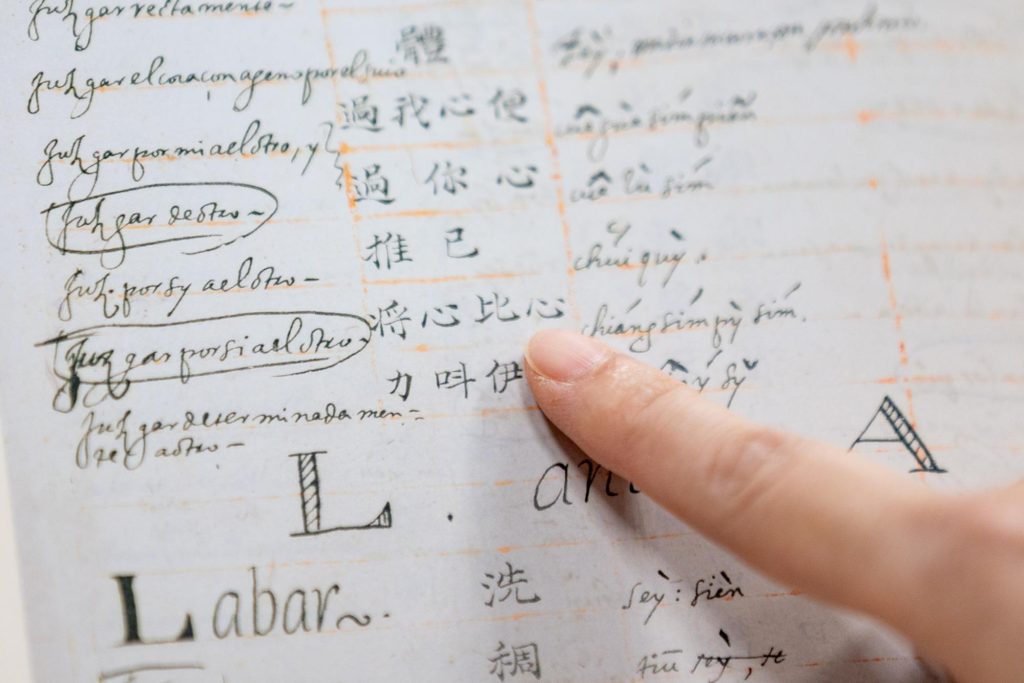
Lee discovers identity of dictionary editor
That enabled the researchers to confirm that the manuscript was edited during the period when Spaniards were colonizing northern Taiwan. There was no direct mention of Fort San Salvador, which was the Spanish military base on Heping Island in Keelung. But the dictionary did mention Parián de Arroceros, which housed Sangley (Chinese) merchants in Manila in the 16th and 17th centuries.
On Saturday (August 31) at 2 p.m., Lee will speak about his research in Mandarin in the Montalbano Family Theatre on Level 8 of the Vancouver Public Library’s Central branch. This free event is part of Vancouver TAIWANfest.
Lee’s research, which was funded by the Chiang Ching-kuo Foundation, raised many questions. For instance, who edited this massive Spanish-Chinese dictionary?
“On the last page of the dictionary, someone had written unrelated numbers along with a translation in a certain language, which made me very curious—who wrote it, and in what language?” Lee stated. “This person must have played an important role in the editing of the dictionary to have the audacity or authority to write what seemed like graffiti on such a beautifully crafted manuscript. But we didn’t have an answer.”
Later, Lee ran into another colleague, international languages expert Liao Xiujuan, and asked for her opinion. Fifteen minutes later, she informed Lee that this text was in 17th-century Cambodian. Moreover, she identified the editor as Juan Bautista de Morales, whose Chinese name was Li Yufan.
“He was a pioneer of the Dominican mission in China, was highly proficient in Chinese, and had compiled other Mandarin dictionaries,” Lee revealed. “The handwriting matched that in this dictionary. Thanks to the help of other scholars, I was lucky enough to identify one of the editors of this dictionary.”

Mixed-race offspring became translators
Minnanese people also compiled dictionaries to learn Spanish.
“These manuscripts show Minnanese people using Chinese characters to phonetically spell out Spanish, enabling communication with the Spanish,” the professor said. “What’s even more remarkable is that these Minnanese people not only learned Spanish but also Tagalog.
“From the words ‘father-in-law’ and ‘son-in-law’ included in these manuscripts, we can infer that these Minnanese people married Filipino women and had descendants,” he added. “Many of these mixed-race offspring later became translators relied upon by the Spanish.”
Lee is well aware of the many negative connotations of colonization. However, he also emphasized that interactions between colonizers and the colonized shaped the world today in ways that some might not appreciate.
“One small consolation is that Spain’s colonization of northern Taiwan occurred during a time when the Spanish ‘Empire’ was already in decline and this was the most peripheral of its colonies,” Lee said. “Most of the time, around a hundred soldiers guarded the fortress, their greatest worry being that the food and weapon supplies from Manila were already three months late and had yet to arrive.
“The Spanish officers were concerned not only about enemy attacks but also about young Spanish soldiers violating Catholic doctrines by sneaking out at night to sleep with their Indigenous girlfriends,” he continued. “The priests, on the other hand, were worried that the pure hearts of the Indigenous people were being corrupted by Spanish silver coins, as they no longer wished to accept traditional bride-price glass beads when marrying off their daughters to Spanish soldiers, but demanded Real coins instead.”
Meanwhile, the Spanish rulers didn’t want their currency being handed over in the form of dowries so that their soldiers could marry Indigenous women.

Lee works with international team
While Spanish colonization in northern Taiwan brought misfortune to certain Indigenous groups, it also introduced concepts of currency, American crops, and the Spanish language. These all had a profound impact.
“Particularly for those who learned Spanish, they quickly gained an advantage in the intertribal competition in northern Taiwan,” Lee noted. “And even during the Qing dynasty, the Han Chinese immigrants who were cultivating land in northern Taiwan had to cooperate with them.”
Through his research, Lee aims to help people understand how people from different cultures managed to live together—and often cooperated for mutual benefit—despite limited communication due to language barriers. He also wants to promote the idea of people speaking their mother tongues.
His research team includes six Taiwanese people as well as a Filipino, German, Spaniard, and a Chinese person from the People’s Republic of China. Lee speaks Spanish with the researcher whose first language is Tagalog, and other scholars speak Mandarin, Taiwanese Hokkienese, and English.
“Through these historical materials, we can see that people around the world, both in the past and present, have generally treated outsiders with kindness,” Lee said. “Even when communication was limited by language, most of the time, people would compensate for this gap with understanding, working together to fulfill each other’s needs, and improve their quality of life.
“As a result, they often made efforts to live harmoniously, despite occasional misunderstandings leading to minor conflicts,” he added. “Most of the time, people were guided by goodwill and mutual benefit, just as we are today. Therefore, with the advanced communication tools and knowledge we now possess, we should not forget the importance of maintaining an attitude of tolerance and understanding toward different groups.”
Update
In the video below, watch Fabio Yu-Ching Lee’s presentation on August 31 at the Vancouver Public Library.
Event details
Vancouver TAIWANfest presents How Minnanese Survived the Age of Exploration on Saturday (August 31). Fabio Yu-chung Lee’s free presentation in Mandarin takes place in the Montalbano Family Room (Level 8) at the Vancouver Public Library Central branch. Follow Pancouver on Instagram @PancouverMedia.
This article is part of “Beyond Chinese”, a joint initiative of Pancouver and the Asian-Canadian Special Events Association. Through interviews with artists and cultural workers, Beyond Chinese intends to offer a more nuanced view of people with Chinese ancestry. Pancouver and the Asian-Canadian Special Events Association gratefully acknowledge the support of Canadian Heritage.