The Museum of Vancouver’s 6,000-square-foot exhibition, Becoming: The Art of Gu Xiong, is a testament to the power of experience in shaping original artistic work. In Part 1 of this two-part series, Pancouver focused on art that Gu had created in his native China in the 1970s and 1980s. Featured in the first of three galleries, these works include the Chongqing-born artist’s depictions of rural life in the Daba Mountains of northern Sichuan. Gu filled many notebooks with his sketches after he, along with millions of other urban dwellers, were sent to the countryside as menial labourers during the Cultural Revolution. In Part 2, Pancouver is focusing on the second and third galleries of the exhibition. These works address his life in Canada and his research-driven visual arts projects exploring international migration and globalization.
Gu Xiong has made his mark in Canada as a celebrated artist, author, and professor in the Department of Art History, Visual Art and Theory at the University of British Columbia. But when he first immigrated from China to Vancouver—following a second residency at the Banff Centre for the Arts in 1989—he had to find a job.
“Because my [English] language was really limited, I couldn’t do any professional work,” Gu tells Pancouver on a tour of the Becoming: The Art of Gu Xiong exhibition at the Museum of Vancouver.
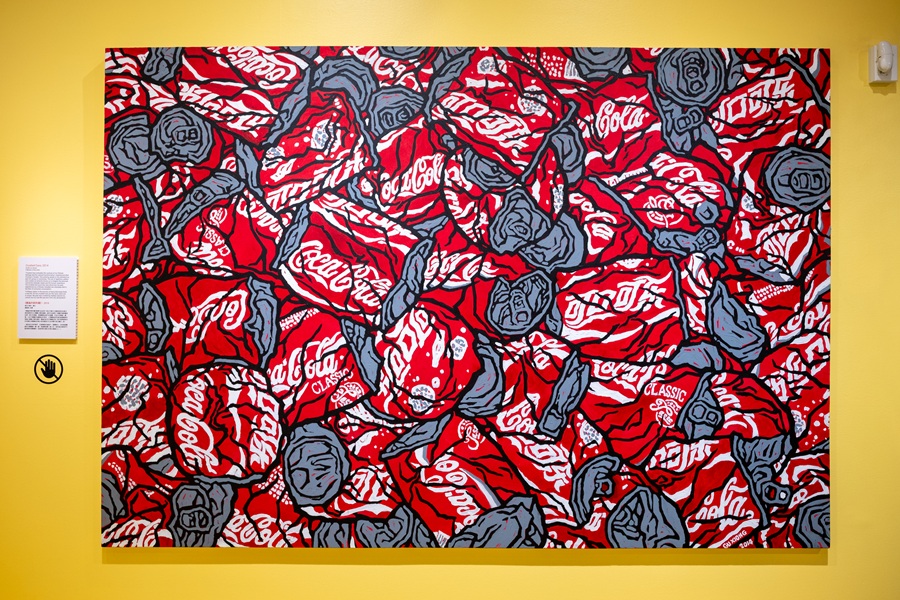
Gu ended up working in a UBC cafeteria, clearing tables and taking out garbage. In those days after students finished a can of cola, they would crush the metal with their feet to make it smaller before tossing it in the trash. This simple act inspired Gu’s 2014 Crushed Cans acrylic on canvas painting, which greets visitors as they enter the second gallery at the Museum of Vancouver.
On a panel beside this piece, he declares that Crushed Cans embodies the contrast of his Chinese heritage and the cultural transformation that he experienced after moving to Canada. Moreover, it “speaks to the individual as part of a group or community”.

Gu says crushed cans affected him
In effect, the crushed Coca-Cola cans serve as a metaphor for Gu’s metamorphosis in Canada.
“A lifeless object, in the process of being destroyed, finds a new life,” Gu states on the panel. “No two crushed cans are the same, each one is unique. My past was crushed by realities beyond my control, but my new life was born from this devastation.”
To the left is his earlier installation, also called Crushed Cans, which was originally exhibited at the Brenda Wallace Gallery in 1992 and 1993. He intersperses individual crushed cans with the message: “Common objects made alike come to life when they are ‘killed’.”
Some observers might see parallels between Gu’s paintings of crushed cans and U.S. artist Andy Warhol’s pop art featuring Campbell’s Soup cans. Gu, however, points out a key distinction. Warhol made no differentiation between the cans—they all appear identical. Gu’s Crushed Cans, on the other hand, demonstrates that each object is one-of-a-kind.
“So that unique shape inspired me to stand up in Canada and rebuild my new identity,” he says.

Family portraits tell a story
Gu chronicles that new life in Canada in the second gallery of the exhibition. There are several paintings of him along with his wife, Ge Ni, and their daughter, Yu Gu.
For example, the mixed-media installation Smile features their individual portraits along with a poem in English and Chinese. It opens with: “I smile when I don’t understand the words that people say to me.”
In the final stanza, Gu writes: “I smile no matter how hard a life I have had.”
Another series of paintings, Awkward Family Portraits, presents paired, cheerful images of himself, his wife, and his daughter in vibrant colours. Gu appears like Groucho Marx with a large black moustache, horn-rimmed glasses, and large upturned eyebrows in two paintings. His wife, Ge, sports a bulbous red clown nose along with a huge smile. Daughter Yu looks normal in the first painting but is depicted in clown makeup with a broad smile in the second piece of her.
“[After] we learned the language,” Gu tells Pancouver, “finally, a real smile appeared on our faces.”

Hard work defined early years in Canada
There’s yet another series of three large portraits of family members above a couch draped in various work clothes. The portrait of Gu is on the left, standing with his CUPE picket sign.
“When I was working in the cafeteria, we went on strike,” Gu recalls. “I was learning that we had to pay a price for that freedom.”
Normally, a family couch is where people relax, watch TV, and talk to friends. But Gu and his wife didn’t have that luxury for many years because they always had to work.
“So, we put our working uniforms there,” he says.
One of his drawings, The Basement, shows a stairwell emerging from an underground secondary suite. Gu says that the inspiration for this dark and moody piece came after he asked his wife how she liked Vancouver.
“She said, ‘It feels just like a basement,’ ” Gu states. “For a lot of people who came here without language, no matter how beautiful this place is, it does not belong to us.”
He acknowledges that his family occupied a basement suite for three years near the corner of East 41st Avenue and Ross Street.

Gu re-invents himself
There are also happier times in the exhibition. An inspirational poem in English and Chinese appears alongside a photograph of Gu and Ge in front of the first home they purchased near Main Street in Vancouver.
One heartwarming moment comes via a poem on a wall by former Vancouver Sun journalist Jamie Lamb and his family. Lamb’s daughter is a friend of Gu’s daughter, and they wrote this to Gu’s wife after she became a Canadian citizen.
“We know it was hard / but we can never know how hard / for how hard could it be / for a woman with such a smile?”
Yet another highlight is Gu’s installation called Campfire, which represents four seasons as seats around a hearth.
“It shows that after all these years, we finally could have time to go camp as a real Canadian family and sit around the campfire,” Gu says.
Through these images and stories, the second gallery reveals how the Gu family’s new life was truly born through hard work, imagination, and re-invention.

From the personal to the universal
The third gallery includes Gu’s ambitious works exploring international migration and globalization. When Gu was hired as a tenured faculty at UBC in 2000, his artistic focus shifted from personal expression to research-based creation. Denise Fong, the curator, made the transition from the family’s personal story to broader themes of historical and contemporary migration.
This section begins with a re-created Chinese-Western restaurant booth featuring objects from the Museum of Vancouver’s Chinese Canadian history collection; videos of Gu, his wife, and others sharing their histories of resettlement; Gu’s re-creations of Chinese Canadian café menus; and a historic photo of The Last Spike that speak to the history of Chinese Canadians in B.C.
One large piece, Yellow Cargo is an installation made up of 800 merchandize boxes. The boxes are labelled with produce stickers from B.C. farms. Shaped like a giant cargo ship, it includes a drone video projection showing the confluence of the Fraser River and the Strait of Georgia emptying into the Pacific Ocean, carrying the made-in-Vancouver produce to the world.
Gu also spent five summers researching the Niagara Falls area where thousands of migrant workers provide essential labour for the agricultural industry. This section of the exhibition includes a 12-minute, three-channel high-definition video(Yu Gu) and an installation of 2,000 different photos of these migrant workers. This is supplemented with fruit baskets from Ontario farms and bottles of “illuminated” water from a Niagara Falls souvenir shop.
According to Gu, migrant workers make an incredible contribution in the Niagara region, building up the economy. He believes that they deserve far more public recognition.
“I talked to a number of farmers,” Gu says. “They said without migrant workers, their family farm cannot survive because nobody would work on the farm.”
Meanwhile, A Migrant Worker’s Crate is filled with objects that temporary foreign workers purchase and ship back to loved ones in their home country.
“The crates are a symbol of the struggle for individual identity within the confines of globalization,” reads the statement alongside this work. “The crate, with many crates exactly like it, can be made unique by placing individual objects within it. Therefore, each worker cannot be labelled as a generic tool of globalization. By placing their personal belongings in the crate, the workers retain their individual autonomy in a global system that treats them as tools rather than as individuals.”

Highlighting Chinese Canadian history in B.C.
One of the more intriguing pieces is Entwining Rivers, a lightbox of the Rhine, Red, and Yangtze rivers coming together. Gu says that “Red River Valley” was a favourite song of young people exiled during the Cultural Revolution. However, when it was presented with Chinese subtitles, the images were of the Rhine River in Europe.
“I was shocked by the twisted cultural meanings,” Gu says with a laugh.
Becoming: The Art of Gu Xiong also shines a light on early Chinese migrants to the B.C.’s west coast, including those sent to a leper colony on D’Arcy Island.
“In the isolated area at the western end of D’Arcy Island, there are no signs to tell people about this history or what happened here,” the message reads. “Perhaps Chinese leprosy patients back then would not have foreseen that a hundred years later, the remnants would resurface, and that Chinese people would once again face the discrimination of being associated with the ‘Chinese virus’. But we will never forget this history and we must never let it repeat itself.”
Another work, A Bone House, includes five digital photos showing where the remains of deceased Chinese immigrants were cleaned and prepared for burial at Harling Point in Victoria. These bones remained buried for seven years before being exhumed, cleaned, dried, and sent back to the deceased person’s hometown in China.
Chinese immigrants in Canada continued doing this until 1937 when the outbreak of the Second World War in China put an end to this practice.
“That history for me is very personal,” Gu says. “As a traditional Chinese [person], no matter where you die, you have to return home. For me, home is not just a birthplace, it is where we have been and feel good to live within.”

Exhibition information
The Museum of Vancouver is presenting Becoming: The Art of Gu Xiong《雲起:顧雄的藝術歷程》until March 29, 2027. Exhibition partners include the Y.P. Heung Foundation, Canada Council for the Arts, Deux Mille Foundation, and Venture for Canada. For more information, visit the Museum of Vancouver website. To learn more about Gu Xiong, visit his personal website.
Follow Pancouver on X @PancouverMedia and Bluesky @pancouver.bsky.social. Also find Pancouver on Instagram @PancouverMedia.