

Lynn Liu went out of her way to ensure that this year’s Vancouver International Music Festival had a global feel. As president of the festival committee, she was also determined to have an Indigenous presence. So she covered off both of these areas by recruiting Edgar Muenala, an Indigenous composer from Ecuador, to perform on the pan flute and offer a workshop.
In addition, she invited the duo Zhambai to perform Zimbabwean music. Jun Rong, a superb erhu player from China, and Taiwanese-born zheng virtuoso Dailin Hsieh also played concerts and taught workshops, along with a bevy of talented classical musicians.
“The multicultural background that I wanted to bring to this festival is very crucial and important,” Liu tells Pancouver over Zoom, “because it’s matching Canada’s background, which is very multicultural.”
Liu herself is an example of how an immigrant from the opposite side of the Pacific Ocean can create a fulfilling and happy life in Vancouver. Her upbringing in southern Jiangsu in China helped sow the seeds for her success in Vancouver as a piano teacher and founder of an international classical music festival.
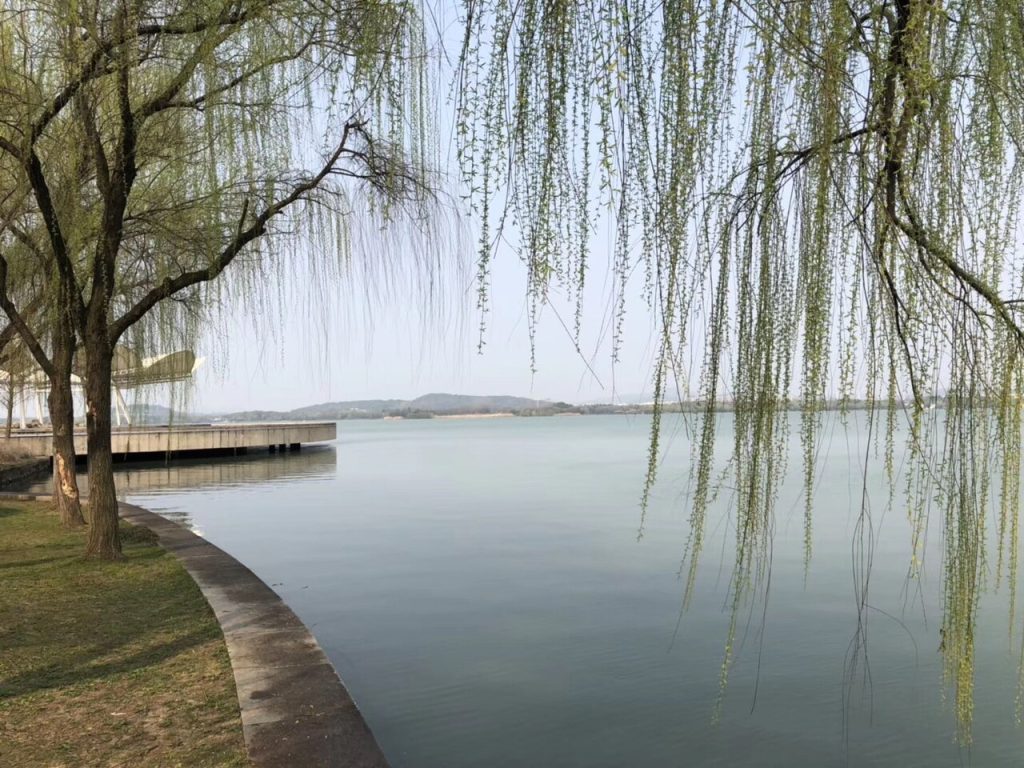
Her hometown of Wuxi is about 140 kilometres east of Shanghai. According to Liu, Wuxi is famous for its spectacular Tai Lake, gorgeous scenery, seafood dishes and pork ribs. For centuries, the province of Jiangsu has been a centre of culture and education. She believes that the overall environment helps explain why Jiangsu is known for nurturing scholars, musicians, and artists.
“We have very famous painters drawing people from our province,” Liu declares. “Also, the best scholars in the country in physics and the science field came from Jiangsu.”
Liu also plays the pipa
Moreover, some prominent national leaders of the 20th century in China and Taiwan were from Jiangsu. The capital of Jiangsu, Nanjing, was the national capital at different times in Chinese history, including during the Ming Dynasty and the republican era. Liu pursued her undergraduate studies in Nanjing before immigrating to Canada as a graduate student.
“I really appreciate that I was born in Jiangsu,” Liu emphasizes.
As a very young child, she began dancing, which brought her in contact with music. She didn’t start playing the piano until she was around 10 years old, which is later than many who earn their livelihoods through music. But she loved it and played continually through her middle-school and high-school years
“Then, I decided to pursue this as my future degree pursuit and also career pursuit.”
In university in Nanjing, she also played the pipa. It’s a pear-shaped, plucked wooden instrument that’s sometimes referred to as the Chinese lute.
“I still have the pipa with me in Canada,” Liu reveals. “I brought it over from my hometown.”
When asked about the difference between Chinese and western classical music, Liu points to the keys.
“Most of the western music is based on major-minor keys,” she says. “But the Chinese music is mostly based on the five tones of the scale. So, it sounds different. That’s why when people hear certain music, they can tell, ‘Oh, that’s kind of a Chinese style.’ This is the major difference.”
Liu adds there are ancient pieces of Chinese traditional music, which have remained popular through many centuries.
As much as she appreciates Jiangsu, she felt the urge to try living outside of China while in her third year of undergraduate studies. She was curious to open herself to new experiences.
Watch Lynn Liu’s interview with Pancouver editor Charlie Smith.
Vancouver’s passion for music education
It’s obviously a very long way from Jiangsu to Manitoba. But in 2002, Liu made this move to attend graduate school at Brandon University because it offered a master’s degree in piano performance and pedagogy. She laughs now as she looks back on those days.
“It’s a very quiet city,” Liu says. “The only thing I did there when I did my graduate study was just [stay] home and [go to] school.”
After graduating from Brandon University, she moved to Toronto, where she stayed for less than a year. From there, she decided to try living in Vancouver, which she loved. So, she’s stayed in B.C.’s largest city, raising her teenage son and living with her parents, who’ve immigrated from China.
“I like the city, the weather, the people here, and the environment, especially,” Liu gushes.
Plus, she appreciates the city’s passion for music education. She didn’t find it difficult attracting enough students to make a living as a piano teacher.
“First of all, I do like kids,” Liu explains. “So, because my major was in piano performance and pedagogy, I was able to convey my knowledge and my experience to these younger kids.”
After a few years in Vancouver, she founded the Vancouver Central School of Music. In 2018, she decided to sell it to work as the principal and music director at Tom Lee Music Academy. She did this for a while before returning to her private piano-teaching practice.
After moving to B.C., Liu dreamed bringing young musicians from other countries to perform in Vancouver. So, she consulted with friends in the music world as well as professors and other teachers about creating an international competition.
“I would say 90 percent of them were very passionate about the idea,” Liu says. “They thought this is a great opportunity for the whole city—and also for those younger ones who are studying music.”
Edward Muenala performs Leonard Cohen’s “Hallelujah” on the pan flute.
Liu launches a festival
That led her to found the Vancouver International Music Competition in 2017. Her down-to-earth personality and personal warmth led others to volunteer for the cause. Contestants performed live or sent videos to try to reach the finals, which were held at the UBC School of Music. The first year’s competition concluded with a gala at the Chan Centre on UBC’s Point Grey campus.
Liu and the other volunteers created the Canada International Arts & Music Society to oversee the competition. The society became a registered charity in 2021, which meant it could offer tax receipts to donors.
That year, the society had to organize a virtual competition because of the pandemic. The competition returned to the Chan Centre in 2022 for the gala.
This year marked another major stepping stone as the society chose to host a festival rather than just a competition. This took place at the VSO School of Music. Young musicians still competed in various categories and performed in front of audiences. However, there were also concerts by the 10 talented artists in residence, including Muenala.
“The competition is still going on and it’s every three years,” Liu says. “But the festival could be in-between when the competition is not on. Then we can bring more educational experience for the younger kids. Maybe that’s also a pathway for them to get ready for the competition the next time.”
It’s a busy workload, but one that Liu relishes for furthering the skills of young musicians.
“I feel that I am contributing to this community—to this city—as a Chinese Canadian and as someone from outside of Canada,” Liu adds. “So, I’m pretty proud of what I’m doing here.”
For more information on the Vancouver International Music Festival, visit the website. Follow Pancouver on X @PancouverMedia and on Instagram @PancouverMedia.
This article is part of “Beyond Chinese”, a joint initiative of Pancouver and the Asian-Canadian Special Events Association. Through interviews with artists and cultural workers, Beyond Chinese offers a nuanced view of people with Chinese ancestry. Pancouver and the Asian-Canadian Special Events Association gratefully acknowledge the support of Canadian Heritage.


