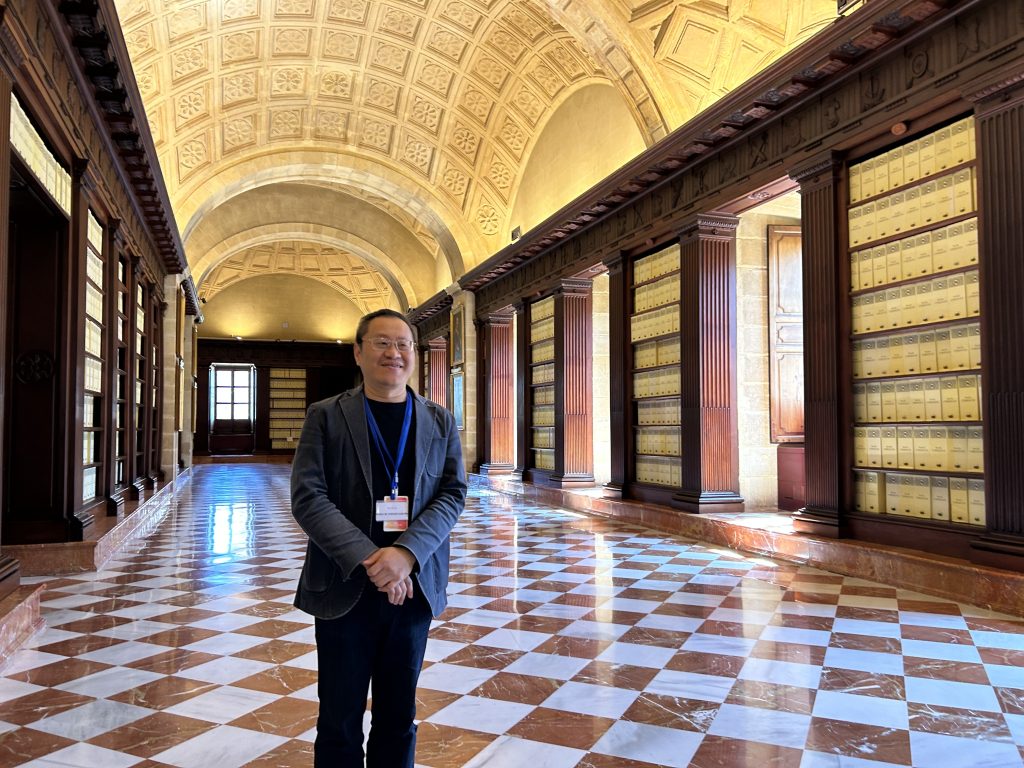
Many poets fall in love with their artform in childhood or as teenagers. Grace Kwan, on the other hand, only started writing poetry seriously in grad school at Simon Fraser University.
“I would always be working multiple jobs,” Kwan (they/them) tells Pancouver over Zoom. “I would be working research assistant jobs, teaching assistant jobs, and then restaurant jobs as well.
“It was during a time where my mental health was worsening so much because of all the stresses that were piled on me,” the Malaysian-born writer and sociologist continues. “So, poetry was one of the ways that I could relieve that because I didn’t have access to a counsellor or therapy. I wasn’t even really aware of what I was going through at the time.”
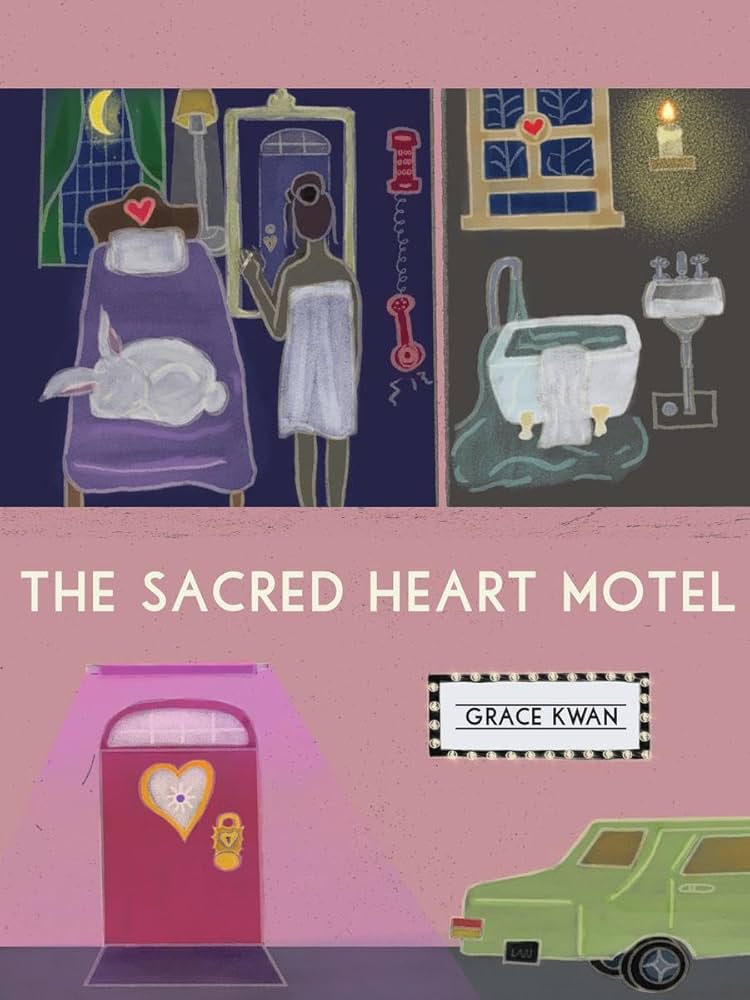
In November, Metonymy Press published Kwan new poetry collection, The Sacred Heart Motel. Through three dozen poems, Kwan offers up eloquent and evocative passages on a wide range of topics, including feelings of displacement, grief, migration, and the inner vibe of a roadside motel.
In one poem, “Gender Studies”, Kwan declares “now I’m an immigrant placeless and still hovering on the limn trying on wages radium and high heels as a second language…”.
“That passage is a great example of the throughline of that poem,” Kwan explains. “I’m putting the experience of migration alongside the experience of queerness and desire and beauty—and experimenting with how they speak to one another.
“While I was writing that poem, I was thinking of that feeling of transience and not belonging,” the poet continues, “and how that translates into the experience of being queer, and the alienation and isolation that that can bring.”
Kwan spent lots of time in hotels and motels
Another poem, “Front Desk”, also addresses desire. A food delivery worker takes a new housekeeper to bed to help her forget a horrible shift.
“It’s nodding to how relationships often also feel temporary and transient when you are in that placeless state yourself,” Kwan says. “Whether it’s romantic or platonic or any kind of relationship, it’s difficult to feel as if it’s real and lasting, even if you’re putting everything into it.”
Kwan has been familiar with the transient lifestyle ever since childhood in Malaysia’s capital city, Kuala Lumpur.
“My parents always told me, ‘You were flying on planes before you could even talk…or walk,’ because my dad was an actor,” Kwan reveals. “So, we were always flying around to his different jobs and staying in different motels or hotels.”
They immigrated to Vancouver when Kwan was eight years old. In subsequent years, Kwan moved from one basement suite to the next.
“It really always felt very temporary and kind of transient, and I found it hard to pinpoint where I really belonged or what I called home.”
These experiences propelled Kwan to explore Asian diasporic literature, intellectual labour, and identity formation as a master’s student in sociology. In those days, Vietnamese American poet and novelist Ocean Vuong had a huge impact on Kwan’s perspective on the world. His novel, On Earth We’re Briefly Gorgeous, won several prizes, including the Mark Twain American Voice in Literature and the American Book Award.
In particular, Vuong’s writing led the young graduate student to explore how diasporic people portray their experiences of immigration and displacement through language.
“It really changed my understanding of my own experiences and even…all the scholarly literature that I had internalized and read,” Kwan states. “It gave me a different lens on it.”

A gritty home for Kwan’s poems
One of Kwan’s poems, “Tsurine”, is a “golden shovel”. This term refers to borrowing a line or phrase by someone else and using these words in sequence at the end of each line in a new poem.
Kwan selected Vuong’s line: “I might still be too young in my grief to know where it ends.” According to an article by Sophie Dufresne on the publisher’s website, Kwan wrote this poem “as a way to process cutting off their parents while writing and editing The Sacred Heart Motel”.
Meanwhile, working in a hotel restaurant enabled Kwan to see the hospitality industry from a different vantage point from the guests. Workers moved through the basement and relied on a network of staff hallways and elevators, popping in and out of view.
Kwan wanted to situate their poems in a physical location, so the collection is split into seven sections, each representing a section of a motel.
“And it’s a motel, not a hotel, because I really like that grittiness and that kind of sleaziness—almost kind of dirty,” Kwan says. “It’s on the side of the road. It’s not a place you’ve looked up on the Internet and booked in advance; it’s something that you stumble upon in the middle of the night.”
The title, The Sacred Heart Motel, was inspired, in part, by Heather O’Neill’s 2017 novel, The Lonely Hearts Hotel, which Kwan describes as a “great book”. Moreover, Kwan feels that O’Neill’s surrealistic and romantic tone and atmosphere influenced some of the writing in the collection.
“I also named it The Sacred Heart Hotel because of that connection to religion and…Catholicism,” Kwan states.
Watch Pancouver editor Charlie Smith’s interview with Grace Kwan.
Malaysia’s difficult history
Kwan recognizes that people of Chinese ancestry from Southeast Asia are underrepresented in the Canadian media and popular culture. Moreover, recent history and the lived experiences of Malaysian Chinese immigrants differ markedly from those from Hong Kong or China.
First of all, many Malaysian-born people of Chinese ancestry, including Kwan, are fluently trilingual. They speak one or more Chinese languages, plus the country’s official language of Malay, and English, which is a holdover from when Malaysia was part of the British Empire.
“I think a lot of people also tend to flatten ‘Asian’ into kind of a monolith,” Kwan states.
Kwan’s mother, for example, is from a Cantonese-speaking family in Ipoh. It’s more rural than the bustling and urban Kuala Lumpur to the south. She never attended college, but she still encouraged her daughter to read the English classics, including some difficult books. This nurtured Kwan’s love of language and storytelling from a young age.
Kwan’s parents spoke Mandarin at home. However, they were also determined that their daughter would learn English as a first language.
“They wanted me to have opportunities outside of the country where I grew up,” Kwan states.
There’s a reason why many Malaysian Chinese parents might feel this way. More than 20 percent of Malaysia’s population is of Chinese ancestry but they don’t enjoy equal rights even though many have lived in the country for generations.
As a result of the Constitution (Amendment) Act in 1971, the majority Malay population has special status over other ethnic groups. The constitution defines “Malays” as Muslims who habitually speak the Malay language and conform to Malay customs.

Kwan’s perspective shaped in Canada
The constitutional amendment took effect almost two-and-a-half years after ethnic Malay mobs attacked the Chinese enclave of Pudu (in the Bukit Bintang and Petaling Street areas) in Kuala Lumpur following the 1969 election. Kwan never lived through these attacks. But Kwan’s mother has alluded to the mindset by mentioning to her daughter that she would never see Chinese characters prominently displayed in Malaysia like they are presented in Vancouver’s Chinatown.
“Because I grew up in the context of Canada and the like, my understanding of racism is more based on what I’ve experienced here,” Kwan states.
During the pandemic, Kwan stayed home almost all the time, therefore avoiding any chance of anti-Asian violence. But as a teaching assistant, Kwan heard disturbing stories from students about being blamed for the spread of COVID-19.
“My students would be writing in their assignments about how they were being verbally and physically assaulted for being Asian outside,” Kwan discloses.
The Sacred Heart Motel isn’t a book about racism, per se. Nor is Kwan trying to represent any specific identity in the collection.
“In terms of what it contributes to the dialogue under diaspora [literature], it’s more an attempt to portray the emotional life and experience that you live as a diasporic person,” Kwan says.
For more information on Grace Kwan, visit their website. More information about The Sacred Heart Motel is available on the Metonymy Press website. Follow Pancouver on X @PancouverMedia and on Instagram @PancouverMedia, and Charlie Smith on Bluesky @charliesmithvcr.bsky.social.
This article is part of “Beyond Chinese”, a joint initiative of Pancouver and the Asian-Canadian Special Events Association. Through interviews with artists and cultural workers, Beyond Chinese offers a nuanced view of people with Chinese ancestry. Pancouver and the Asian-Canadian Special Events Association gratefully acknowledge the support of Canadian Heritage.