Artistic directors of several music festivals have offered a bounty of advice for anyone aspiring to perform at one of their events. At the Jade Music Fest last week, festival organizers cited everything from providing topnotch music videos to being kind to stagehands.
Doug Cox, long-time executive producer of Vancouver Island MusicFest, pointed out that folk festivals often consist of many musical genres. That can include roots, global, blues, folk, classical, new country, rock ‘n’ roll, and spoken word. This makes them more culturally expansive than what’s offered on the blues, country music or jazz festival circuits.
“As an artist, you can often fit into more than one of those cultures and reach different audiences through each one,” Cox said in one panel discussion.
Cox disclosed that he has five or six different press kits, depending on what the job entails. His goal is to be welcomed into places he may not have entered before, whether it’s as a producer or as a dobro player.
“I have a bio and a press kit as a singer-songwriter and a press kit as a blues guy,” Cox revealed. “Those are the worlds I appeal to. So, what worlds do you fit into? What worlds do you cater to? What worlds do you want to fit into? How diverse do you want to be?”
Mission Folk Festival Society’s executive and artistic director, Michelle Demers Shaevitz, said that she attends four or five music festivals each summer outside of her own. That’s in addition to attending five to 10 booking conferences per year.
When Demers Shaevitz attends festivals, showcases, or workshops, she watches how musicians engage with others. That’s in addition to taking in their performances.
If a stage manager tells her that a musician is great to work with, that can help move this artist higher up on her list. For her, every interaction is an opportunity to shine. She noted that there are also avoidable mistakes.
“I will get press kits and booking requests from somebody who wants a massive A/V situation at a small outdoor, rural festival,” Demers Shaevitz said. “That says to me that you did not do your homework. That’s not how we book and it’s not what we book. That’s disconcerting.”

Invite artistic directors to live shows
Andy Hillhouse, artistic and executive director of Harrison Festival Society, pointed out that his event is free to the public, unlike many other music festivals. He noted that the quality of artists’ videos can make a huge difference in attracting audiences.
“I’ve had some great artists who send low-quality videos, and it doesn’t seem to draw people,” Hillhouse said. “And some kind-of-okay artists who make a really good video drew a lot of people. It’s a very interesting phenomenon these days because it’s very competitive. It’s worth investing in.”
The artistic director of the Vancouver Folk Music Festival, Fiona Black, said that there are literally thousands of artists who would love to perform at her event every year. Staff don’t have the time to answer every unsolicited email that comes in.
However, Black encourages artists to invite her to their shows if they are performing live in Vancouver.
“That, for me, is the most important thing,” Black stated. “That’s when I get to see you at your best and how I can envision you at the festival best—if I get to see your live show.”
Hillhouse echoed this point. For him, the ideal curation involves going out into the community and discovering new talent.
“One way that communities can help with that is to let us know what’s going on—where there are gigs in our area and that kind of thing, just so we can come out and see people perform,” he said. “There is the route of looking for official shows and then there is the other thing of contacting us and inviting us to shows and performances live.”
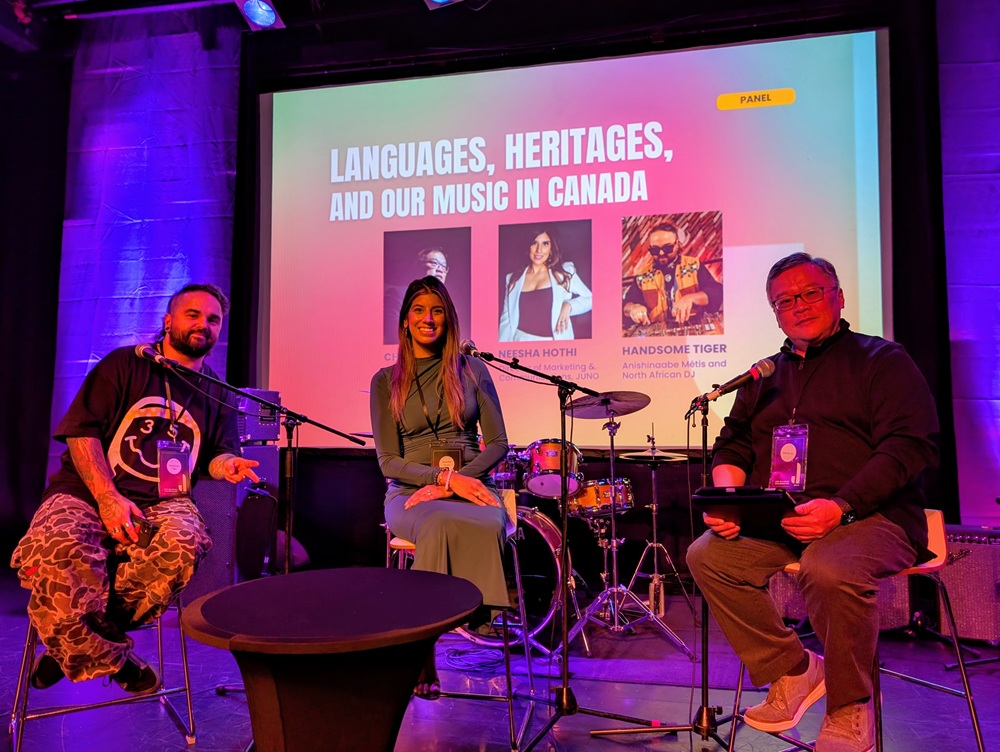
Jade Music Fest chief organizer Charlie Wu moderated the first panel discussion on November 6 at Performance Works. He pointed out that there are opportunities for music festivals to attract new audiences by inviting North American-born musicians who can speak Chinese languages. Moreover, he stated, they can explain their culture in ways that English-speaking audiences can understand.
Wu also mentioned that some music festivals invited a Taiwanese Indigenous band, Kanatal, to perform in 2022 when it was touring Canada. This resulted in collaborations and information-sharing between Indigenous musicians from Taiwan and North America. Wu was in the audience for the second discussion featuring Cox and Demers Shaevitz on November 7.

International mix differs depending on the fest
Meanwhile, Cox advised musicians to consider augmenting their incomes through other means even when they’re on tour.
“You can teach at music stores; you can teach through media; you can teach one-on-one; you can also mentor people,” he stated.
Each festival has a different mix of international to national to provincial artists.
For example, the Vancouver Folk Music Festival booked artists from 16 countries this year, including Korean, Palestinian, Ukrainian, and African performers. About half the acts were from outside of Canada. According to Black, the remaining 50 percent were a blend of local, regional, and national.
“I think we have to have that commitment to diversity and try and reflect our community on our stages,” Black said. “Vancouver is one of the most diverse cities in the world. How do we fund that? It’s a complicated question.”
She also declared that the Vancouver Folk Music Festival loves to arrange collaborations between the local and international artists—and not just on workshop stages.
“I love it when those collaborations go on, whether they record together or tour together,” Black added.
Hillhouse said that the Harrison Festival of the Arts traditionally books six to nine international acts among the 30 performers. Another eight to 10 are local, with the rest being drawn from across Canada. The Mission Folk Festival lines up about five internationally focused performers among its 25 acts. Another 10 are nationally focused, with the rest being local, according to Demers Shaevitz.
Artistic directors want to hear musicians’ stories
The Vancouver Island MusicFest will be on hiatus next year. Cox said that it usually invites about 30 percent of its acts from the island, with another 20 percent coming from other parts of B.C.
“We’re always considering genres of music in terms of variety,” Cox stated. “We’re considering genres of people’s cultures and we’re considering gender balance as well—and age balance, too. We think about all of that.”
Cox chairs the Juno Awards roots and traditional steering committee. He advised musicians in the audience to consider requesting to be members of juries. Cox also suggested other ways to become more familiar about the industry.
“The best way to learn how to write grants is to sit on a jury that judges grants,” he said. “The best way to learn how to promote a show is to put on a show.”
Demers Shaevitz, like the other festival artistic directors, said that she is keenly interested in hearing artists’ stories. She wants to know if an artist is from a rural or urban background and how their particular culture informs their music.
“If you have a strong feminist point of view, make sure that’s mentioned somewhere in your bio,” Demers Shaevitz advised. “It gives us a broader way to understand you. It gives us more opportunity to present you to our audience.”
Event details
The Jade Music Fest took place in Vancouver from November 6 to 9. It aims to make Vancouver the North American hub for Chinese-language music production while offering Canadian and international musicians a platform to perform in their heritage Chinese languages. For more information, visit the Jade Music Fest website. Follow Pancouver on Twitter @PancouverMedia and on Instagram @PancouverMedia.