
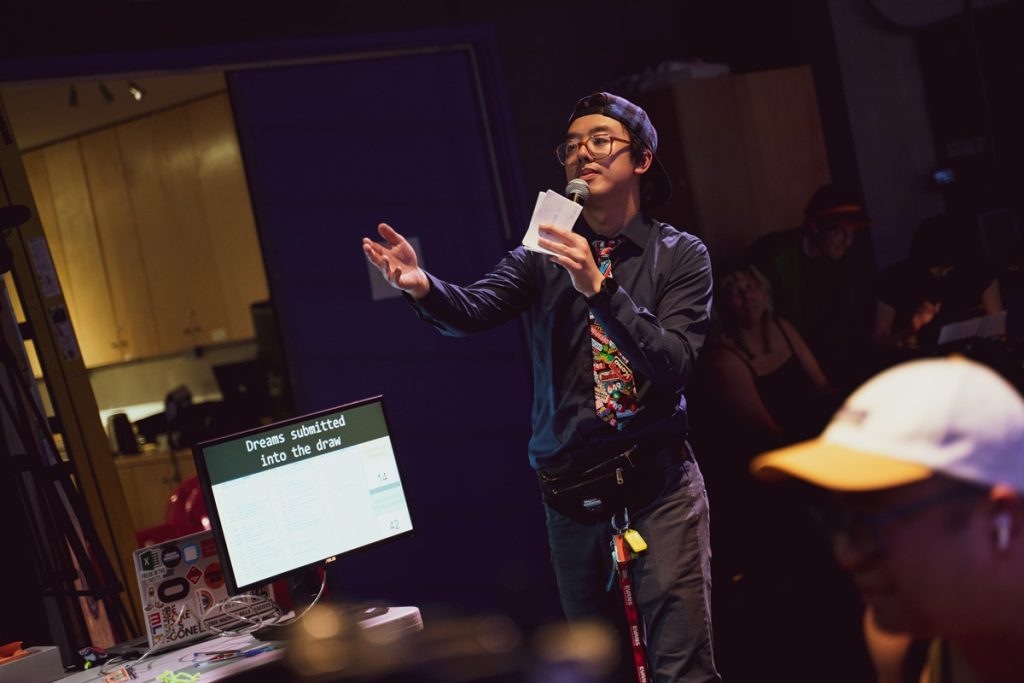
When Howard Dai was growing up in Taiwan, he loved seeing how the winning lottery numbers were announced on TV. The flamboyance and excitement of these productions and other game shows left a lasting impression on the Vancouver actor and associate artist at rice & beans theatre. So much so that Dai became inspired to create Dream Machine. It’s a large-scale immersive and interactive show that combines dream-making with a lottery.
“Through the gesture and form of a lottery draw, Dream Machine seeks to explore the parallel between immigration and gambling: The process of immigration, the immigrant’s wish for their children, and the sacrifice they have to make,” the rice & beans theatre website states. “It is an immersive experience that will directly summon the audience’s dreams and aspirations that may be present in their life or have long forgotten about. In it, Howard aims to curate a space where players meet each other through their dreams and uplift each other with their ambitions.”
Dai workshopped the show as lead artist last December with Vancouver Asian Canadian Theatre. Then earlier this month, Dai performed it as a work-in-progress at the Tremors Festival, which is presented by Rumble Theatre. After taking in audience feedback at the festival, Dai will present it again for free as a work-in-progress at 7 p.m. on June 26 and 27 at PL1422. (RSVP through this link.)
Dai’s acting credits include Salesman in China and Romeo & Juliet at Stratford. He was an assistant director on two East Van Panto productions and was the 2022 digital-artist-in-residence at the PuSh International Performing Arts Festival.

Dream Machine engages audiences
In a Zoom interview with Pancouver, Dai mentions that he dealt with a lottery and diasporic guilt in one of his previous shows, 菠蘿麵包 Pineapple Bun, which was set in a bakery in Taipei. In Dream Machine, which is still in development, he is able to make the entire show about a lottery. It comes complete with audience interaction.
Dai loves that theatre takes place live, which makes the audience a key component of any production. Prior to his performances at the Tremors Festival, audience members were asked to write down a personal dream on a piece of paper. Dai was able to connect each dream to the person through a spreadsheet, which was created as other shows were being presented. During the show, these dreams become tickets in the lottery—with audience members being given the option to share their dream publicly.
In effect, Dai is encouraging people to write down and voice their aspirations. He acknowledges that this might even increase the likelihood of them manifesting their dreams. Moreover, it’s one way to remain positive about one’s future in the face of a flurry of negative news in the world. As for Dai, he reveals that these days, his dreams tend to be short-term.
Howard Dai will present Dream Machine as a work-in-progress at 7 p.m. on June 26 and 27 at PL1422 in Vancouver. RSVP through this link. Follow Dream Machine on Instagram at dream.machine.show. Also, learn more about Howard Dai by visiting his website or through this feature article in Pancouver.
Follow Charlie Smith on Bluesky @charliesmithvcr.bsky.social. Follow Pancouver on Instagram @PancouverMedia and on X @PancouverMedia. In addition, find Pancouver on Bluesky @pancouver.bsky.social.




