
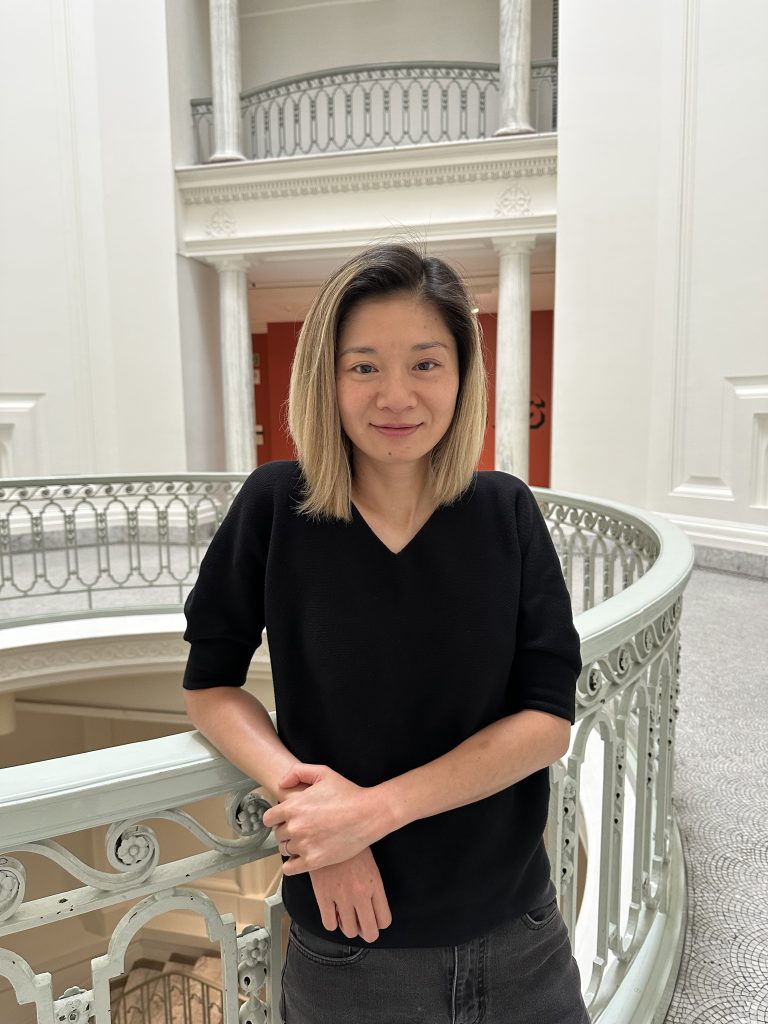
Vancouver cultural worker Lynn Chen 陳勵瑩 feels that her identity is multifaceted. The programming coordinator at the Vancouver Art Gallery’s Institute of Asian Art also feels that her identity evolves over time.
“It has a fluid nature, no longer bound by language, race, or geography,” Chen tells Pancouver over Zoom.
She has lived in Vancouver longer than she lived in Taiwan, where she was born. Despite this, Chen maintains that she will always be seen as a “foreigner”, whether it’s in Canada or in her birthplace.
“My Taiwanese identity has evolved within me and become a hyphenation of my overall identity,” Chen explains. “Because of this, I can be more open and more critical in my perspectives.”
As the Institute of Asian Art approaches its 10th anniversary in November, Chen notices a great deal of fear about Asia’s growing role in the world. Moreover, she feels that this can lead to stereotyping and misunderstandings.
“We are now living in a world that is increasingly polarized, and media and political divides often deepen these separations,” she states. “So having a channel for dialogue is important to bridge that divide.”
Nearly two decades ago, Chen noticed a big gap between the reality of Asia and how it was presented in the media and film. In response, she co-founded Cinevolution Media Arts, a grassroots, migrant-driven organization promoting cross-cultural communication.
In those days, she says, most people remained in their own cultural, ethnic, and linguistic silos.
“Even in a diverse society, communities often remain separate with little cross-cultural exchange, leading to stereotypes about Asia,” Chen declares. “We also recognized that language can be a major barrier for new immigrants.”
Lynn Chen speaks with Pancouver editor Charlie Smith.
Institute of Asian Art opens new vistas
Cinevolution aims to break down these barriers by connecting immigrants and marginalized communities with international events and participatory media art festivals. For Chen, this is a means for introducing alternative perspectives and new ways of thinking. It also invites collaboration and exchange across cultures.
In 2011, the society launched the Your Kontinent Festival, which addressed diasporic identities through art and independent and experimental films. It included industry panels, workshops, and pop-up events in public spaces across Richmond. In 2014, grew into a 10-day event.
“Art and life are quite interwoven; you can’t really separate them,” Chen says. “Art is part of me; it shapes the way I think and provides me with a lens through which to be both sensitive and critical.”
She likens art to putting on a different pair of glasses through which the world can be seen.
In 2014, the Vancouver Art Gallery launched the Institute of Asian Art. Someone sent her a job posting with a request that she share it with her network. But Chen found that she was draw to this initiative because it aimed to foster intercultural exchange and dialogue.
“That’s something I’m really passionate about,” she says.
Moreover, the first director, Zheng Shentian, is a renowned scholar and was elected chair of the Federation of Chinese Canadian Artists in Vancouver in 1993. He graduated from the China Academy of Art in Hangzhou, where he served for over 30 years as a professor and chaired the oil painting department. He was also a visiting professor at the University of Minnesota and San Diego State University before immigrating to Canada in 1990.

Diverse artists offer alternative viewpoints
According to Chen, Zheng has been a leader in promoting and providing platforms for art and cultural exchange.
“I admired his dedication and wanted to be part of shaping this emerging initiative,” Chen states. “The Institute was young, and I was excited about the opportunity to contribute to its development.”
She points out that the Institute of Asian Art is like a gateway for reframing norms that have a Eurocentric perspective. In addition, it offers a platform to showcase diverse artists and voices to provide alternative points of view. This, in turn, encourages people to view the world in new and meaningful ways.
Sometimes, this occurs through public dialogues that Chen has hosted. Examples include discussions with Hong Kong-born artist Ho Tam and Korean-American feminist academic S. Heijin Lee.
Then there are the exhibitions, such as Filipino Canadian artist Lani Maestro’s No Pain Like This Body. The red neon sign diptych stacked parallel phrases vertically. One side said “No Pain Like This Body”. The other declared “No Body Like This Pain”.
This Vancouver Art Gallery Offsite exhibition made an international list as one of 12 standout public art projects of 2023. Maestro was inspired to create the piece after walking through Vancouver’s gritty Downtown Eastside.
Chen was especially impressed by Jin-Me Yoon: About Time, which ran from October 15, 2022 to March 5, 2023. It addressed colonialism, imperialism, and militarism while still exploring the diasporic experience of a Korean Canadian based in B.C.
“I love that show so much,” Chen says. “Often after work, I was sitting in the exhibition just to have a moment to myself and look at Jin-Me’s work.”
Jin-Me Yoon speaks about her art in this Vancouver Art Gallery video.
Guarding the sacred fire
As a settler herself, she can identify with Yoon’s emphasis on examining larger forces shaping society. Chen is well aware that she immigrated to a place where resources were taken violently and her presence makes her a part of this complicated history.
She came face-to-face with this reality when she participated in a protest against the Trans Mountain Pipeline Expansion project. In the drizzling rain, she gathered in a circle to drink tea and listen to Elders and community members.
“Over those days and nights, we took turns guarding the sacred fire to keep the spirit alive,” Chen recalls. “It was that time that struck me and made me realize, that the struggles of the community and what they were fighting to protect is something we all need to be engaged in.”
She acknowledges that Taiwan has also faced waves of colonization, which also left a lasting mark.
“It’s all intertwined,” Chen says. “And as a cultural worker in one of the largest institutions on the West Coast, I do have the responsibility to continually learn and relearn.”
In 2022, artist Ho Tam spoke with Lynn Chen and the Vancouver Art Gallery’s Stephanie Bokenfohr.
Update
After this article was published, the Vancouver Art Gallery renamed the Institute of Asian Art as the Centre for Global Asias.
This article is part of “Beyond Chinese”, a joint initiative of Pancouver and the Asian-Canadian Special Events Association. Through interviews with artists and cultural workers, Beyond Chinese offers a nuanced view of people with Chinese ancestry. Pancouver and the Asian-Canadian Special Events Association gratefully acknowledge the support of Canadian Heritage.




