
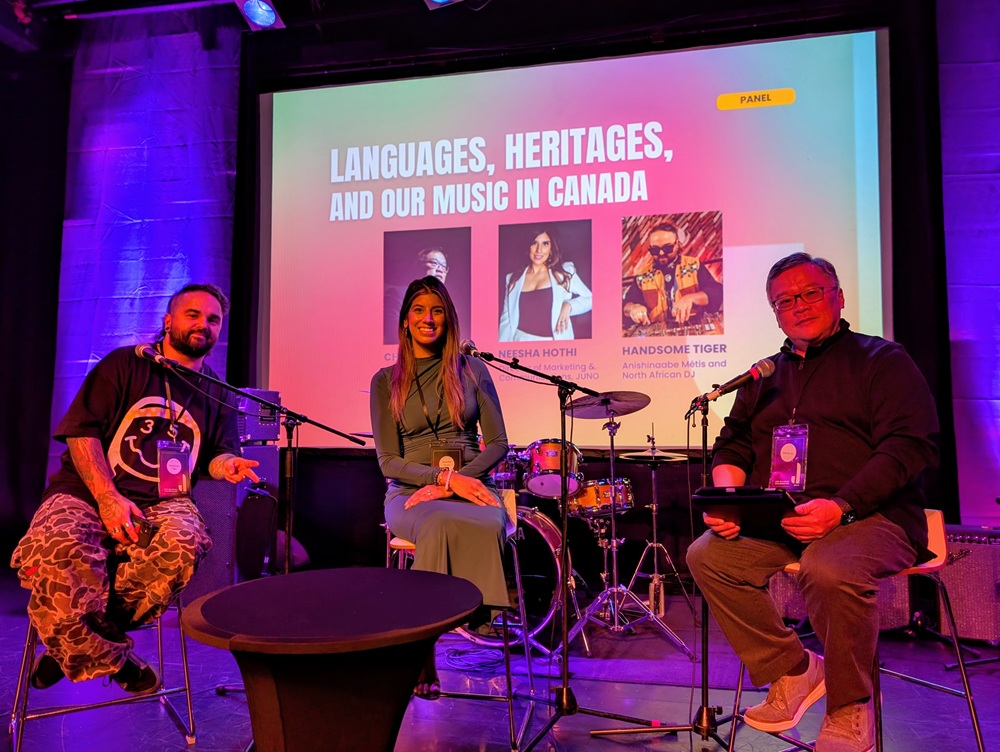
The mainstream music community must stop looking at Canadian pop and hip-hop in minority languages as a silo separate from the rest of the industry. That’s according Neesha Hothi, founder and CEO of Neesh Communications and a leading voice in cultural storytelling.
The Vancouver branding expert maintains that performers in languages other than English and French are indeed part of the totality of Canadian pop culture landscape and fabric—and they should be seen as such.
“We can’t speak about Canada and our multicultural population and the melting pot that we are, then still say that all of our music needs to be English-language music,” Hothi told a Jade Music Fest audience. “I think where some of the misconceptions come in is the understanding that it all still needs to be the default language for the default audience.”
Hothi, who has Punjabi ancestry, noted that it’s often harder for “in-language or in-culture artists”. That’s because they don’t have the “default audience” for many cultural spaces. As a result, Hothi feels that these artists are sometimes sidelined because their fans aren’t deemed to have as much weight or value as the venue’s traditional audience.
“Small venues are disappearing; stages are disappearing—I recognize those things,” Hothi acknowledged. “Equally, we need to have equitable opportunities for ethnic in-language artists to have spaces and stages. Because otherwise, we’re not providing opportunities for local artists—because they are as Canadian as your English-language artists—to grow and to become everything that they can become.”
She quickly added that if this cultural infrastructure doesn’t exist, multilingual artists will continue leaving Canada for other countries where they will become stars.
Hothi made her comments at a November 5 panel discussion at Granville Island’s Revue Theatre called “Languages, Heritages, and Our Music in Canada”. It was moderated Charlie Wu of the Society of We Are Canadians Too, which launched the Jade Music Fest in 2022 to advance appreciation for contemporary Chinese-language music in Canada.
Listen to Handsome Tiger’s Baile Dub.
Indigenous artists achieve cultural breakthroughs
Hothi’s fellow panelist was Anishinaabe Métis and North African music producer/DJ Handsome Tiger. The Vancouver-based artist described injecting his cultural language into his music as “a step towards reclamation and being proud of who we are”.
“I have a quote that I wanted to share by Louis Riel,” Handsome Tiger stated. “He said that my people will sleep for 100 years. But when they awake, it will be the artists that give them their spirit back.”
Handsome Tiger performs electronic powwow and global club music ranging from gqom from South Africa to baile from Brazil to soca and jabjab from the Caribbean. He marries this music with traditional sounds from his cultures dating back thousands of years.
“There is a responsibility in getting to use that in my music,” Handsome Tiger emphasized.
At the Jade Music Fest, Hothi and Handsome Tiger both discussed how Indigenous artists have made major breakthroughs at the Juno Awards. This year, for example, Snotty Nose Rez Kids won a Juno for Rap Album/EP of the Year for Red Future. It was not in the Indigenous category.
Back in 2024, the Cree-Oji artist Aysanabee won the Juno for Songwriter of the Year and Alternative Album of the Year following the release of Here and Now. This marked the first time that an Indigenous artist had won Junos in these categories.
Handsome Tiger noted that as he was growing up as a mixed-race Indigenous kid, he didn’t see famous Native and North African people on-stage.
“If we don’t have the seat at the table, there’s no representation,” Handsome Tiger emphasized. “It’s hard for a young artist to see themselves as someone else on-stage that they can receive those accolades if you don’t have someone to look up to who looks like you or has a similar culture to you.”
Watch Snotty Noze Rez Kids and Tia Wood at the 2025 Junos in Vancouver.
Junos evolve with greater awareness
Hothi was director of marketing for the Vancouver Junos Committee in 2018 and 2025. She described Snotty Nose Rez Kids’ performance on the Juno stage with Tia Wood in 2025 as the best representation of urban Indigeneity that she has ever seen. She attributed this in part to the spectacular costumes by Vancouver designer Jason Pillay.
“The genuine representation of not only the artistry but the community was so incredible,” Hothi declared. “That was just a standout moment for me.”
At this year’s Junos, Hothi was also thrilled to see three artists of Punjabi ancestry—Jazzy B, Chani Nattan, and Inderpal Moga—perform live in Vancouver.
This was not the first time that Punjabi artists had appeared on the Juno stage. Back in 2009, comedian Russell Peters hosted the Junos at Rogers Arena, appearing alongside with bhangra dancers and dohl players from the South Asian Arts Society.
However, this time the representation was far more contemporary.
“The urbanness of these performances was just bang-on for today’s day and age,” Hothi said.
Punjabi artists Jazzy B, Inderpal Moga, and Chani Nattan brought an urban feel to the Junos.
Advice for artists performing in other languages
Handsome Tiger and Hothi each offered guidance for artists at the Revue Theatre, including several who perform in Chinese languages.
Handsome Tiger pointed out that there are more opportunities for Indigenous artists because Canadians are now more curious about Indigenous culture. Therefore, it can be advantageous for these artists to fuse their culture with their music.
“It’s just a very important time,” Handsome Tiger stated. “I feel like all of us have always been ready for it.”
Hothi advised musicians who look at what’s available from a funding perspective, highlighting the work of organizations such as Creative BC, Music BC, and FACTOR. She said that it’s critical to understand what’s available, including funding for gigs or conferences in other countries.
“We have to learn the systems to also operate within the system.”
Furthermore, Hothi encouraged artists who perform in languages other than English to network with people in the Canadian music community as they still think about reaching global audiences.
At the same time, she emphasized that she wasn’t suggesting that musicians had to go mainstream or become like white performers in order to do this.
“You cannot win an award you did not submit to,” Hothi stated. “You cannot be a judge for an organization that you did not apply to. This is where we have to be our own advocates.”
To learn more about the Jade Music Fest, visit the website or follow the festival on Instagram @jademusicfest. Follow Pancouver on X @PancouverMedia and Instagram @PancouverMedia.




