

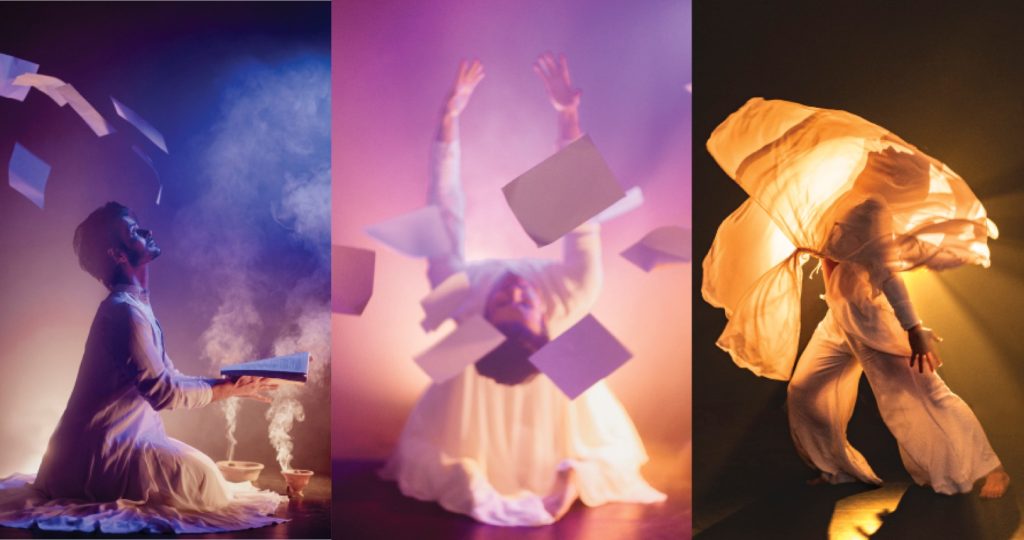
In a world rife with religious communalism and racial silos, Indian classical dancer and choreographer Gaurav Bhatti wants to remind us of our common humanity. In his new full-length Kathak dance piece, Bulleh Shah: Seeker of Light, he draws inspiration from an 18th-century Sufi poet from Punjab.
In 1680, Bulleh Shah was born as Sayyid Abdullāh Shāh Qādrī in what is now Pakistan’s province of Punjab. He gained fame as the “Poet of the People” for speaking out against powerful institutions. He also rejected divisions based on identity.
“His name was so important in the title,” Bhatti tells Pancouver over Zoom. “He was named ‘Seeker of Light’ because his teachings were about unity and love and oneness. We are all one and everybody should love each other. And he believed in that.”
The Dance Centre and New Works will co-present the world premiere of Bulleh Shah: Seeker of Light on Friday (March 28) and Saturday (March 29) at Scotiabank Dance Centre. Bhatti’s work is part of the Dance Centre’s Global Dance Connections Series.
According to Bhatti, Bulleh Shah: Seeker of Light incorporates influences from different Indian classical dance and contemporary styles. However, it’s not a fusion piece. Kathak dancers tell stories through hand movements—known as mudras—as well as footwork (tatkar), and spins (chakkars). Facial gestures are critically important, expressing wonder, humour, love, repulsion, fear, anger, pride, sympathy, and peace.
For Bhatti, it’s imperative to build narratives on top of the poetry through Kathak’s movement vocabulary, which differs from Bharatanatyam. While both Indian classical dances utilize mudras in storytelling, Bhatti says that they’re not as extensive in Kathak. This artform features more intricate footwork and spins.
“It’s not just about the movement,” Bhatti insists. “It’s about the intention behind it.”
Watch the trailer for Gaurav Bhatti’s new work.
Bhatti promotes unity through dance
He began thinking about his piece in 2017. Over the years, Bhatti has enjoyed residency support from the Dance Centre as well as from companies in the United Kingdom (Dance City and Aakash Odedra) and India (Shed 9, Aditi Mangaldas–Drishtikon Dance Foundation).
“It’s a universal story,” Bhatti says. “It’s about love and bringing peace and everyone together, ultimately. We are all here for a very, very short period of time. We should all come together and celebrate and dance.”
Whereas Bulleh Shah was a Muslim from what is now Pakistan, Bhatti hails from the village of Bidhipur in Indian Punjab. Bhatti says that he grew up in a liberal family with a grandfather who believed that God is in everything. Moreover, he notes that the concept of seva (selfless service) imbues all major faiths in Punjab.
“We were never forced to follow a particular religion,” Bhatti reveals. “I remember going to a church. I remember going to a masjid. I remember going to a Hindu temple as well.”
As a child, he loved to dance, often inspired by Bollywood movies. It wasn’t until Bhatti immigrated to Canada that he became enamoured with Kathak.
One of his gurus was Saveeta Sharma, artistic director of Ottawa-based Upasana The Spirit of Dance. He trained with her for about three years, reconnecting with his culture and learning very quickly. Then, he travelled to Mumbai where he studied Kathak under Lata Batalkar, founder and director of the Aditi Nrityalay dance institute. At a workshop in Liverpool, Bhatti met another guru, Aditi Mangaldas, who mentored him on his new dance piece.
Solo show with original music
In his interview with Pancouver, he rattles off several other top Kathak artists whose works have influenced his artistry. They include Birju Maharaj, who specialized in the Lucknow Gharana, along with his father, Acchan Maharaj. Bhatti also cites Fasih Ur Rehman and his guru, Maharaj Ghulam Hussain Kathak. Rehman grew up in Lahore, where Kathak is known for its extreme bending.
“There is a lot of relationships in terms of styles and lineages,” Bhatti explains. “It’s about unity to me… So, I follow everything. I dance what I love.”
Bulleh Shah: Seeker of Light is a solo show, but many people off-stage helped bring it to light. Ryan Stafford oversees lighting, with Manish Kansara designing the set. Muhammad Alamgir served as costume designer, and Saatvic assisted Bhjatti as dramaturg.
Meanwhile, Rushil Ranjan and Max Guthrie composed and arranged original music, which is recorded. The musicians— Sami Ullah Khan, Faraz Ahmed and Harman Singh (vocals); Mohit Gangani (tabla); Ashish Gangani (pakhawaj); Amir Ahmed (saarangi); Bhanu Sisodia (dhaama); and Sunny Shishodiya (padhant)—are all in India.
Bhatti emphasizes that his Bulleh Shah project is not only about dance. It’s also about creating unity. And he hopes that members of the Punjabi diaspora will attend his show. That’s because Bulleh Shah: Seeker of Light will offer an opportunity to experience Indian classical dance rooted in Punjabi as opposed to the more commonly presented Hindi- or Sanskrit-based works.
“It gives them a chance to see something other than what they see on TV,” Bhatti states.
Event details
The Dance Centre and New Works will present the world premiere of Bulleh Shah: Seeker of Light at 8 p.m. on Friday (March 28) and Saturday (March 29) at the Scotiabank Dance Centre (677 Davie Street). For tickets and more information, visit the New Works website or the Dance Centre website. Find Gaurav Bhatti on Instagram @gaurav_ss_bhatti/ and on Facebook.
Follow Pancouver on X @PancouverMedia and Bluesky @pancouver.bsky.social. Pancouver is also on Instagram @PancouverMedia. In addition, follow Charlie Smith on Bluesky @charliesmithvcr.bsky.social.




