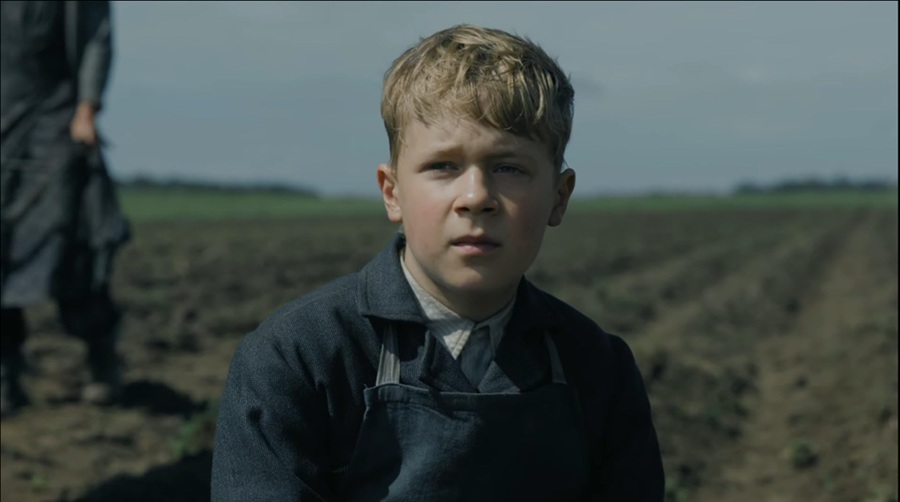
The light glint of the grey-blue water bathes the dunes, mudflats, and tall, sand-coloured grass of a Frisian Island called Amrum near the northernmost point of Germany. Cinematographer Karl Walter Lindenlaub presents us with a wealth of beauty in the film titled Amrum, named after the island itself. The vastness alone gives the coming-of-age drama an epic quality. We see wide, sweeping shots that capture the island’s lyrical landscape with an astonishing splendour, so visually tranquil that it almost seems to contradict the historical period depicted in the film.
The VIFF Centre will screen Amrum from May 15 to 19 and again on May 21 and 28.
Amrum is quite a shift for acclaimed Turkish German film director Fatih Akin in terms of style and tone. Whereas some of his earlier works—Head-On (2004), The Edge of Heaven (2007), and In the Fade (2017)—relied on fast-paced urban grit, Amrum draws instead on a neorealist style that is more classical, observational, and naturalistic.
Could the film differ from Akin’s earlier work because it’s not strictly his own? In the opening credits, it is introduced as A Hark Bohm film by Fatih Akin, a framing that signals the true authorship and perhaps Akin’s way of honouring his beloved mentor. The film draws on the childhood memories of Hark Bohm, who co-wrote the screenplay with Fatih Akin and who collaborated with him on several previous projects. He sadly passed away last November, but thankfully, the film premiered at Cannes in May 2025 and was shown in Germany prior to his death.
Amrum centres on Nanning (a strong feature debut for first-time actor Jasper Billerback), a 12-year-old boy and a member of Hitler Youth. When his mother (Laura Tonke) falls into postpartum depression deepened by the death of her Fuhrer, Hitler, she refuses to eat. The boy sets out to lift her spirits by procuring the only things she craves: honey, white bread and butter. What seems like an easy task turns into a fable-like quest. The boy undergoes a series of ordeals as he is forced to navigate bullies, treacherous tides, and mudflats to obtain the highly coveted food for his mom.
Both Bohm and Akin are blunt and honest in how they approach the subject matter. They make Nanning move through a world he cannot fully understand, taking in its rhythms without totally grasping its meaning, as many children do. The boy is confronted by difficult truths about his staunchly Nazi family, forcing him to reckon with both the cruelty of the Nazi Reich and his family’s allegiance to it. While his parents remain deeply entrenched in Nazi ideology, the boy also meets villagers who stand in quiet opposition to the regime at first and later grow more vocal as we watch them take down swastika flags in the final days of the war.
Nanning struggles to reconcile these conflicting ideologies. When the boy loses his innocence along the way and breaks away from indoctrination, the film does not push that in our face in a preachy way. We get it. We even find ourselves sympathizing with those, like Nanning, entangled in a fascist world without agreeing to the ideology.
What stands out alongside the cinematography is the strength of the child-led cast. The performances are simple and effortless. There is an unpolished quality to the acting, which works in the film’s favour in supporting its neorealist nature. The lead actor, Billerback, is often described as “the emotional engine of the film”, but the other child actors, especially Kian Köppke (Hermann), are also impressive. Köppke plays Nanning’s best friend and provides a crucial character in contrast with Nanning’s reserved nature. The wonderful Diane Kruger, a regular in Farih Akin’s films, has a minor but significant role as a rebellious, anti-Nazi potato farmer.
The music was composed by Stefan “Hainbach” Götsch and produced in a very unusual way. In one of his YouTube videos, Hainbach reveals the great lengths he went to in composing the film’s original score using a wind harp, which was placed near the sea. This stringed instrument is played entirely by the wind, adding a quiet tension as the boy traverses the harsh terrain.
Many films like this one explore the psychological toll and moral compromises experienced by German citizens during the Second World War, though some critics argue that such portrayals overshadow the suffering of Jewish people during the Holocaust. However, Antrum avoids this by creating a subplot involving an uncle who was ostracized because of his relationship with a Jewish woman. This part marks a turning point, prompting the protagonist realign his ideological loyalties.
There have been countless Second World War films and many about the Holocaust, but we still need works as powerful as Jonathan Glazer’s The Zone of Interest and Akin’s Amrum. While these two compelling films employ very different cinematic languages, (one through chilling detachment, the latter through a coming-of-age lens), they both avoid didacticism and moralizing. Through these works, we focus instead on the nuanced and complex human existence.
Films of this nature are pressing today because they shed light on the persistence of fascist ascent in the world around us. They remind us of the importance of recognizing and resisting these ideologies before they take deeper hold.
What did Sophie Scholl an anti-Nazi activist say before she was guillotined at the age of 21? “The sun still shines! Such a fine, sunny day, and I have to go… What does my death matter, if through us, thousands are awakened and stirred to action?”
No activist should have to die in opposition to fascism and genocide. Let’s hope these films speak for those voices and keep the urgency alive.
The VIFF Centre will screen Amrum from Friday (May 15) to Tuesday (May 19), with additional screenings on May 21 and 28. For tickets and showtimes, visit the VIFF Centre website.
Nural Sümbültepe is a B.C. teacher. Follow Pancouver on Instagram @PancouverMedia, on X @PancouverMedia, and on Bluesky @pancouver.bsky.social.