When Ken Hsieh jumps on a Zoom call with Pancouver, he’s eager to talk about the Vancouver Metropolitan Orchestra’s 2024-25 season. But Hsieh, the orchestra’s music director and an award-winning conductor, is also willing to expand on other issues. This results in a delightful 45-minute interview touching upon everything from his changing interpretations of Brahms and Beethoven symphonies to shattering stereotypes about people of Chinese ancestry.
The Edmonton-born maestro says that there are perceptions that people with Chinese ancestry often become doctors, accountants, or engineers. But Hsieh, whose parents are from Taiwan, never fit into this mold.
“Look at me!” the conductor says with a laugh. “I suck at math. I don’t do anything well in terms of drawing, and I don’t have an affinity for bubble tea.”
But Hsieh is highly skilled at directing the simultaneous performance of an ensemble of classical musicians. It explains why he has been invited to conduct orchestras in many cities in China, Taiwan, and Japan, as well as across Canada.
As he enters his 22nd season leading the Vancouver Metropolitan Orchestra, Hsieh says that it’s not getting any easier. As time marches on, he unravels more aspects to musical pieces, such as German composer Robert Schumann’s Symphony No. 4, Op. 90 in D minor. And this spurs him to develop new interpretations.
“I’ve conducted it in Vancouver; I conducted it with the Montreal Symphony; I conducted it in China with the Suzhou Symphony and in Japan,” Hsieh says. “And now, I’m coming back to this piece after doing it for 12 years—it’s so difficult. I’m discovering more things.”
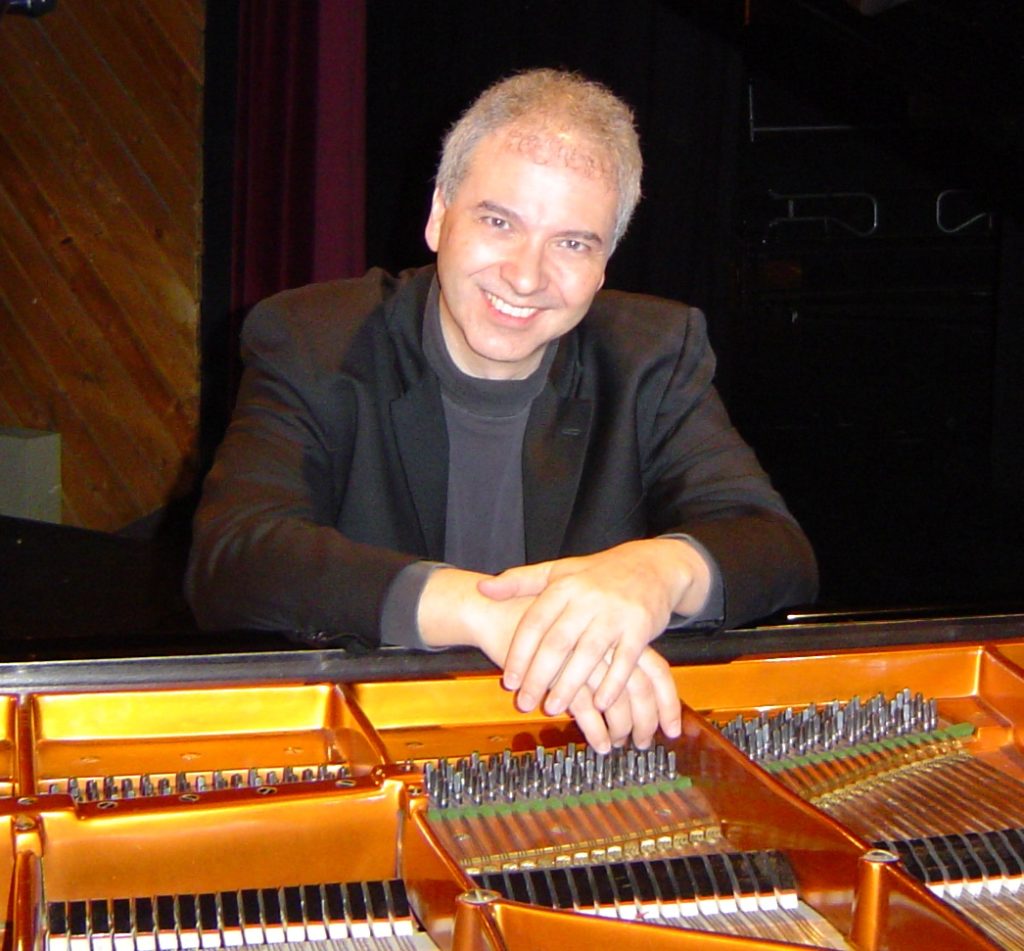
Hsieh welcomes pianist Stéphane Lemelin
The Vancouver Metropolitan Orchestra will perform this energetic Schumann symphony at its season opener at the Orpheum Theatre on Friday (September 6). That will be followed by piano soloist Stéphane Lemelin performing another difficult piece, German composer Johannes Brahms’s Piano Concerto No. 2.
Hsieh met Lemelin, director of McGill University’s Schulich School of Music, when he was one of Lemelin’s students at the University of Alberta. Hsieh describes his former instructor as “one of the most knowledgeable guys I have ever met in my life”, as well as a “wonderful pianist”.
“I really am so excited for this coming 2024-25 season because I think it is probably one of our biggest seasons yet.”
That’s saying something, considering that over the past two years, the Vancouver Metropolitan Orchestra’s lineups have included renowned Korean-born flautist Jasmine Choi, UBC School of Music associate professor and piano soloist David Fung, and Japanese classical pianists Ikuyo Nakamichi and Hayato Sumino, a.k.a. Cateen.
This season, Hsieh will relish the return of Ryan Wang, a teenage piano soloist from Vancouver who previously played as a guest soloist for the Vancouver Metropolitan Orchestra. In 2013, Wang gained international fame as a five-year-old performing Variations on a Russian Theme on The Ellen DeGeneres Show.
“This kid is already making waves in Europe, especially where he’s studying in London,” Hsieh says. “But he’s performing in Paris; he’s performing in Poland—you just name it. So, what we wanted to do was give him an opportunity to perform the Chopin piano concerto before he goes into the competition next year.”
Another highlight will be renowned pianist Robert Silverman, who will perform with the Vancouver Back Choir in February.
“Not only that, we’re doing the Carmina Burana In the second half, which I think is a piece that everybody would enjoy,” Hsieh reveals.
High regard for Japanese musicians
He has a strong connection to this mid-1930s cantata by Carl Orff, which is based on 24 medieval poems. Hsieh recalls performing it on percussion in Powell River and with the Vancouver Youth Symphony. He confesses that he’s slightly terrified over the prospect of conducting Carmina Burana, but he’s also looking forward to it.
In April, the Vancouver Metropolitan Orchestra will feature New York–based solo violinist Eugenia Choi, who used to be a member of UBC’s music faculty. In recent years, she has performed with orchestras on four continents.
“She will be coming to perform Piazzolla’s Four Seasons, which I think is a phenomenal piece,” Hsieh says. “Then, we will end our season with a very, very distinguished up-and-coming violinist.”
Without revealing the name, Hsieh discloses that this musician is making waves in Japan on this instrument in the same way that Cateen has done on the piano.
Hsieh holds many Japanese musicians in very high regard. After graduating from the Royal Conservatory of Music and UBC, he completed post-graduate studies in orchestral conducting at two top Japanese academies: the Toho Gakuen School of Music and Senzoku College of Music.
He recalls playing Camina Burana under Japanese conductor Kazuyoshi Akiyama, who studied at the Toho school.
“You know, at that time I didn’t really watch the conductor too much, to be honest,” Hsieh says. “But what I really appreciated was that Akiyama was so clear…in his beat that anybody can follow it. If you had an orchestra full of monkeys, they could follow him without any problem.”
He thinks Japanese conductors succeed due to their analytical approach. That embeds consistency in rehearsals, performance, and how musical ideas are presented.
“It was really what I needed at the time,” Hsieh states.
Watch Pancouver editor Charlie Smith’s wide-ranging interview with Ken Hsieh.
Sapporo festival transforms Hsieh
He ended up as a conductor after injuring two fingers playing handball, which made it more difficult to perform on the piano. Hsieh was around 19 years old. Later at a festival in Quebec, a Japanese woman suggested that he take up conducting because she didn’t think he would make it as a pianist.
That, in turn, prompted Hsieh to watch 20 or 30 videos to learn what conductors do. He figured out that through body movements, conductors elicit sound from other human beings.
“It’s fascinating because I make no sound,” Hsieh says. “But the orchestra, essentially, is my instrument, right? But I don’t have total control.”
He likens conducting to being a psychologist. He needs to be good at reading minds and feeling the mood to get the best out of the musicians.
A major turning point came when he was hired as an assistant conductor at the Pacific Music Festival in Sapporo, Japan. The great Leonard Bernstein created this event to help younger conductors gain experience working with masters from around the world.
“I was 22 years old at that time, and I remember assisting all these great conductors,” Hsieh says.
He learned how really superb conductors could present an outstanding concert on very short notice. Hsieh later decided that Metro Vancouver needed a symphony orchestra that could offer similar mentorship, which led him to create the orchestra.
“We’re still keeping our mandate, which is to bring opportunities for the young ones, because the young ones come and they perform,” Hsieh notes. “And they gain their experience. Then, when they apply to the Vancouver Symphony or the Winnipeg Symphony, they have a better chance of succeeding in an audition.”

Humble beginnings in Edmonton
It’s been a remarkable journey for Hsieh, who began playing piano at a very young age at the urging of his mother. In his youth, he also learned the violin and percussion.
“It was actually a joy,” he comments. “Piano, I found, was a little bit too lonely because you’re always by yourself practising. But when you make music as a violinist or as a percussionist, it’s actually quite fun.”
That’s because violinists and percussionists are more likely to perform with others. Now, many years later, Hsieh remains amazed over how he can click with certain people anywhere in the world because they understand how to play music together.
According to Hsieh, there were only four Taiwanese families in Edmonton when he was a kid. His father was an engineer who was attracted to Alberta to work in the oil industry. As a result, Hsieh became heavily assimilated in the broader community, which included many people of Ukrainian ancestry.
Later when he studied in Japan, he was often mistaken for being either Chinese or American. In fact, Taiwan has deep connections to Japan as a result of 50 years of Japanese colonization from 1895 to 1945. Hsieh says that many Taiwanese people appreciate some of the things that came from Japan, including western art and railways. This is particularly so after living through the iron-fisted rule of China’s former Nationalist leader Chiang Kai-shek in the decades following the Second World War.

Going beyond “Chinese”
Nowadays, Hsieh thinks the word “Chinese” is a very broad term that has different meanings for many people. It can refer a language, ethnicity, nationality or race.
“If you talk to anybody from Hong Kong, for example, they will say, ‘Yes, I’m Chinese, but I am a Hong Kong Chinese,’ ” Hsieh states. “And then, I’m sure if you talk to certain people who are living in the very western part of China who are maybe of Muslim descent, they still call themselves Chinese. But they are the Chinese Muslims.”
Similarly, he adds that people of Chinese ancestry from Malaysia might describe themselves as Chinese Malay.
“The word ‘Chinese’ is very similar to the word English. and I tell you why: because when you go to London, you know you’re speaking English,” Hsieh points out. “When you go to America, you’re speaking English; when you go to Canada, you’re speaking English; when you go to Australia, you’re speaking English.”
However, all these English-speaking people are not described as English people—they have their separate national identities as Australian, Canadian, American, et cetera. Moreover, Hsieh points out that there are people with Chinese ancestry in many other countries, such as India, where they embrace their national identity. Hence, the confusion over the word Chinese.
“The misconception right now is that it’s really been associated with mainland China,” Hsieh says.
Moreover, he acknowledges that there was a lot of history of Chinese people in China going back through various dynasties.
“The problem is that, say there is a particular Chinese ethnic group that does something the rest of the world doesn’t agree with,” Hsieh states. “Then, the rest of us all get blamed for it, too.”
Not all English speakers are “British”
On the flip side, even within China, Hsieh has observed tremendous cultural differences between regions. Beijing differs from Shanghai, which differs from Sichuan. Each has its own regional cuisine and there are many regional languages.
“For example, I go to Chengdu in Sichuan a lot,” he says. “The food is just so incredibly spicy.”
According to Hsieh, the southern Chinese city of Kunming has a bit of a hippie vibe.
Taiwan, on the other hand, has had a huge influx of people over the centuries from Fujian Province, which is on the east coast of China.
“It’s quite fascinating that you see the language and the food and the way people speak and people act,” he relates. “It’s very similar to a lot of the Taiwanese people. I’m not saying all of them.”
In Hsieh’s mind, he would ever call an English speaker “British” if he were born in Canada. But he also says that sometimes, there is a reason why stereotypes emerge, such as the belief that Singapore is an uptight place where things get done in contrast to the more chaotic Malaysia.
“We are all essentially human beings, but we’re all brought up differently,” Hsieh emphasizes.
The Vancouver Metropolitan Orchestra will perform with piano soloist Stéphane Lemelin at the Orpheum Theatre on Friday (September 6). For tickets and more information, visit the orchestra’s website. Follow Pancouver on X (formerly Twitter) @PancouverMedia and on Instagram @PancouverMedia.
This article is part of “Beyond Chinese”, a joint initiative of Pancouver and the Asian-Canadian Special Events Association. Through interviews with artists and cultural workers, Beyond Chinese offers a nuanced view of people with Chinese ancestry. Pancouver and the Asian-Canadian Special Events Association gratefully acknowledge the support of Canadian Heritage.