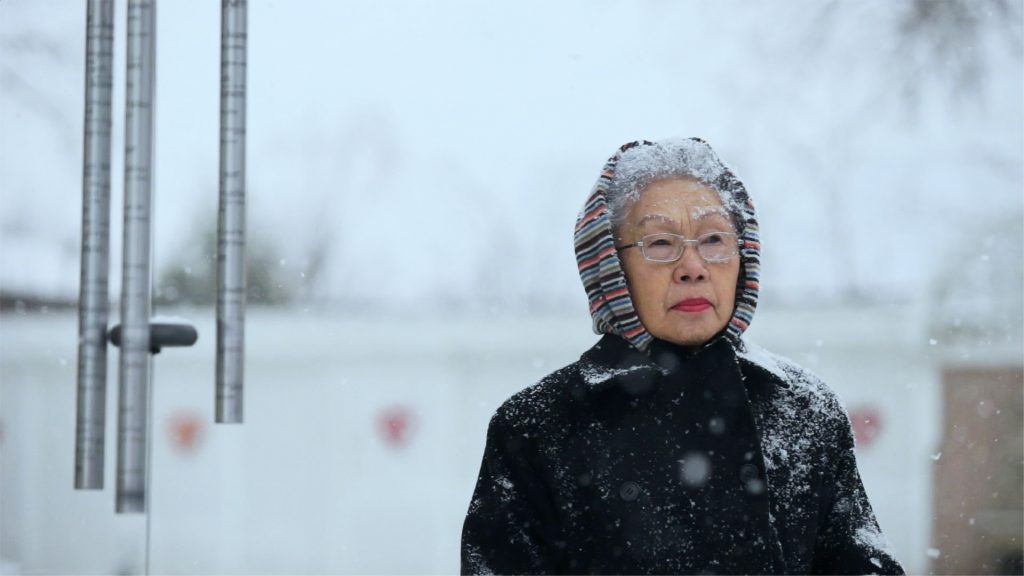
Mama Yang is the type of character one might encounter in a Dostoyevsky novel. Like Prince Lev Nikolayevich Myshkin in The Idiot, Yang represents the Christian ideal of loving thy neighbour. Only in this case, Yang is not fictional. She’s an aging immigrant widow living in New York in Taiwanese director Ching Hui Lee’s sensitive documentary, Come Home, My Child 愛子歸來.
At the outset, Mama Yang is working as the energetic, 86-year-old director general of Boon Christian Broadcasting Centre. She diligently mails handwritten letters to Chinese prison inmates serving exceedingly long sentences in New York state, sometimes after being enmeshed in people-smuggling enterprises.
With a saintly spirit, Mama Yang encourages them to improve themselves and not lose hope for a reunion with their families. In return, these inmates spill stories of how they came to America with such high hopes, only to wind up behind bars. Moreover, they express their deepest appreciation to Mama Yang for providing them with such a precious human connection.
“I feel like a lost lamb,” writes Yang Hao Lu in one exchange. “I’m hoping for some advice from you. With endless gratitude.”
He’s doing 75 years to life after being imprisoned for kidnapping in 1996.
Yang meticulously places each inmate’s letter in a filing cabinet. She’s documenting the lives of those whose very existence has all but been snuffed out by the state. Along the way, Mama Yang befriends the heartbroken mother of one inmate, Haiguang Zheng.

Mama Yang inspires
Meanwhile, in phone calls from prison, inmates share how much they treasure Mama Yang’s letters. Yet as she develops bonds with them, she still has difficulty communicating with her own granddaughter.
The film’s director, Lee, reinforces how cold the inmates’ lives have become by laying their voices over bleak scenes of winter. Multiple exteriors of their penal institutions, including a sinister prison watch tower, offer another frigid reminder.
As Donald Trump storms back into the White House and plans mass deportations, Come Home, My Child 愛子歸來 delivers deep insights into what could be in store for undocumented migrants yearning to breathe free in America. The director, Lee, spent 10 years filming her masterpiece, which shouts its rage at mass imprisonment.
Yet in response to her own difficult family history, Mama Yang’s resilience and service to others offer an inspirational message.
“I believe out of sorrow, oftentimes we’ve learned to help others because we realize how painful it’s been for us,” fellow humanitarian Barbara Hust says in a revealing moment in the film.
In these troubled times, what the world needs now is love. Good old-fashioned Christian love, like that embodied by the astonishing Mama Yang.
Watch the trailer above.
Event details
LNY Splash, the Society of We Are Canadians Too, the Victoria Taiwanese Association, and the Victoria Film Festival will co-present Come Home, My Child 愛子歸來 at 7:30 p.m. on February 1 at the VIC Theatre (808 Douglas Street) in Victoria. Purchase tickets, on the Victoria Film Festival website.
In Vancouver, LNY Splash and VIFF will co-present Come Home, My Child 愛子歸來 at 5 p.m. on February 9 at the VIFF Centre. Purchase tickets on the VIFF website. The film includes English and Traditional Chinese subtitles.
For more information about films in the Lunar New Year series, visit the LNY Splash website. Follow Pancouver on X @PancouverMedia, Bluesky @pancouver.bsky.social, and Instagram @PancouverMedia. Follow Charlie Smith on Bluesky @charliesmithvcr.bsky.social.