
The seventh edition of a contemporary dance festival by Indigenous women artists begins live performances at 7 p.m. on Wednesday (February 19). The Matriarchs Uprising double bill at Scotiabank Dance Centre will feature Raven Spirit Dance’s Tracing Bones and Friday Creeations’ Bawaajgun: Visions IN Dreams.
Raven Spirit Dance’s co-artistic directors, Michelle Olson and Starr Muranko, strive to share stories from an Indigenous worldview through contemporary dance.
“What memories do we hold onto, what do we tuck away and what do we allow to transform over time as we call our future selves into being?” the company says of its show. “Tracing bones, rooting stories, casting dreams…Remembering our sovereign song.”
https://vimeo.com/1046862439
Friday Creeations is led by artistic director Christine Friday, an Anishinaabe Kwe storyteller who combines traditional and contemporary dance elements. She has more than 30 years’ experience as a dance artist. Bawaajgun: Visions IN Dreams is an excerpt of the company’s Firewater Thunderbird Rising show.
Olivia C. Davies, managing artistic director of O.Dela Arts, created Matriarchs Uprising and curated this year’s festival.
https://vimeo.com/1046850036
Meanwhile, on Thursday (February 20), there’s another double bill starting at 7 p.m. at Scotiabank Dance Centre. Ktunaxa-Scottish artist Samantha Sutherland’s naŧa derives its name from a grammar device in the Ktunaxa language. She is an artistic associate with O.Dela Arts, former guest artist with Ballet BC, and former associate artist with Red Sky Performance.
“This piece follows four characters representing four branches of one soul,” the Matriarchs Uprising website states. “How does our environment and the people we are around, shift our behaviours and self-presentation? What occurs when the four branches intersect? This ensemble work seeks to unravel the intricacies and multiplicities of identity within each one of us.”
Matriarchs Uprising features Dow and Kramer
Also on Thursday will be Sophie Dow’s all roads lead home 3.0. Dow, who has Michif / Assiniboine and French / Ukrainian heritage, is an artistic associate of O.Dela Arts. In addition, she is an artistic associate with Chimera Project Dance Theatre and Compagnie V’ni Dasi / Louis Riel Métis Dancers.
“Nine days away from her thirtieth solar return, Sophie moves through nearly 3 decades of questions, joys and perceptions of her time in this body on this earth,” the Matriarchs Uprising website notes. “Dancing through and with the circus of life, all roads lead home 3.0 is part choreography; part audiography and part filmography — a braided multidisciplinary approach to storytelling as an imprint of the past and a manifesto for that to come.”
https://vimeo.com/1046858315
Next, on Friday (February 21), Lara Kramer’s Gorgeous Tongue will begin at 8 p.m.
“Anchored in this world and orbiting a universe beyond, a lone performer unfolds memories on stage through rhythmic scores,” Kramer’s website states. “For Gorgeous Tongue, Lara Kramer invites Nêhiyaw/Métis dance artist Jeanette Kotowich to embody stories, dreams, and songs that stem from Lara’s Anishinaabe lineage. Entering Kramer’s artistic constellation, Kotowich performs multiple movement sequences to embrace the past and usher in a new world. Gorgeous Tongue is a celebration of Indigenous transmission, transformation, and futurity.”
https://vimeo.com/1030954944
Māori artists will perform
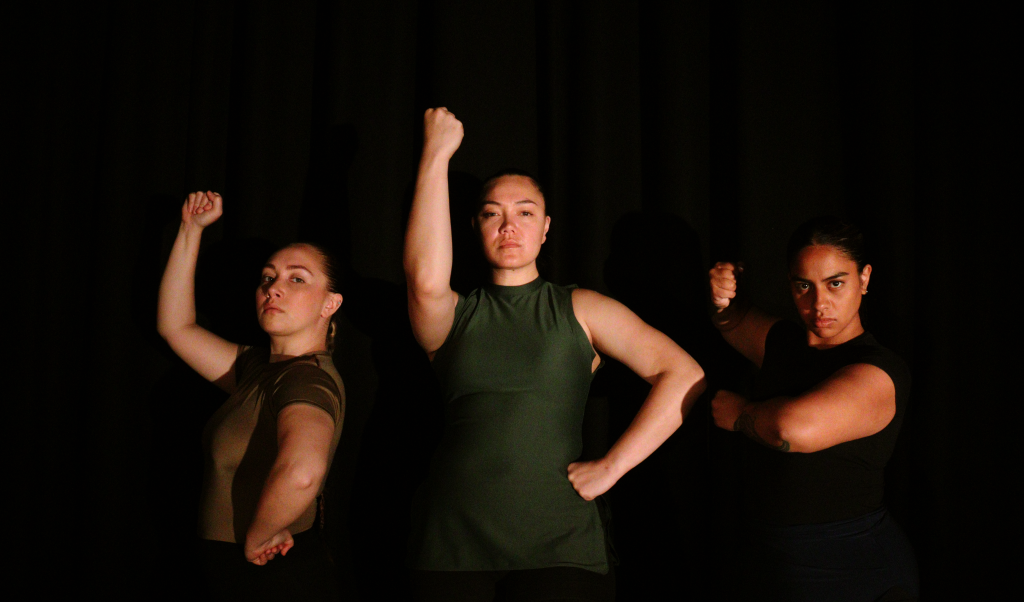
The final live performance, TOA III, begins at 8 p.m. on Saturday (February 22) at the Scotiabank Dance Centre. Three Māori artists— Bella Waru, Fallon Te Paa, and Kaycee Merito—merge contemporary dance with their embodied ancestral knowledge of the Māori martial art known as Mau Rākau. According to the Matriarchs Rising website, TOA III “presents a holistic, authentic & proudly Indigenous image of the modern day ‘warrior’.”
“Mau Rākau as a form is constantly evolving; adapting techniques & approaches with the times,” the website adds. “The form was threatened by New Zealand’s colonisation, outlawed for 60 years under the Tohunga Supression Act of 1907.”
Forty years ago, Māori academic and politician Pita Sharples encouraged the revitalization of Mau Rākau. It was part of a broader initiative to revive the Māori language as well as cultural, spiritual, and ceremonial practices and wisdom.
From February 17 to 22, Matriarchs Uprising is also offering free on-demand videos. with dance artists Jeanette Kotowich, Ngaire Lyden-Elleray, Katina Olsen, Amelia Jean O’Leary, and Kelly Nash, and Raven Spirit Dance.
https://vimeo.com/1030957381
O.Dela Arts will present Matriarchs Uprising in partnership with the Dance Centre, with live performances from February 19 to 22. For tickets, visit the Matriarchs Uprising website. From February 17 to 22, Matriarchs Uprising is also making on-demand videos available at no charge.




