

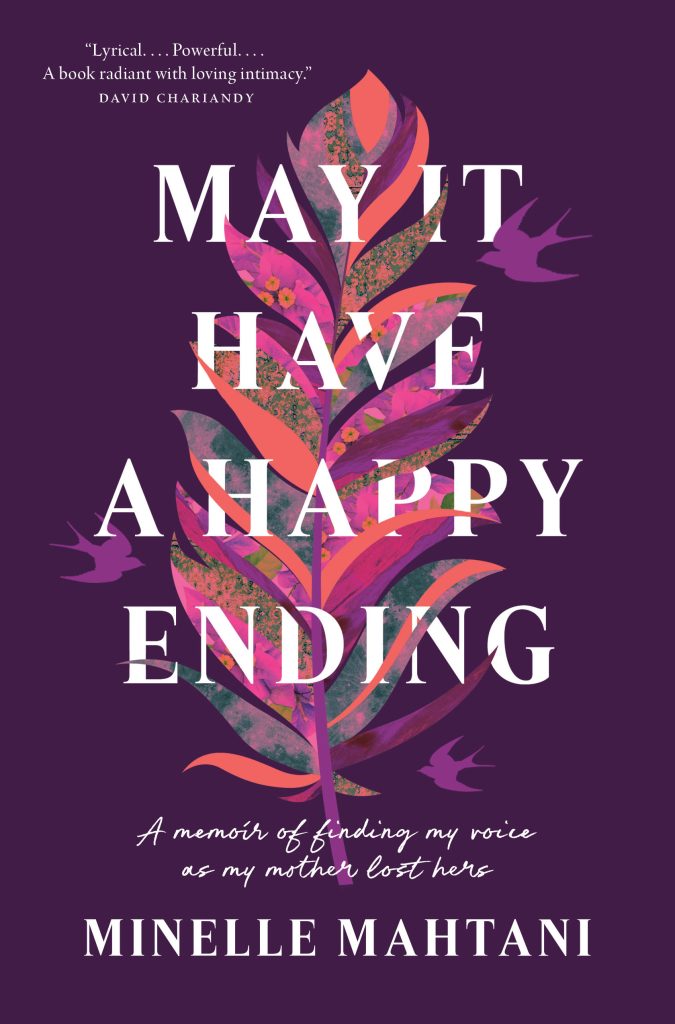
On many occasions, I have felt that book reviews reveal as much about the reviewer as the author. With that in mind, I’m not going to write an extensive evaluation of Minelle Mahtani’s May It Have a Happy Ending: A Memoir of Finding My Voice as My Mother Lost Hers. Mahtani, the head of Canadian Studies at UBC, doesn’t need to have her story filtered through the eyes of a white male journalist whose lived experiences differ so markedly from hers.
I’ll just say this: her book is revelatory, candid, deeply personal, and well-written. It’s not a standard memoir told in chronological order. Rather, Mahtani delivers a non-linear series of vignettes from her life, often redolent with emotion and full of surprises. Anyone born into a mixed-race household will probably identify with Mahtani’s recollections of growing up with a Sindhi Hindu father and a Muslim mother of Iranian ancestry who was raised in West Bengal.
Having worked in public and private radio myself, I wasn’t that interested in sections of the book dealing with the inner workings of a private radio station where she worked. I much preferred reading about her family life, her mother’s struggle, academia, and a disturbing event in London many years ago.
However, I was intrigued by Mahtani’s thought-provoking observations about hosting her Sense of Place talk show. She welcomed and amplified diverse viewpoints, aiming higher intellectually than the norm in radio.
“I had forgotten that sound is always racialized and gendered,” Mahtani writes in her memoir. “I had forgotten that whiteness is simultaneously unmarked. My content was intentionally non-white. But the medium through which I was producing those stories was not.”
Yet Mahtani notes that early in her tenure as a talk-show host, she had been “working so hard at sounding standard—at sounding white—that I sounded like nobody at all.”
It made me think about how Pancouver presents stories on this website.
She also addresses how interviewers—sometimes influenced by the teachings of journalism coach John Sawatsky—play a game of extraction with their subjects. Moreover, Mahtani points out how the process of extraction is “at the heart of colonial practice”.
“We refuse to meet them on their own terms; instead we insist that they meet us on ours,” she writes. “We refuse the risks, dangers, opportunities of egalitarian intimacy.”
Egalitarian intimacy in journalism? Levelling the playing field between the interviewers and their subjects? These are heady ideas well worth embracing in newsrooms across the land.
Minelle Mahtani discusses May It Have a Happy Ending with UBC School of Journalism director Kamal Al-Solaylee.
May It Have a Happy Ending made the Top 10 memoir list of 2024 with Audible Canada. Follow Pancouver on X @PancouverMedia and on Instagram @PancouverMedia. Follow Charlie Smith on Bluesky @charliesmithvcr.bsky.social.




