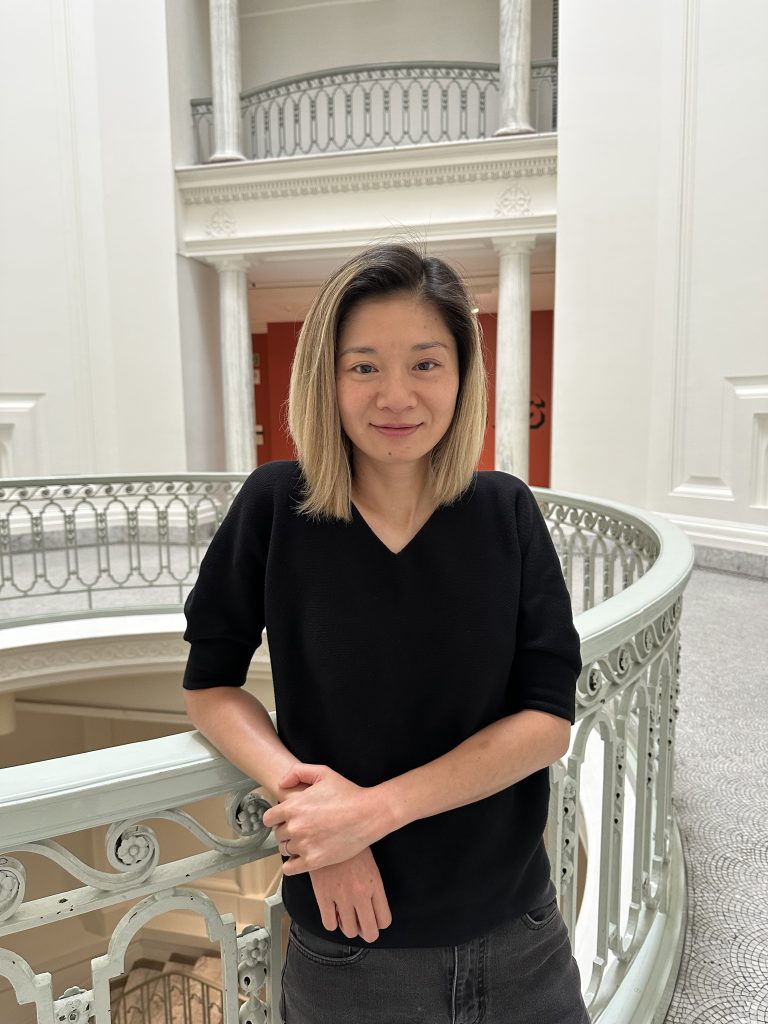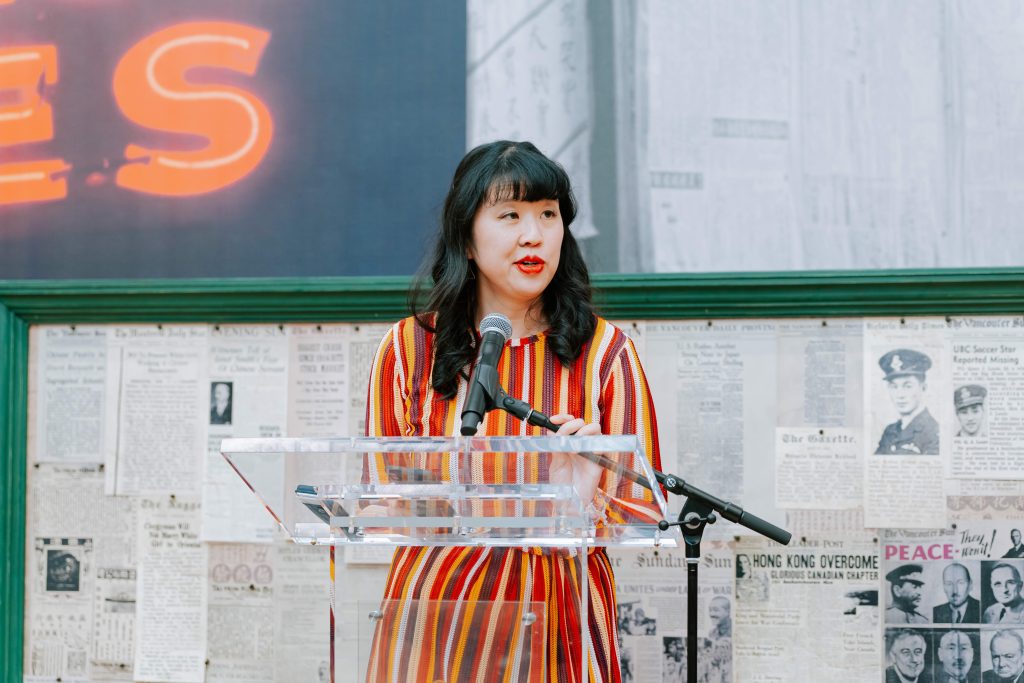
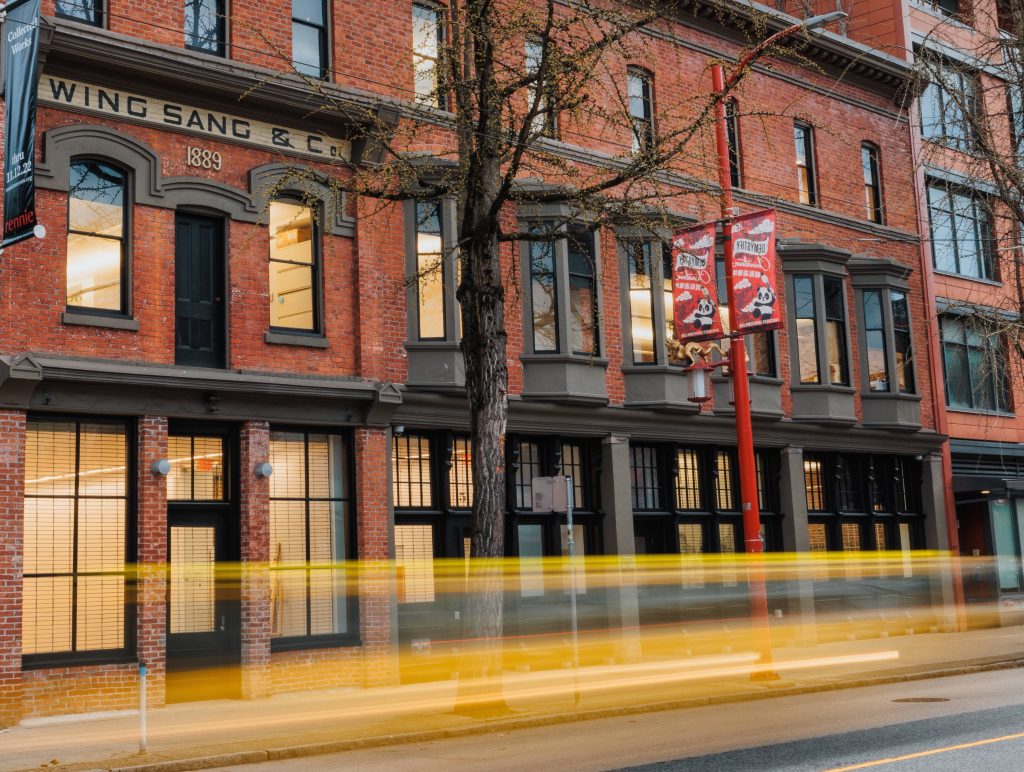
Dr. Melissa Karmen Lee has learned a great deal about the diversity of the Chinese diaspora. Her PhD. dissertation at Lancaster University focused on this topic in the 20th and 21st century through the lens of literature and art. She is also showcasing this diversity in her current position as CEO of the Chinese Canadian Museum. It comes via a crowd-sourced photo wall inside the historic Wing Sang Building in Vancouver’s Chinatown.
“We ask people to submit photos of where they came from—from all different parts of the world,” Lee tells Pancouver over Zoom. “So, we have photos of Chinese Canadians from South Africa and from Vietnam.”
She notes that Canada is also home to many Taiwanese Canadians with Chinese ancestry. There are Canadians with deep roots in the Philippines and the Caribbean who have Chinese ancestry. There are also Indo Canadians of Chinese ancestry, particularly Hakka Chinese, and Canadians of Chinese ancestry from various Southeast Asian countries.
Lee points out that there is also a large population of Chinese Canadians from Mauritius, particularly in Toronto.
“They meet every year in Kitsilano under a big tree and have picnics,” she says.
The CEO then recalls a visit to the museum from Paul Chiang, the member of Parliament for Markham-Unionville. He was born in Pakistan’s largest city, Karachi, to Chinese parents. According to Lee, Chiang speaks English, Mandarin, Cantonese Hakka, Urdu, and Punjabi.
“He said, ‘I don’t see any Pakistani Chinese Canadians on the wall.’ So, he sent me his photo,” Lee says with a chuckle. “I think it just shows you how vast the Chinese diaspora is.”
Lee oversaw unveiling of inaugural exhibitions
Moreover, Lee says that the museum’s “life’s work” will be to explore and represent the cultural histories of diverse Chinese Canadians. But such a monumental task cannot be accomplished overnight.
“We’ve only been open for a year,” Lee emphasizes.
As CEO, she oversaw the unveiling of three inaugural exhibitions on opening day on July 1, 2023. The grand opening coincided with the 100th anniversary of Parliament passing the Chinese Immigration Act. Known since then as the Chinese Exclusion Act, it banned virtually all Chinese immigration.
“This law was in existence for 24 years until it was repealed in 1947,” Lee says.
She recalls learning very little about the history of Chinese Canadians when attending elementary ad secondary school in Vancouver. Lee heard a bit about the imposition of a discriminatory $50 in 1885, which later rose to $100 and then $500. She also heard about how Chinese labourers build the railway that connected B.C. to Central Canada.
However, there was nothing in her school about the Chinese Exclusion Act, which prohibited almost all Chinese immigration from 1923 until 1947.
“I think it was not really integrated into the curriculum until 2006, which was when the…Harper government issued an apology for what the Canadian government did to the Chinese Canadian community,” Lee states. “And then it became integrated into the curriculum.”
As a result, her two daughters, who are in Grade 1 and Grade 4, will learn about this history. Lee maintains that apologies from the federal, provincial, and municipal governments helped bring this about.
“It gives a more diverse and nuanced view of the people who built Canada—and the hardship, as well as the perseverance of how this nation and this country was formed.”
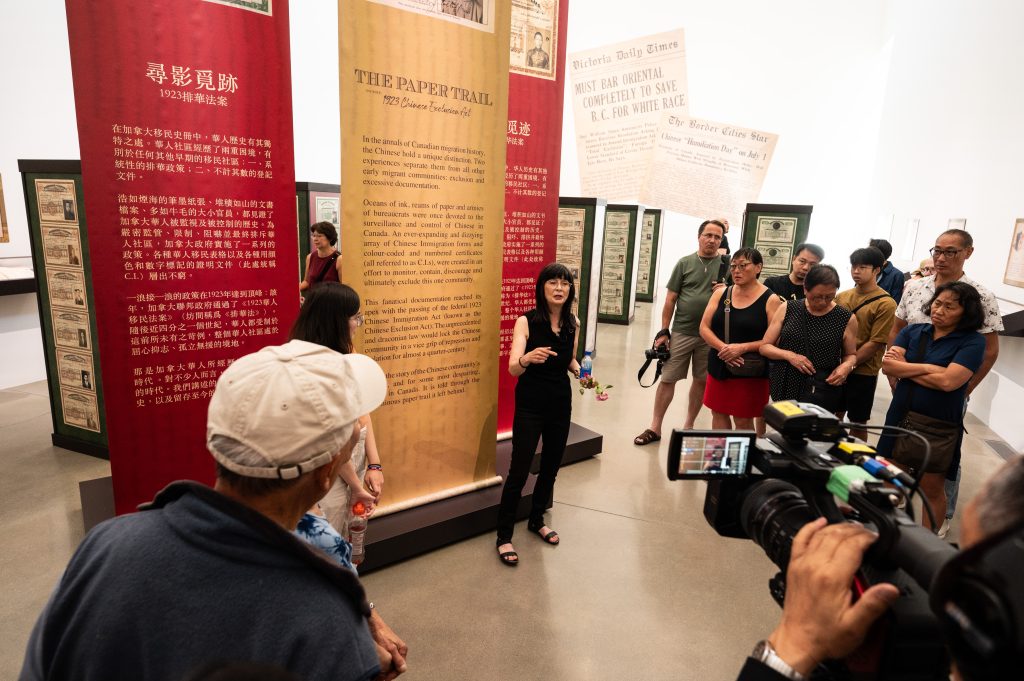
Paper Trail documents state discrimination
The Chinese Canadian Museum also includes tremendous nuance in its feature exhibition, The Paper Trail to the 1923 Chinese Exclusion Act. Curated by Catherine Clement in partnership with the Canadian Military Museum, it showcases a large collection of certificates of identity documents. These papers tracked Chinese Canadians under the Chinese Exclusion Act, reminding them of their subordinate status in Canada.
“It’s an exhibition that chronicles the stories of over 400 families that were affected by this legislation,” Lee says. “And it shares this really devastating intergenerational trauma that has impacted the Chinese Canadian community.”
Chinese settlers paid $23 million in head taxes, which would amount to $1.5 billion in today’s dollars. Half of the money went to the B.C. government.
“When you paid the tax as a Chinese national, you would get a receipt,” Lee explains. “That receipt was your head-tax paper, which had your photo, your name, and what your port of entry was.”
No museum in Canada had ever presented these documents until they were compiled for The Paper Trail to the 1923 Exclusion Act. This exhibition continues at the Chinese Canadian Museum until December 1.
On the ground floor is an introduction to Chinese Canadian migration, which includes a timeline. Many are under the impression that the first Chinese people came to B.C. during the 1850s Gold Rush or with the construction of the railway.
Lee reports that the first recorded Chinese presence in B.C. came much earlier. In 1788, Chinese labourers and sailors landed in Nootka Sound off Vancouver Island.
“They actually were shipwrights,” Lee says. “And they came with the British and they interacted with the Indigenous people of the time in B.C.”

Transported back to the 1930s
This first-floor exhibition focuses significant attention on the long history between Indigenous people and the Chinese community in B.C. It differs markedly from the history between white European settlers and Indigenous people. According to Lee, Chinese and Indigenous people’s history is characterized by a great deal of working together, intermarriage, and intercultural sharing, which unfolded over 200 years.
“That, I think, is also a really kind of optimistic and nuanced part of relationships between settlers and Indigenous stewards in Canada that…is really worth sharing,” she says.
Meanwhile, the third floor of the Chinese Canadian Museum has an interactive exhibition. Period Rooms: Historic School Room and Living Room enables visitors to explore a Chinese school classroom from the early 20th century. It was housed inside the building where the Yip family used to live.
In addition, a Yip family room features furniture from the 1930s. The grandchildren and great-grandchildren offered advice to the curator on such things as the colour of the wallpaper and the ever-present piano.
“We have a phonograph where you can take out records and play music, and the Yip family told us what music they used to play,” Lee continues. “We have an old-fashioned telephone, so when you open it and when you take out the telephone, you can listen to actual Yip family members talk about what it was like to live in that room. And we have photo albums and photos that the Yip family lent to us so that we could really kind of feel like [being] transported into that part of time.”
The society that operates Chinese Canadian Museum bought the Wing Sang Building from the Rennie family in November 2022. Renovations were completed in time for opening day eight months later.
Lee roots run deep in Chinatown
For Lee, working at the museum is a homecoming. Her family is part one of the city’s oldest benevolent associations, which built the Lim Sai Hor Kow Mock Benevolent Association Building in 1903. It was home to a reform school and a Chinese newspaper.
“I grew up in the ’80s, going to Chinatown with my grandmother,” she says.
After graduating from Prince of Wales Mini School, Lee attended McGill University in Montreal, where she earned a bachelor’s degree with a double concentration in English literature and history. She graduated with a master’s of arts in literature from the University of Canterbury before moving on to her PhD.
For many years, Lee curated exhibitions in Hong Kong. She also worked as a senior lecturer at the Chinese University of Hong Kong. She returned to her hometown before the pandemic to become director of education and public programs at the Vancouver Art Gallery.
“I’m a writer; I’m a literature major; and I was really happy when I moved back here, working at the Vancouver art Gallery,” Lee says. “I thought I was going to stay there. But I think it’s rare that you get to work on opening up a museum.
“This is actually the second museum I’ve opened up,” she adds. “The first one I did was in Hong Kong… So, you could say that I have this niche genre of being a museum startup specialist.”
Watch Pancouver editor Charlie Smith’s interview with Dr. Melissa Karmen Lee.
Carving a path forward
On a more serious note, Lee recognizes that few people of colour are in leadership positions of cultural organizations, especially in Canada. She felt a calling to do this work as a woman of colour.
In fact, she feels that she’s standing on the shoulders of the men and women who came to Canada in the 1800s. Now, Lee is carving a path forward for the next generation.
It’s one thing, Lee declares, to have allyship or for museums or directors to have Asian artists or Asian actors and actresses. However, she doesn’t want to minimize the importance of Asian board chairs, Asian directors, Asian producers, Asian grant officers, or an Asian minister of culture.
“Those are where, often, decisions are made,” Lee says. “So, I think a lot about that, which is why I’m really glad that our museum exists.”
For more information on the Chinese Canadian Museum, visit the website. Follow Pancouver on X (formerly Twitter) @PancouverMedia and on Instagram @PancouverMedia.
This article is part of “Beyond Chinese”, a joint initiative of Pancouver and the Asian-Canadian Special Events Association. Through interviews with artists and cultural workers, Beyond Chinese offers a nuanced view of people with Chinese ancestry. Pancouver and the Asian-Canadian Special Events Association gratefully acknowledge the support of Canadian Heritage.