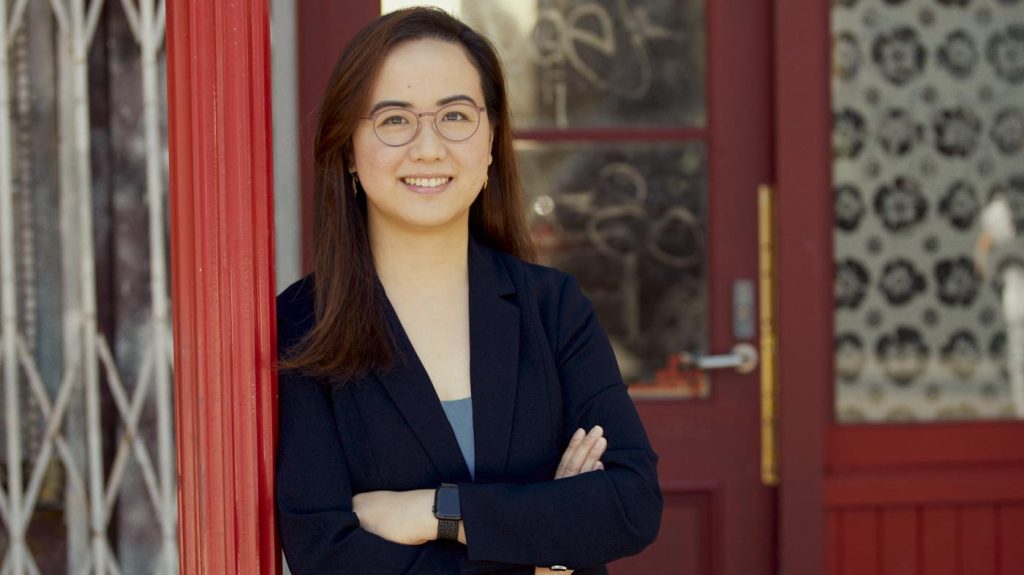
In 2017, Denise Fong’s life headed in a new direction after she landed a job at the Burnaby Village Museum. She tells Pancouver over Zoom that back then, her background was in anthropology and archeology. Fong didn’t feel that museums really reflected nuances of diversity within local communities.
But then, she embarked on researching the history of Chinese Canadians in Burnaby. As Fong (方靜怡) examined museum collections, she noticed very little about Chinese Canadians in a contemporary context. Moreover, few records existed from the early days offering Chinese Canadians’ first-person perspectives.
“You may see a few photographs of Chinese Canadian farmworkers [and] a few oral histories here and there, but that was the extent of it,” Fong says. “So, I began to see this as an issue that I wanted to delve more into as I was navigating my own graduate research. And so that’s how I really started to become more engaged in the work of museums.”
She co-curated the Burnaby Village Museum’s award-winning Across the Pacific exhibition, which reflected her keen interest in engaging visitors with personal stories. It explored the history and legacy of Chinese Canadians in Burnaby since the late 1800s. Fong also co-edited Rooted: Chinese Canadian Stories in Burnaby, which the City of Burnaby released on the 100th anniversary of Parliament banning Chinese immigration in 1923.
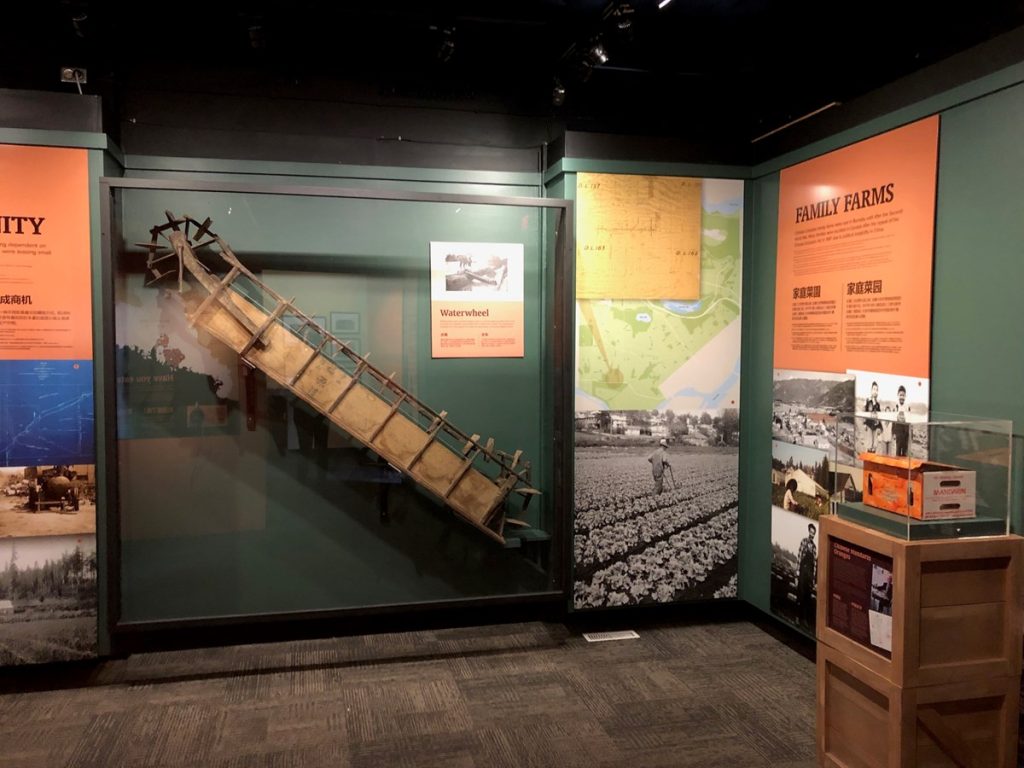
Fong co-curates A Seat at the Table
Fong worked closely with community members to reveal how Chinese Canadians lived in Burnaby.
“Now, museums are recognizing the importance of co-curating and co-creating knowledge with people in the communities who are knowledge keepers and knowledge holders,” Fong says. “My work in this realm is really focused on the relational aspects of curating—so, focusing on the process of working with people rather than just focusing on the end product.”
Fong spent nearly six-and-a-half years with the Burnaby Village Museum and also served as a City of Burnaby planning assistant from June of 2020 to October 2023. For the past year, she has been the permanent full-time curator of urban cultures at the Museum of Vancouver.
Prior to accepting this position, Fong co-curated A Seat at the Table with Museum of Vancouver curator of contemporary culture Viviane Gosselin and UBC historian Henry Yu. This Museum of Vancouver exhibition used food and restaurant culture as a springboard for sharing diverse histories of people of Chinese ancestry. It was also presented at the Chinese Canadian Museum in Chinatown and offered Fong another opportunity to collaborate with racialized communities.
“That is one of the areas where I really hope to expand and look into as I continue to work in this role,” Fong explains. “It’s also about understanding the needs of the groups that are engaged in this kind of cultural work. And to understand ways of how we can support and uplift some of the ongoing initiatives that they’re already doing.”
Shaw Multicultural Channel broadcast this preview of A Seat at the Table.
Pushback against fixed story lines
Fong earned her PhD from UBC in interdisciplinary studies, focusing attention on how Chinese Canadian history is represented in museums. Through this scholarship, she learned a great deal about the wide range of experiences among Chinese Canadians.
“I think one of the really important findings from my own study was to see how expansive and nuanced this definition of Chineseness is for different people,” Fong states.
She points out that when North American museums traditionally created collections on different cultural groups in the past, they were invariably centred around the interests of white curators and white donors.
According to Fong, white curators “collected things that looked exotic and interesting to them”.
“A lot of it has to do also with the fact that museums have, for the longest time, been in the business of ‘commodifying’ the sense of otherness,” she declares.
Nowadays, however, Fong is noticing more pushback against fixed story lines rooted in “essentialized notions” of what it means to be Chinese Canadian. Traditionally, this term was associated with Chinatown or certain village dialects from China. However, scholars are now examining other spaces where Chinese communities have been established and flourished.
Plus, Fong emphasizes, they’re taking gender into account. This can entail moving away from binary constructs and exploring how queerness can also define conceptions of Chineseness. In particular, Fong sees this taking place in arts and cultural spaces.
“This is still a very growing and changing area for me,” she says. “It’s hard to pinpoint what it means.”
Watch Pancouver editor Charlie Smith’s interview with Denise Fong.
Creating more welcome spaces
Fong feels it’s important for museums to become more welcoming spaces not only for people with Chinese ancestry, but also for other racialized communities. She notes that there’s growing resistance against putting communities into institutional silos—i.e., by having a section of Chinese stories or a section of Japanese stories in different areas of the museum.
“This is not just about geographically siloing them to stories about Chinatown,” she states. “But it’s also a kind of temporal siloing where we only focus on the stories of the first-gen or second-gen Chinese Canadians that arrived in the early years and…had those deep roots to Guangdong, Southern China. But we need to kind of open up that space so that more people can see themselves reflected in the museum space.”
Canadian families who trace their ancestral roots back to China can often count one or more generations living in Vietnam, Malaysia, Singapore, the Philippines, India, and other countries. Fong was the curatorial lead on a recent Museum of Vancouver exhibition called Mirage: Disused Public Property in Taiwan.
It included about 150 photographs by Taiwanese contemporary artist Yao Jui-Chung and his students. They documented abandoned buildings, convention centres, and other publicly financed structures all across the island.
“It was a really, really amazing experience working with Yao and also with the documentarian Sandy Lo on this project,” Fong says, “because we’re able to really bring people’s attention not only to Taiwan and the really flourishing art scene in Taiwan, but to also think about the ways in which this project informs how we look at what’s happening around us in Vancouver and other parts of the world.”
Fong offers advice to teachers
One of the great privileges of her work is sharing insights at local public schools.
She enjoys talking to secondary school teachers about the importance of students documenting family histories. It’s a wonderful way of bringing history to life for students.
One teacher who took her advice even sent her a video of an interview one of his students did with her grandfather. The grandfather was delighted that a family member had finally taken an interest in his journey of migration from China and Hong Kong to Canada.
“All of us who are working in these different areas can—when we have the opportunity–share the impact of storytelling with people so that they can then activate some of this work,” Fong states. “In whichever area they’re doing their work—whether it’s in the legal industry, whether it’s in education, whether it’s in arts—there are just so many ways in which we can do this work together.”
To learn more about the Museum of Vancouver, visit its website. Donations are tax-deductible and can be made online or by phoning 604-730-5305. Follow Pancouver on X @PancouverMedia and on Instagram @PancouverMedia.