
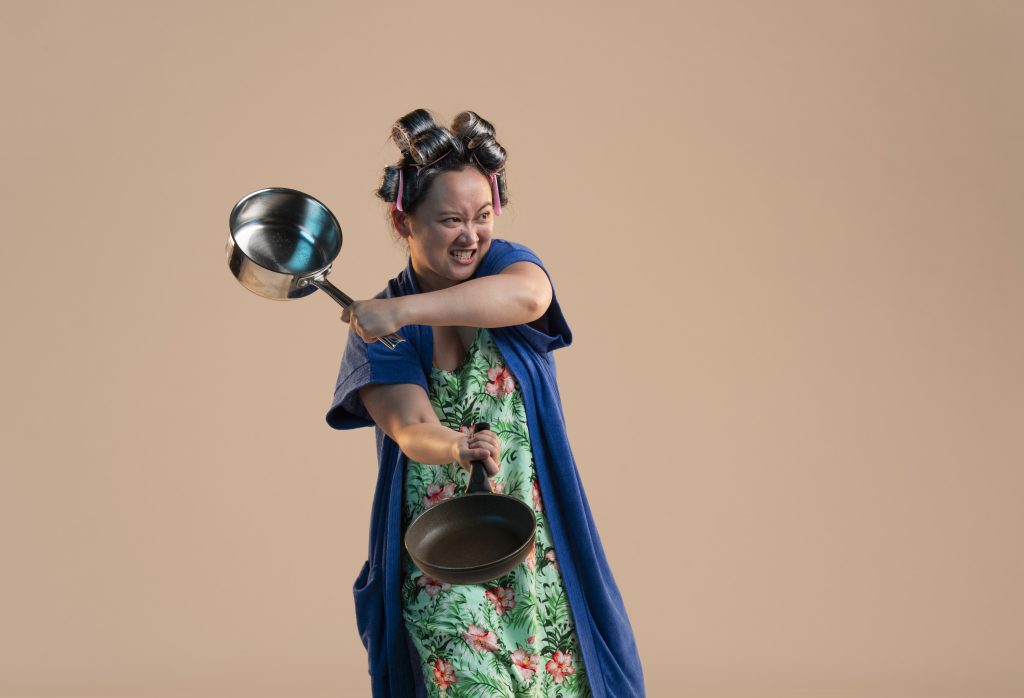
Members of the so-called 1.5- or second generations have written a growing number of Canadian plays. These playwrights—either the children of immigrants or Canadian-educated kids who moved to this country when they were young—are thoroughly conversant in at least one and sometimes both official languages. They are also completely comfortable with Canadian idioms, customs, and cultural norms, which inform their creative processes.
However, it’s much rarer for a first-generation immigrant artist who arrived as an adult to write plays in Canada. Especially scripts rooted in their country of origin that include dialogue and cultural references in a language other than English or French.
This is part of what makes Grandma. Gangsta. Guerilla. so intriguing. The playwright and star, Abi Padilla, moved to Canada as an adult from the Philippines. She came up with the idea of a play about a tough-talking Filipina grandma when she was studying acting at Studio 58 in Vancouver.
“I wanted to do martial arts; I wanted to rap; I wanted to dance hip-hop,” Padilla told Pancouver last year before a stage reading at the Advance Theatre Festival. “I also wanted to play a female character that was not sexualized and just pure 100 percent being badass.”
In a more recent interview with Pancouver last month, Padilla pointed out that second-generation Filipino artists often don’t fully understand contemporary norms in the Philippines. That’s because they have never lived there. As a result, according to the playwright, they miss out on the joy of cherished day-to-day experiences.
To cite one example, she recalls the delight of waking up to the sound of a street vendor hawking taho. Padilla said that when she heard the word in the morning, she would scramble out of bed. Then she would dash outside to buy this sweet, pudding-like tofu treat.

Cultural elements embedded in dialogue
Padilla felt it was important to incorporate cultural elements specific to the Philippines in her play, as well as Tagalog dialogue. She did this to ensure that Grandma. Gangsta. Guerrilla. would resonate authentically with first-generation immigrants.
The play, which is directed by Leslie Dos Remedios, weaves in the lead character’s experience living under Japanese occupation in the Second World War. Filipinos waged a courageous guerrilla campaign against invaders who perpetrated sexual slavery.
The cast of Grandma. Gangsta. Guerilla. also includes Yorlene Bernido, Evelyn Chew, Raugi Yu, Vince Sendrijas, Terrence Zhou, and Kevin Nguyen.
In researching the play, Padilla interviewed her own grandmothers. And she insisted that they can’t simply be defined by any hardships that they encountered in life.
“How would I remember my grandmothers?” Padilla stated last year. “I would remember their feisty sense of humour; I would remember the taste of their cooking; I would remember the times that we played together… At the end of the day, I would want to remember them for all the good things that they did for me.”
Ruby Slippers Theatre will present the world premiere of Grandma. Gangsta. Guerrilla in partnership with the Shadbolt Centre for the Arts, Presentation House Theatre, and Blackout Art Society. The first run will be at the Shadbolt Centre for the Arts at 7:30 p.m. from February 6 to 8. Plus, there will be a 2 p.m. matinee performance on February 8 at the Shadbolt Centre. That will be followed by a run at Presentation House Theatre in North Vancouver at 7:30 p.m. from February 13 to 15, with 2 p.m. matinee performances on February 15 and 16. For tickets, visit the Ruby Slippers Theatre website.
Follow Pancouver on X @PancouverMedia and on Instagram @PancouverMedia. Follow Charlie Smith on Bluesky @charliesmithvcr.bsky.social.




