
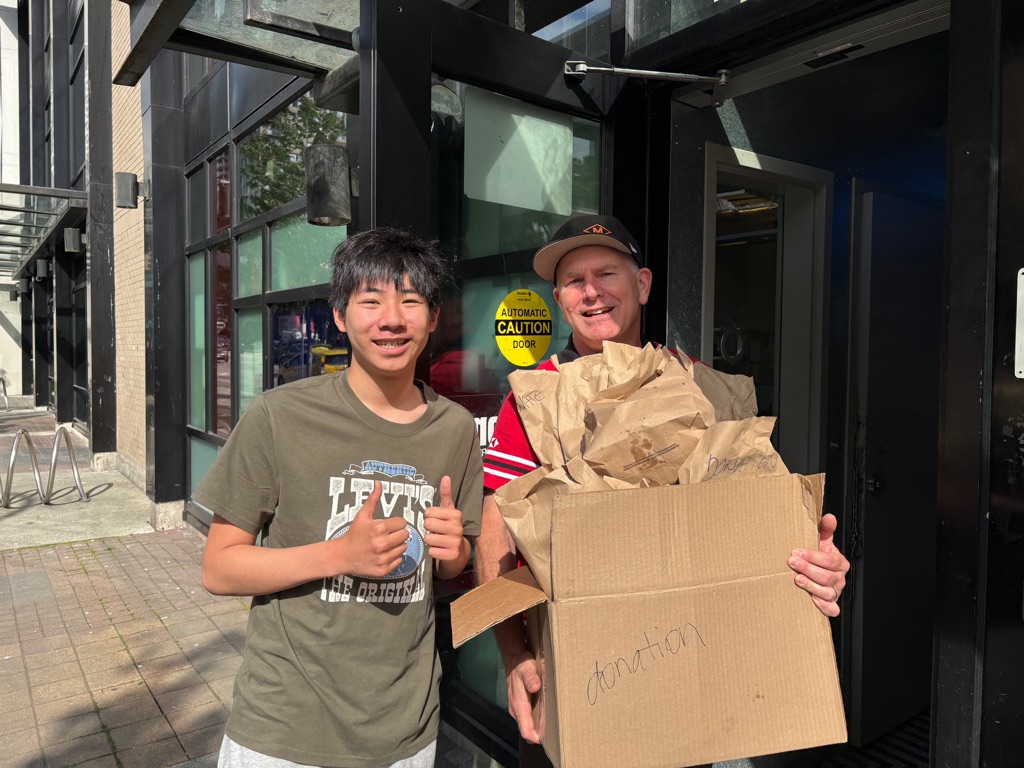
In early April, St. George’s School student Max Wang did something truly remarkable. With two Crofton House students—Audrey Sung and Elliana Sun—Wang co-organized a night of entertainment that raised more than $9,000 for Atira Women’s Resource Society.
But this was far from his first foray into helping the less fortunate. Wang is the founder and president of Feeding it Forwards Foundation, which collects donated surplus food that local businesses can no longer sell. Feeding it Forwards distributes it to community organizations, thereby helping those in need while reducing food waste.
In the Q&A below, Wang reveals how he came up with the idea of Feeding it Forwards. He also highlights the impact that it is having on various communities.
Pancouver: What is the mission of Feeding it Forwards?
Max Wang: Feeding it Forwards is a youth-led nonprofit organization that is working to reduce food waste and also improve food security. What we do is simple: we collect safe, surplus food from bakeries, grocery stores, distributors, caterers, and other businesses. From there, we donate it to shelters, food programs, hospitals, and various other community organizations. This is all food that would’ve otherwise gone to the landfill for various reasons, but is still perfectly edible! Since beginning our operations in 2024, we raised more than $33,000. We have rescued more than 103,000 pounds of food, equivalent to saving almost $500,000 worth of food from the landfill. This has created more than 86,000 meals for more than 5,000 people across the more than 10 charities that we have donated to.

Pancouver: How did you come up with the idea for Feeding it Forwards?
MW: I first became interested in the idea of food waste when I watched the documentary Just Eat It in my Grade 6 humanities class. My Grade 6 Humanities teacher, Mr. Schein, was the founder of Food Stash, and his organization made a massive impact when it comes to reducing food waste and insecurity in Vancouver. What stood out to me in the documentary was the sheer extent of food waste: truck loads upon truck loads of perfectly good food! Of course having grown up in an Asian household where food was always regarded as being incredibly wasteful, this was very shocking to me.
In my Grade 8 year, I ended up re-watching the documentary, and I was inspired to do something—at this point I had seen so many people my age start initiatives and do good for their community, so I thought why not! The idea was simple: contact local businesses, ask whether they had surplus food, find a community organization that could accept it, and arrange transportation between them. The first rescues were small and done by my parents and I, and a friend and his parents. From there, we only expanded. We built more recurring partnerships, we recruited more volunteers, invited a part-time driver to the team, and expanded our reach.

Pancouver: Teenagers have many ways of occupying their time. Why is it so important for you to be doing this work?
MW: For me food waste is important because I grew up in a household where it was seen as incredibly wasteful to throw out any amount of food. So, having realized the massive issue that is food waste across Canada, I genuinely wanted to do something about it!
The reason why I continued to do FIF was because I really wanted to prove that young people could be taken seriously. Teenagers are often underestimated and maybe it is true that young people do not control government policy or major corporate decisions. But, we can still organize volunteers and raise funds. Age can perhaps make parts of the work more difficult, but it can still be a strength because young people bring so much energy and creativity to the world.
This work has also taught me that meaningful impact depends on consistency. A single donation is valuable, but a dependable weekly pickup can provide much more long-term support. That is why I spend so much time communicating with businesses and coordinating volunteers, because I know that much of nonprofit work is about making sure your systems work: to unlock the visible impact.

Pancouver: How do you raise money for the organization?
MW: The biggest way Feeding It Forwards raises money is through Krispy Kreme fundraisers. Every couple of months we sell Krispy Kreme donuts in various locations across Vancouver. Sometimes seven or more! This is incredibly profitable for us, because we buy at a charity discount from Krispy Kreme, and we can mark-up the prices to earn more money for the organization. Often I end up asking friends, and friends of friends to come out and volunteer, to get the manpower that we need. These have been very successful, and just these donut sales have raised more than $20,000 alone!
Another way we fundraise is through corporate sponsorships. For example, Acuitas Therapeutics has donated $4,000 to Feeding it Forwards, and it all started with a cold email I sent in 2024! It is incredible to see how companies are willing to help, those like Acuitas.
Recently, we’ve started to raise money for external organizations as well. For example, Feeding it Forwards co-organized a charity concert with two other youth-led non-profit organizations that raised $9,287 for Atira Women’s Resource Society and brought together more than 250 people.
The money we get helps cover transportation (renting vans when needed, paying drivers), fundraising expenses.

Pancouver: What’s the process for collecting food?
MW: The process usually begins by forming a partnership with a food business. We cold-email hundreds, or even thousands of local bakeries and grocery stores. We discuss what type of surplus food a store may have, how frequently donations would be available, and when pickups can take place, and how the food must be stored and transported.
We then match the donor with an appropriate recipient (usually many!). That decision depends on things like location, and the amount and type of food.
For each rescue, a volunteer or driver picks up the food, records its weight on a scale (this is usually either located at the partner, or the driver/volunteer carries one in their car, or we estimate the weight), and then it is put and tracked down on our food donation tracking document, which has recorded all of Feeding it Forward’s impact since our inception.

Pancouver: Feeding it Forwards has expanded to Calgary. What can you tell us about the work taking place there?
MW: Our Calgary branch is currently led by Saom Sakib. We’ve started operations by collaborating with Leftovers Foundation. We help take on some of their food routes by organizing logistics and finding volunteers, and we help get food from store A to recipient B. This is important because we help reduce the strain on local charities, and we make meaningful steps to reducing food waste by redistributing food locally in Calgary.
Our first Calgary rescue took place on June 2026, and we recovered more than 70 pounds of food from Blush Lane organic Market and Good Earth Coffeehouse.
We have new partnerships pending, and we can’t wait to announce them soon.
Pancouver: Do you have any final words for our readers?
For more information or to donate cash for food to Feeding it Forwards, visit the website.
Follow Pancouver on Instagram @PancouverMedia, on X @PancouverMedia, and on Bluesky @pancouver.bsky.social.




