Former Powell Street Festival executive director Emiko Morita curated the Return to Paueru Gai: 50 Years of Powell Street Festival exhibition at the Nikkei National Museum & Cultural Centre (6688 Southoaks Crescent, Burnaby). Below, you can read her remarks at the opening reception on March 26.
Thank you, Sophie [Yamauchi Latimer]…. and thank you deeply for so gamely taking on the executive director position of Powell Street Festival last year, freeing me to move on and curate this project.
While leading Powell Street Festival for nearly a decade, I gathered and learned so many things—from “where to find the tug-of-war rope” (it took me several years!) to “how to be in community in a good way.” The idiosyncratic, grassroots nature of the festival is what makes it such an awesome experience, and it is very dear to my heart.
It has been my honour and privilege to bring this exhibition and book to life—gathering images and quotes, building installations and selecting artifacts that celebrate a half-century of community building and cultural regeneration.
Throughout the research process, we encountered errors in documents and contradicting narratives, and we also experienced the fallibility of memory. And when we were building the database of festival coordinators and presenters, most of the 1980s information was missing. We searched archives across the country, scoured the New Canadian, Vancouver Shinpo, Nikkei Voice as well as Tonari Gumi’s newsletters. Just before the book deadline, we found the festival programs were right under our noses, duly processed in the Nikkei Museum archives!

We also discovered some special things such as a Freg Herzog photo hanging in Takeo Yamashiro’s hallway, Taki Bluesinger Sekiguchi’s photographic collection that had just been received at Belkin Art Gallery, and Roy Kiyooka—his words and chuckle on film, his involvement in Bart Uchida’s performance pieces, and his festival photographs—also at the Belkin Art Gallery.
You’ll find these inside amongst the image clusters—the themes are Arts & Culture, Martial Arts, Community, Taiko, Volunteers & Production, Festival Site as well as Neighbourhood Engagement and Off-Season Arts Presentations. We spent many months reviewing thousands of images, making the final selections, chasing down or creating digital files, then restoring, printing, and mounting over 170. (A shout out to photo tech wizard Rob Marks!)
Ultimately, what became evident throughout our research is that the festival is shaped by a collective vision, and a deep commitment to place, culture, its volunteers, and to human rights. It is much more than a performative cultural celebration. Powell Street Festival is radically inclusive—it welcomes hard conversations, differing views, and evolving identities—making it a vital space for connection and transformation.

I experienced this firsthand. Through the festival, I made a tangible connection to the neighbourhood where my grandparents first settled and then were forcible removed during the Internment era. I built strong relationships with Japanese Canadian and Downtown Eastside community members—and through those friendships, I found the courage to use my voice.
I am really excited to share this exhibition with you this evening.
The six-foot wide photo behind me was taken by Tamio Wakayama during the first Powell Street Festival in 1977. Please take a moment to consider that this gathering was, and continues to be, an act of empowerment, a gesture to honour our ancestors and a reclamation and regeneration of cultural identity. I believe the festival can strengthen our belief in humanity and our courage to advocate for human rights.
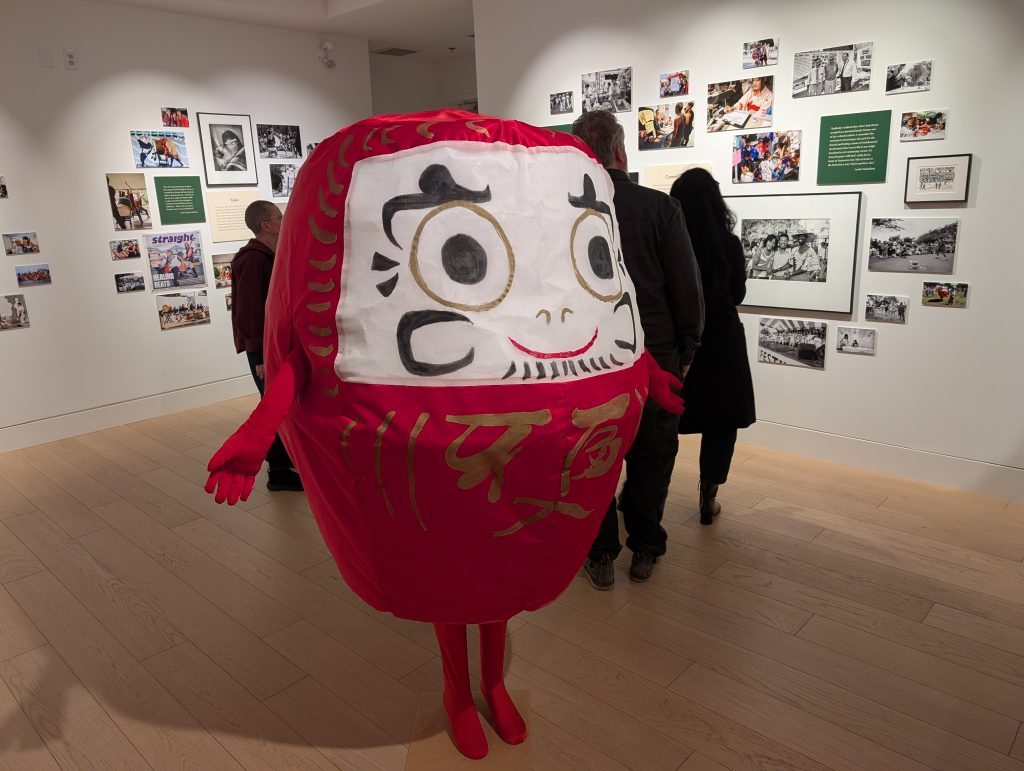
Shifting gears, let me tell you about the installations included in the exhibition. You’ll find the ever-popular Daruma (thank you Mark McGregor for this legacy) [and] Macro Maki’s giant sushi costumes—the mural includes aerial shots of folks donning the costumes on the festival site and you are welcome to try them on tonight!
You may also encounter Ningyo, a puppet we built for the Indigenous-led procession Wild Salmon Caravan in 2018. Don’t let her scare you! In Japanese folklore, she reminds us to be responsible with our natural resources.
And it may be too chaotic tonight but please do find time to explore the View on Demand videos and the Archival Binders on the resource table. There are some real nuggets that I’ll let you discover for yourself!

Like the festival itself, this project would not be possible without many, many people contributing a diversity of perspectives, experiences, skills, and support. The opening title wall in the foyer, the Visitor’s Maps, and the accompanying book acknowledge the folks involved in different components of the project, but I’d like to take a moment to single out a few.
Eddy Takayanagi joined the board around the same time that I starting working for the festival. We learned together and he was a steadfast source of support and guidance as the festival’s President. Thank you for running alongside me and thank you, tonight, for the exhibition and book title, Return to Paueru Gai.
The Japanese Canadian Legacies Society funded the book publication, and Arsenal Pulp Press has done a fantastic job with the editorial and design work. Thank you, Brian Lam, for trusting that we could pull this off in such a short timeline.
And thank you to my life partner and curatorial advisor Henry Tsang. Henry graciously provided backfill at home during my tenure at PSF and then, to top it off, offered his artistic expertise throughout this project. He further elevated the exhibition by anchoring a NSERC grant through Emily Carr University of Art and Design, where he teaches. Thanks to this, and support from Canada Council for the Arts, we had a top-notch production and installation team. Some of them are here—please give them a round of applause, they installed over 300 pieces! [Henry, Steven Dragonn, Luigi Pulido, Freya Harding, Sahali Tsang, Alex Hass, Miles Saraswat, Tomás Herrera, Foorozan Taleifard, and Eric Ko].
Thank you to Daien [Ide] and the team at Nikkei Museum’s archives who accommodated me and the research team for over two years. And thank you Sherri [Shinobu Kajiwara] and Danielle [Jette] for making the gallery accessible and hosting the exhibition. I am grateful to present Return to Paueru Gai in this space and in the context of the larger Nikkei community discourse.
Years ago, Dr. Izumi Sakamoto asked me how the festival’s ethos and core value of social justice was transferred through the generations. This question deeply influenced how I approached my work at the festival. And I’d like to thank her and the Japanese Canadian Art and Activism Project for their support.

In curating this project, my goal has been to connect the festival’s core values and traits to tangible facts and lived memory so that it might serve as a meaningful resource and an inspiration for future generations.
Central to this goal is the recognition of all the people who have contributed—especially the volunteers and community groups, past and present. As you enter the gallery, you’ll see an installation hanging above you. It’s made from volunteers’ hachimaki—headbands gifted each festival weekend—and it is titled Otsukare, which translates to “thank you for your work.” It stands as a tribute to everyone whose hands, hearts, and histories have shaped this community.
I also invite you to make a wish at the Daruma Well-Wishing station in the foyer. And take home a souvenir Omamori! Thank you and have fun tonight!
The Nikkei National Museum & Cultural Centre (6688 Southoaks Crescent, Burnaby) presents Return to Paueru Gai: 50 Years of Powell Street Festival from March 26 until September 5. The exhibition can be seen from Tuesdays to Fridays from 10 a.m. to 6 p.m. and on Saturdays and Sundays from 10 a.m. to 5 p.m. Admission is by donation.
Emiko Morita also edited a new book, Return to Paueru Gai: Fifty Years of Vancouver’s Powell Street Festival, which is available on the Powell Street Festival Society website. Published by Arsenal Pulp Press and funded by the the Japanese Canadian Legacies Society, it includes essays by Musqueam Elder Mary Point, the seniors of Tonari Gumi (the Japanese Community Volunteers Association), cultural worker Julia Aoki, Pancouver editor Charlie Smith, writer Angela May, and members of the Japanese Canadian Art and Activism Project.
Follow Pancouver on Bluesky @pancouver.bsky.social, on X @PancouverMedia, and on Instagram @PancouverMedia.