The Richmond Art Gallery will soon unveil two new environmentally themed exhibitions. Zoë Chan curated Dear Plastic, which is a group exhibition featuring works by Ari Bayuaji, Emily Hermant, Caroline Monnet, Alex Tedlie-Stursberg, and Cheryl Wong. Chan is the curator at the Richmond Art Gallery.
Meanwhile, Sean Lee, director of programming at Toronto-based Tangled Art + Disability, curated Speak No (emergency). Tangled Art + Disability is the co-presenter of this exhibition, which is a solo show featuring climate-related works by queer, feminist disabled artist Persimmon Blackbridge.
Dear Plastic and Speak No (emergency) will be on view from January 18 to March 23. Pancouver reached out to Zoë Chan to learn more about the Dear Plastic Exhibition. Read her responses below.
Pancouver: Can you talk about the origins of the Dear Plastic exhibition? Where did the idea come from? What are you hoping to convey in this exhibition?
Zoë Chan: The exhibition’s title comes from an ’80s song by Björk’s old band, The Sugarcubes. They had a pop song called “Dear Plastic”—the lyrics evoked early scientists’ idealism and optimism around the discovery of plastic, but then ends on an elegiac tone, as plastic is now forgotten and taken for granted.
I remember being surprised by the song’s title because typically we focus on plastic’s toxic qualities—how it is polluting our waters and ecosystems, and entering our bodies as microplastics as they break down. Despite this, we depend on plastics in numerous parts of our lives—for instance for clean water, food, medical supplies, electricity, and Internet…So I wanted to make an exhibition that looked at both the positive and negative characteristics of this paradoxical material that is now an essential part of our lives…
I was also very inspired by a book called Plastic Matters by Heather Davis. Davis argues that we can’t escape plastic, given that it’s literally everywhere, in the water and even in our bodies; instead, we must learn to reckon with and live with plastic’s permeation.

Pancouver: What are the factors or criteria that appeal to you when deciding on an exhibition to curate.
Zoë Chan: I don’t have a fixed set of criteria. Sometimes, I start with an idea or sometimes, it’s recurring themes or artistic approaches that I’m seeing in artists’ works. I’m also inspired by other exhibitions, films, TV, books, the Internet… I am often drawn to works that are aesthetically striking, but which at the same time invite us to reflect on our world today.
Pancouver: Why did you feel it was important to include Ari Bayuaji’s Catcher of Dream series?
Zoë Chan: Ari’s work is very beautiful—he works a lot with old materials that are washed up on the beaches of Bali, where he’s from. His Catcher of Dream series comprises hanging tires that he found on the beach that were growing barnacles. He was fascinated by how animal life had adapted to living on the tires, this intersection of the synthetic and the natural world. I wanted this idea to come through: that what we consider a natural landscape now usually includes plastic and human-made objects…

Pancouver: What can you tell us about some of the sculptures in the exhibition?
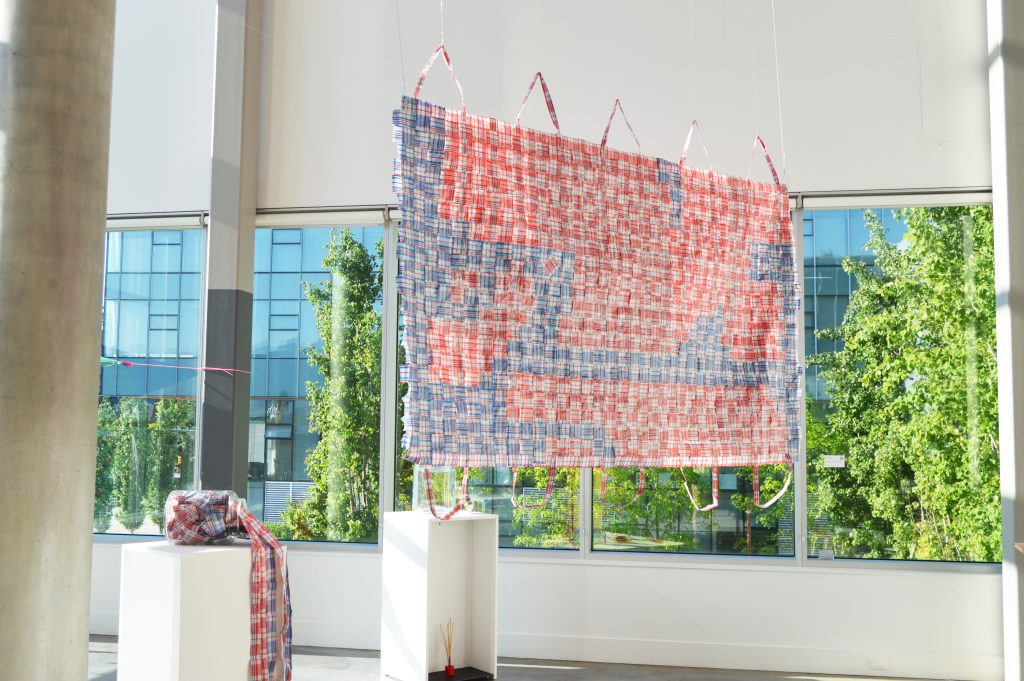
Zoë Chan: Weaving is highly represented in this exhibition—the artists Ari Bayuaji, Caroline Monnet, and Cheryl Wong are all working with this medium but with such unexpected materials as shipping rope, housing construction materials, and red, white, and blue nylon bags.
Pancouver: You’ve also curated work from Cheryl Wong. Why did you feel this was important in the Dear Plastic exhibition?
Zoë Chan: I wanted to include a work that engaged with a very iconic and instantly recognizable commodity like the red, white, and blue carrier bag. Given their sturdy and spacious design, these nylon bags have become associated with moving and migration globally, though they originated in Hong Kong in the ’60s. It also has been linked in a derogatory manner to lower economic status and class because it’s cheap and affordable. At the same time, it has been coopted by luxury brands like Louis Vuitton. It has all of these histories and sometimes difficult realities running through it, which makes it as a material to work with incredibly rich. Also, the City of Richmond has an incredibly diverse population with a high percentage of people with links to Hong Kong, Mainland China, and Asia…I’m sure the materiality of these bags will resonate with a lot of people.
Listen to the song that gave the exhibition its title.
The Richmond Art Gallery will present Dear Plastic from January 18 to March 23. Over the same period, the Richmond Art Gallery and Tangled Art + Disability will co-present Speak No (emergency). For more information, visit the Richmond Art Gallery website. Follow Pancouver on X @PancouverMedia and on Instagram @PancouverMedia. Follow Charlie Smith on Bluesky @charliesmithvcr.bsky.social.