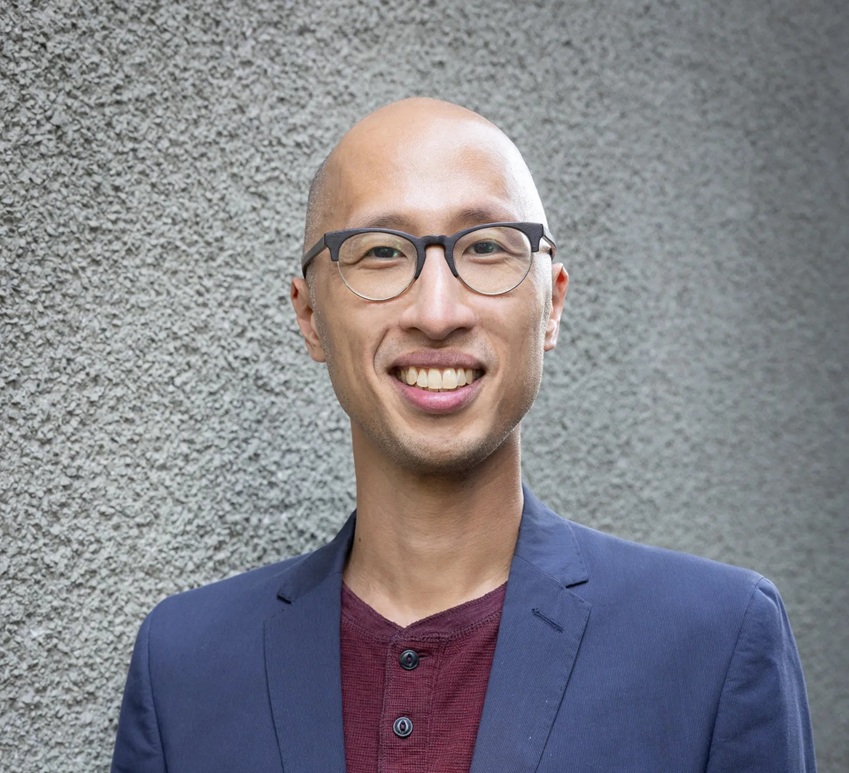
By Ryan Cho
The following is an excerpt from Ryan Cho’s new book, Brotherhood is a Constant Possibility: Asian Masculinity in a World Made for Whiteness (published by Thornapple Press).
[After a decade of being a musician, I had become an] Asian artist who spent most of his creative practice focused on Western art and worldviews. It didn’t happen because I was thinking; it happened because in a society and culture where whiteness was seen as typical and desirable, I wasn’t thinking.
Strangely enough, it was studying and performing Western music that provided me the opportunity to travel to China for the first time. I was singing with the University of Victoria Chamber Singers when we did a two-week performance tour of China in 2005. The trip included stops in Shanghai, Suzhou, Chongqing, Chengdu, Xian and Beijing, in addition to singing on Chinese Television and National Public Radio. I made the trip with my closest friends, most of whom were white Canadians of various stripes.
I was beyond excited for the trip. As an ethnic Chinese person who didn’t speak Mandarin or Cantonese, I saw it as a chance to connect to my heritage in a deeper way: It was my opportunity to “go home.” I had high expectations for my time in China to be both fun and transformative. My legs shook with anticipation as I squeezed into a cramped middle seat and inhaled the recycled air on the eleven-hour flight from Vancouver to Beijing.
I have many memories of that trip, including some R-rated college hijinks I won’t go into. One of the more dramatic things that happened was that a group of us got terrible food poisoning from eating some bad cheese at a Chinese Boston Pizza the night before we were scheduled to sing live on Chinese Television. Many of us had to slip away from the stage mid-performance to vomit in an adjacent bucket or washroom and then return to continue singing in our tuxedos and black dresses. The show had to go on, I suppose.
But as for connecting to my heritage, my Chinese identity and the people in the cities we visited, the experience was the opposite of what I hoped for and expected. On our first morning in Beijing, I walked down to our hotel lobby and tried to say 你好 nǐ hǎo—good morning—to the locals and staff. My earnest attempts were met with stony-faced disregard. Soon after that, Evan, our tall, blond and blue-eyed lead tenor, sauntered down from his room with an unassuming, goofy demeanour and repeated the same words with no hint of proper intonation. He was met with smiles and praise.

On a night off from performing, a bunch of us went out to a crowded nightclub in Xian. The place was full of colourful laser lights and trendy Chinese house music. My white friends were treated like celebrities. Eyes and attention were focused on them. People were friendly, asked them to dance, bought them drinks and flirted with obvious interest. Locals had at best a passing indifference to me, and at worst a normalized disdain. I was a Chinese person who didn’t speak Mandarin or Cantonese. The judgment in their eyes spoke volumes: “What is wrong with you?” and “You should be ashamed for not knowing what you should know.”
Those experiences left me with a confusing mix of alienation and pain, something that scholars David L. Eng and Shinhee Han would later call racial melancholia: the loss and grief Westernized Asian people feel for a cultural identity they have never known because they have assimilated into a Western country that labels them as an other.
Later in the trip, my attempts to blend in with the locals were hopeless. My gait, my mannerisms and my body language were not Chinese. Despite my dark eyes and black hair, people could recognize me as a foreigner from a block away. They saw what most Westerners didn’t see. I walked like a Canadian.
It was as if I had become a secondary character in my own story. The homecoming I had imagined was replaced with the disorienting realization that China wasn’t ever going to be a place for me to “come home” to. Instead of strengthening a connection to my roots, the trip confirmed that I was not Chinese: I didn’t belong there, and it made the tension of not fully belonging in white Canada more obvious and alienating during the year after I returned.
Thornapple Press published Brotherhood Is a Constant Possibility: Asian Masculinity in a World Made for Whiteness. Learn more about the book and the author, Ryan Cho, by visiting Ryan Cho’s website.
Follow Pancouver on Instagram @PancouverMedia, on X @PancouverMedia, and on Bluesky @pancouver.bsky.social.