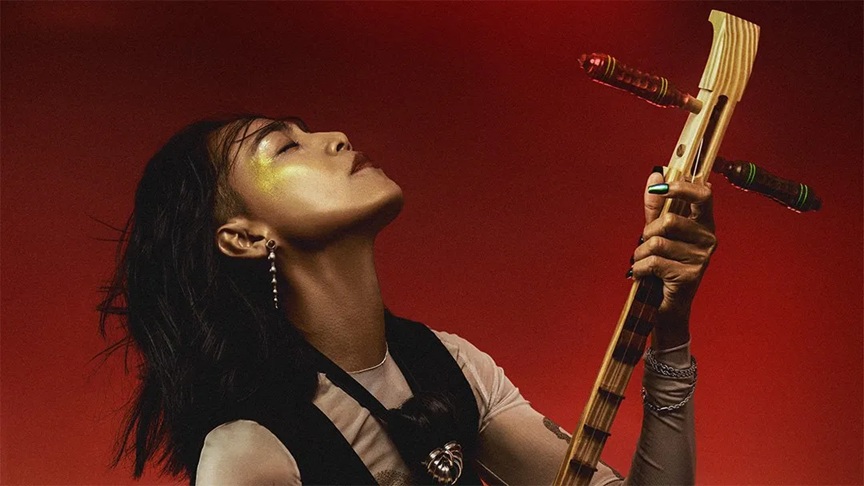
Taiwanese Indigenous musician Sauljaljui embraces a philosophy of “finding a way home through music”. This is reflected through her three albums, a TV show that she hosts, and appearances at many international music festivals.
“I feel my music is quintessentially Taiwanese,” Sauljaljui tells Pancouver in Mandarin over Zoom. “It’s a blend of Indigenous influences and other elements, including global ones, making it truly diverse.”
Later this month, Sauljaljui will bring her intensely emotional Paiwan melodies, Hengchun folk, and global sounds to the Vancouver Folk Music Festival and Mission Folk Music Festival.
Sauljaljui maintains that her Taiwanese Paiwan heritage has a direct influence on her music. That’s because tonality is a key feature of the Paiwan language that she sings. As a result, melodies are predominantly in a minor key.
Her first Paiwan-language album in 2016, Tracing the River of Life (順著河流走), and her 2019 follow-up, Insides Revealed (裡面的外面), were each nominated for Golden Melody Awards.
“The songs we create are deeply rooted in a connection to the land, to people, and to nature,” Sauljaljui says. “I feel that a defining characteristic of Paiwan culture is to share the beautiful aspects of life. It is truly a culture of sharing—so the core theme I’m bringing this time centres on sharing.”
Pancouver associate editor becky tu translated Sauljaljui’s responses into English.
Watch Sauljaljui’s music video for “Finding Each Other”.
Sauljaljui highlights shared Indigenous struggles
A prime example of her desire for meaningful connection and to sing about the land is “Finding Each Other”. This track is on her 2024 album VAIVAIK (尋走), which captured the Gold Medal for World Music at the Global Music Awards. It also won a Golden Melody Award for Best Indigenous Album.
“Finding Each Other” is about the mutual desire to bond over stories that Indigenous people wish to protect. For this composition, Sauljaljui relies on two guitar chords to represent the river and the sea.
“I met a poet from the Marshall Islands who told me how rising sea levels were causing their island territory to shrink,” Sauljaljui notes. “He wrote about this experience of being submerged and displaced.”
Sauljaljui then told the poet that her home is downstream from a reservoir. And this reservoir was deliberately flooded even though it was on traditional territory occupied Paiwan Elders. Therefore, she believes that the Paiwan people have something in common with Indigenous residents of the Marshall Islands.
“While their lands are being submerged due to environmental destruction, our traditional living grounds were intentionally inundated,” Sauljaljui emphasizes. “So, regarding these two stories—I feel they both speak to a people and a culture on the verge of vanishing.
“I wanted to embrace that spirit through the river near our reservoir,” she continues. “It’s a very pure feeling—realizing that even though we are worlds apart, we as Indigenous peoples are actually sharing the same message: safeguarding the land.”
Watch the Official Music Video for “Become One”.
Austronesian languages and Taiwan
The video features Taiwanese Indigenous musician Putad Pihay and Taiwanese Indigenous vocalist, actor, and cultural advocate Sra-Rata, a.k.a. Lulji Ljaliguan. Sauljaljui initially tried recording the vocal tracks separately before realizing that this was the wrong approach.
“Of course, getting together meant we needed some time to build the right mood and connection,” Sauljaljui says. “As Indigenous people—I belong to Paiwan group while the other two singers are Amis—we share a natural bond. Once we got together, it didn’t take long to connect; perhaps after just a sip of alcohol, that connection sparked, and we were able to record the song.”
Sauljaljui collaborated with Pihay on another track entitled “Become One”. It was the official theme song for the inaugural World Indigenous Traditional Games in 2025.
“At the time, Taiwan was—for the first time, I believe—framing itself as the ancestral homeland of the Austronesian peoples,” Sauljaljui explains. “There is a prevailing global theory that Taiwan is the origin point—the ‘mother’—of the Austronesian language family. So, adopting this perspective, Taiwan hosted the World Indigenous Games that year and invited people from Austronesian nations across the globe.”
Sauljaljui and Pihay allowed their imaginations to run free after being commissioned to create the theme song. The soaring vocals are accompanied by Paiwan and Amis tribal melodies with instruments from diverse cultures.
“Having previously participated in events involving the Austronesian islands, we could easily visualize the traditional dance steps, the raw power of the movements, and the intensity in the dancers’ eyes,” Sauljaljui reveals. “We already held these images of the people in our minds when writing the song.
“During the production process, I decided to incorporate the voices of young men from the tribes—warriors from the youth associations—adding their spirited cheers to the track,” she adds. “This gave the song a more commanding presence and infused it with a distinct Taiwanese spirit.”
Watch the Official Music Video for “Dazzling Beyond Compare”.
Expressing culture through non-Indigenous instruments
Moreover, Sauljaljui dedicated a third song, “Dazzling Beyond Compare”, to Pihay and another Indigenous “sister”, Emlyn, from Mauritius. The official music video was recorded on Maria Island off the east coast of Tasmania.
Maria Island used to be populated by Indigenous people. Nowadays, she says that many islanders are of mixed heritage due to intermarriage with white settlers.
“So, no one speaks their ancestral tongue anymore,” Sauljaljui points out. “However, they are striving to preserve their culture—for instance, by making traditional woven-bamboo boats.”
According to Sauljaljui, this upbeat song highlights how both the environment and the people need protection to shine in all of their beauty.
“The lyrics also speak to the moment when you are doing what you love—when you are truly shining—even the sun seems to pale in comparison,” she declares. “Whether you are protecting something—like the people safeguarding that island—or protecting your own dreams, you have the freedom to shine brilliantly.”
The music video for “Dazzling Beyond Compare” opens with her strumming on a yueqin, a.k.a. the moon lute. It’s a traditional Chinese string instrument. As a teenager, Sauljaljui also picked up another instrument outside of her culture—the guitar.
“I think there are many musicians all over the world [who] might be holding instruments that don’t belong to their own traditional ethnic group,” Sauljaljui states. “Yet they can still express their own culture and sing their traditional songs while playing them. That is the message I want to convey.”
Sauljaljui creates serpent’s crying sound
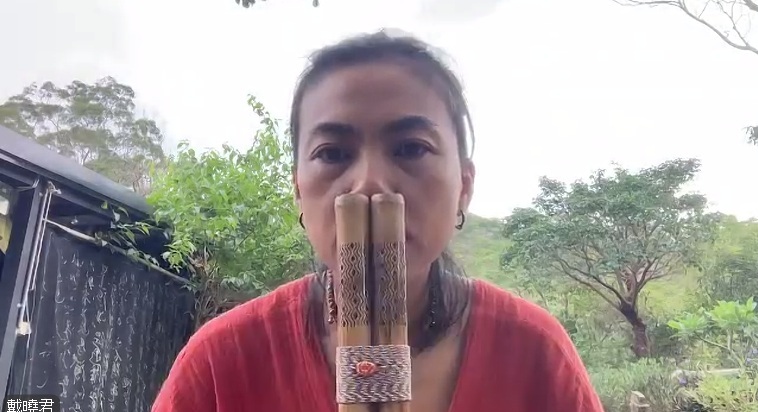
She also plays the double-barrel bamboo nose flute. Over Zoom, Sauljaljui offers a demonstration of this unusual instrument.
She makes music by emitting air from each nostril through two long bamboo tubes. According to her, this creates the crying sound of the supreme ancestral spirit and guardian of the Paiwan people—the Hundred-Pacer Snake (Vulong). This serpent and the Paiwan people are siblings.
“For the Paiwan, the Hundred Pacer dwells not in some distant heaven but on the pillars of the house, on the clothes they wear, and in every moment that calls for protection,” the website Taiwanese-gods.org states.
Traditionally, only Paiwan men were permitted to play the double-barrel bamboo nose flute. But that hasn’t discouraged Sauljaljui.
“If you want to carry on a traditional legacy, it doesn’t matter if you are a man or woman,” Sauljaljui insists. “What truly matters is your heart.”
The Vancouver Folk Music Festival will present Sauljaljui on the South Stage at 4:30 p.m. on Friday (July 17) at ʔəy̓alməxʷ / Iy̓ál̓mexw Jericho Beach Park. She will also be part of Eastern Sunrise at 11 a.m. on Saturday (July 18) with Aysanabee and Mitsune, which will be hosted by Tennyson King. For tickets and more information, visit the Vancouver Folk Music Festival website.
The Mission Folk Music Festival will present Sauljaljui on the Main Stage at 6:10 p.m. on Saturday (July 25) in Fraser Heritage Park. She will also be on the Fraser Stage as part of Sonic Conversations with Nastasia Y 1:50 p.m. on July 25. Then at 12:30 p.m. on Sunday (July 26), Sauljaljui will be part of a presentation with Mahihkan called Mother Tongues on the Fraser Stage. For tickets and information, visit the Mission Folk Music Festival website.
Pancouver associate editor becky tu translated Sauljaljui’s answers from Mandarin into English. Follow Pancouver on X @PancouverMedia and Bluesky @pancouver.bsky.social. Also find Pancouver on Instagram @PancouverMedia.