On my daily commute to downtown Vancouver, I often transfer at Marine Gateway to catch the SkyTrain.
The station area is always bustling. Coffee shops, convenience stores, supermarkets, and a cinema blend into one another as commuters hurry in and out, filling the plaza before disappearing into waiting trains. Like everyone else, I used to pass through without a second thought. I never imagined I would one day stop here.
Until one afternoon.
In a quiet corner of the plaza, I saw a man.
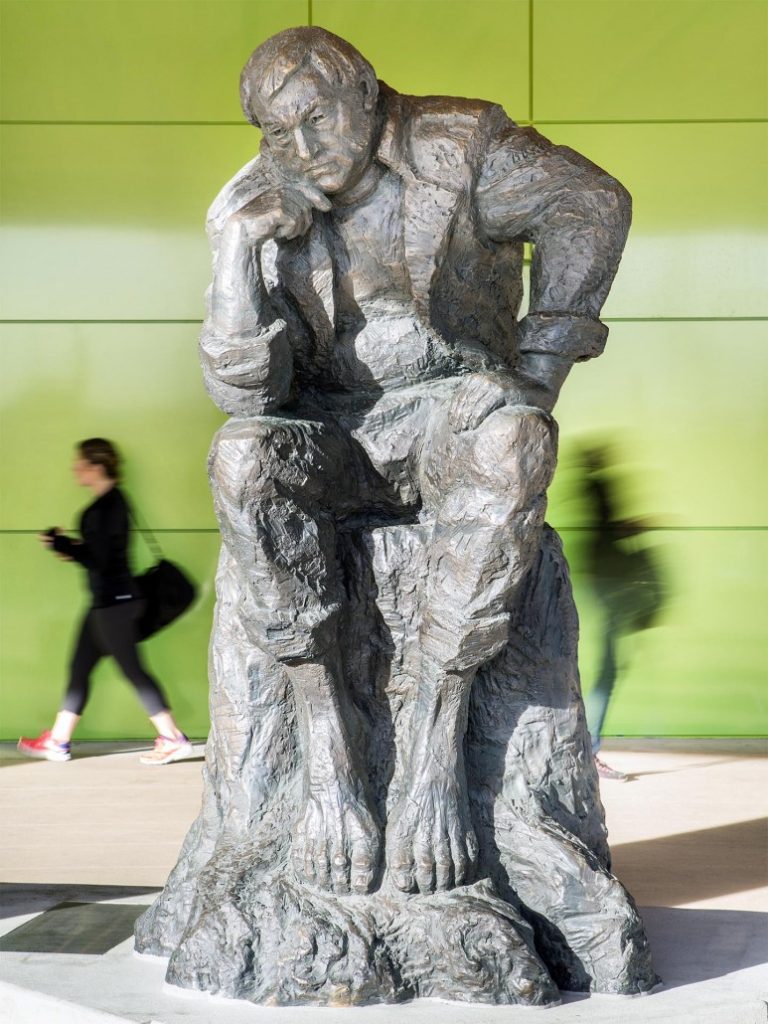
He was barefoot, his trousers rolled up to his knees, his coat unbuttoned and shirt slightly open. Sitting on a rough wooden stump, he rested his chin on one hand, as if lost in thought. There was no grand pedestal beneath him, no distance that usually separates the public from statues of historical figures. Without the modest plaque and the bronze sculpture by Chinese Canadian artist Ken Lum, I would never have known that he was Simon Fraser.
It was a name I had known for nearly thirty years.
I first encountered it when I was looking for my first job after I arrived in Canada.
Back then, I took an offer working as a researcher at Simon Fraser University. Every day on Burnaby Mountain, I passed the university signs bearing those words. To me, “Simon Fraser” was simply the name of an institution—like many universities named after people from history. I never stopped to wonder who he actually was.
Later, I came to know the Fraser River, the longest river in the province.
Whenever the SkyTrain crossed the river, I would watch the water unfold outside the window. On clear days, I could see all the way to the snow-capped mountains in the distance. “Fraser River” appeared again and again on transit maps, drawing the boundary of the fare-zones.
A university and a river—both carried the name of the same person.
Yet he remained only a name, until that afternoon.
Beside the bronze statue was a wooden bench. It was not an ordinary city bench, but a massive piece of cedar, shaped from a single log harvested from the trees that once stood on this site. Its natural edges remained intact, along with the grain, weathered cracks, and rings that marked its years.
I sat down.
Only then did I notice how carefully the bench had been placed.
Sitting there, I found myself looking out in the exact direction Simon Fraser was facing. Just a few feet apart, we sat together.
I rested my hand on the rough cedar surface, tracing the deep cracks left by time. Above me, a SkyTrain rumbled past, sending a faint vibration through the plaza. When the sound faded, the city returned to its usual rhythm.
A commuter dragged a suitcase across the pavement. Someone walked out of the supermarket carrying shopping bags. A little boy ran toward the statue, stared up at it with curiosity for a moment, and was soon pulled away by his mother.
Almost no one stopped.
Only a few pigeons wandered around the sculpture, pecking at crumbs and occasionally fluttering their wings, as if keeping the old explorer company for all those who were too busy rushing by.
I thought about the young person I was nearly thirty years ago—the newcomer who was still trying to find his place in a new country. If someone had told me then that one day I would sit here beside Simon Fraser, sharing a quiet moment with him, I would never have believed it.
Back then, I knew a university.
Later, I came to know a river.
And only that afternoon did this name finally acquire a face I could recognize.
I did not take a photo.
I did not pose for a selfie.
I simply sat there a little longer, watching people come and go, watching trains glide overhead one after another.
When I finally stood up to leave, I knew that the next time I heard the name “Simon Fraser,” I would think of more than a university or a river.
I would remember that quiet afternoon.
And the barefoot man sitting peacefully on a wooden stump.