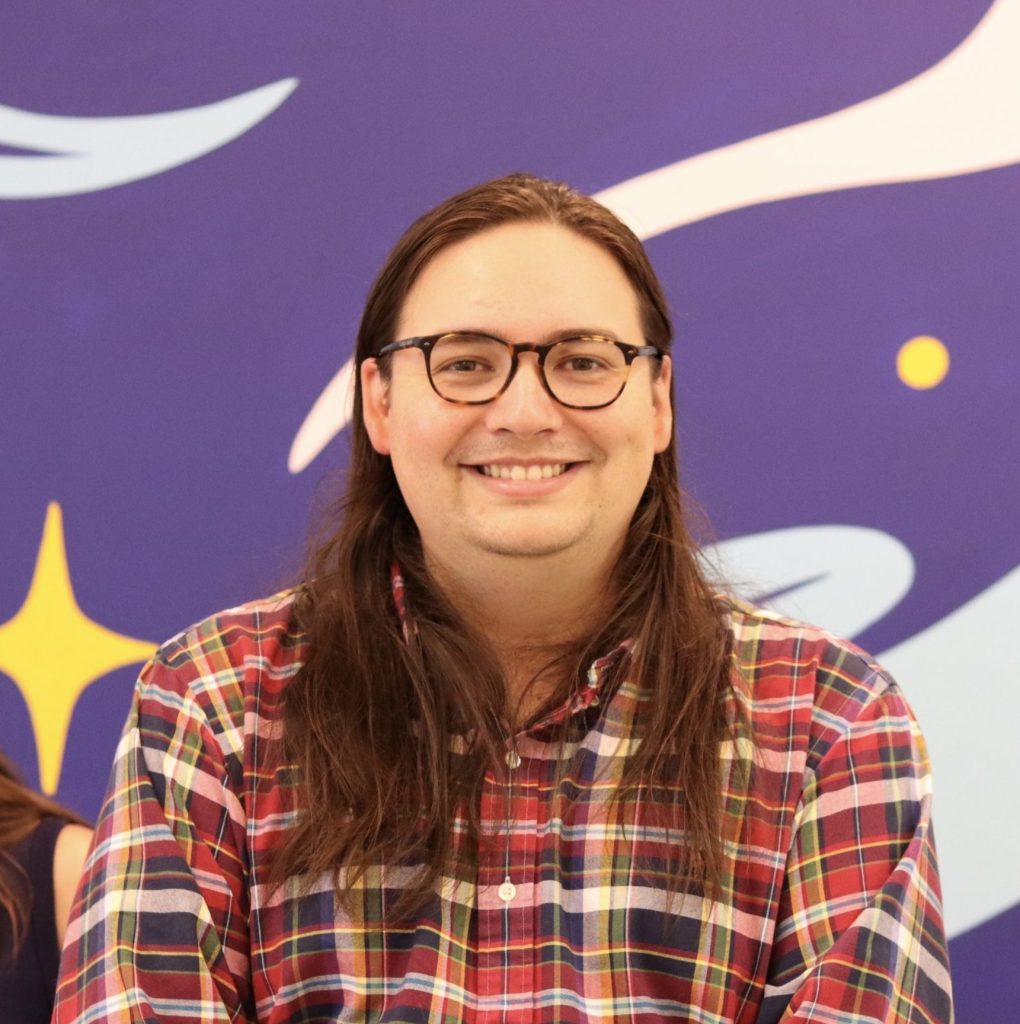
Eliot White-Hill tells stories of his Coast Salish culture through his art and written works. His Coast Salish name is Kwulasultun and his Nuu Chah Nulth name is Kwaayas. And White-Hill is astonished by parallels between mythical creatures in Asian cultures and supernatural beings represented in Coast Salish cultures.
“The Chinese dragon is long, like a snake,” White-Hill, Kwulasultun tells Pancouver over Zoom. “It’s almost identical to the serpents in our culture. There are sea serpents, but there are also serpents that fly through the air.”
One of those creatures of the sea is Sisiutl, a legendary two-headed-serpent. Last year, the Lantern City presented Kwakwaka’wakw artist Richard Hunt’s vibrant image of Sisiutl in šxʷƛ̓ənəq Xwtl’e7énk Square to welcome the Year of the Dragon.
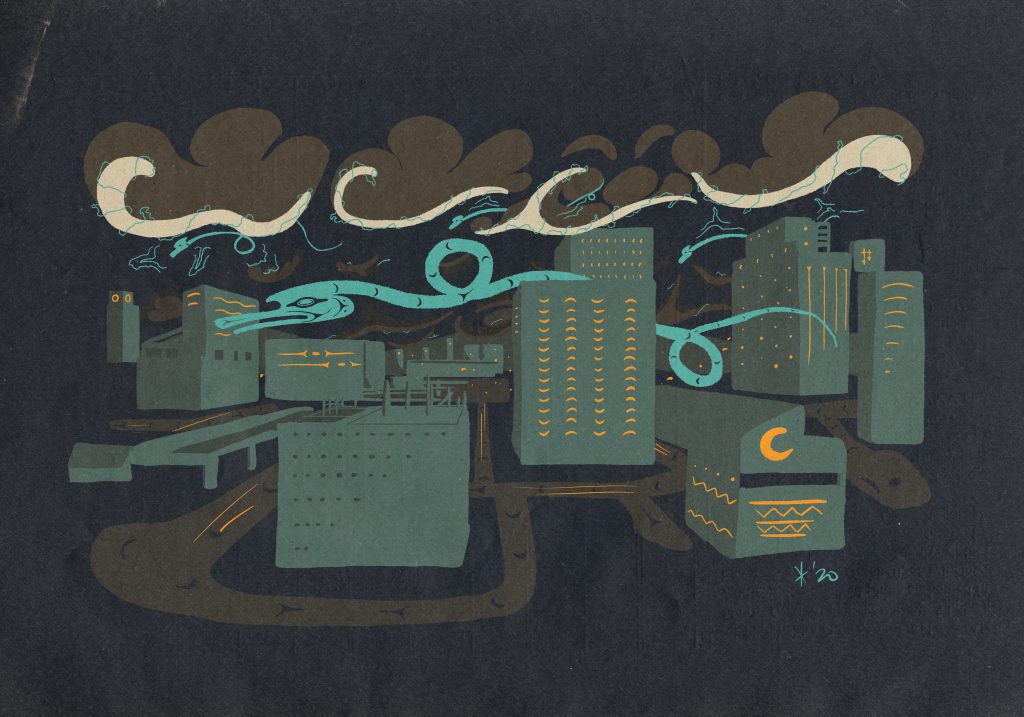
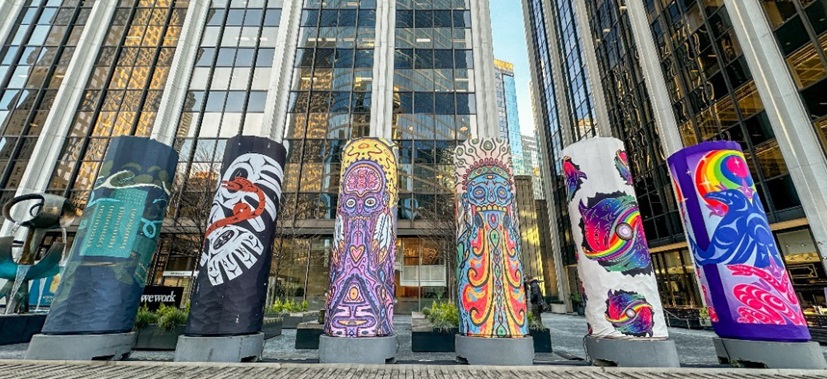
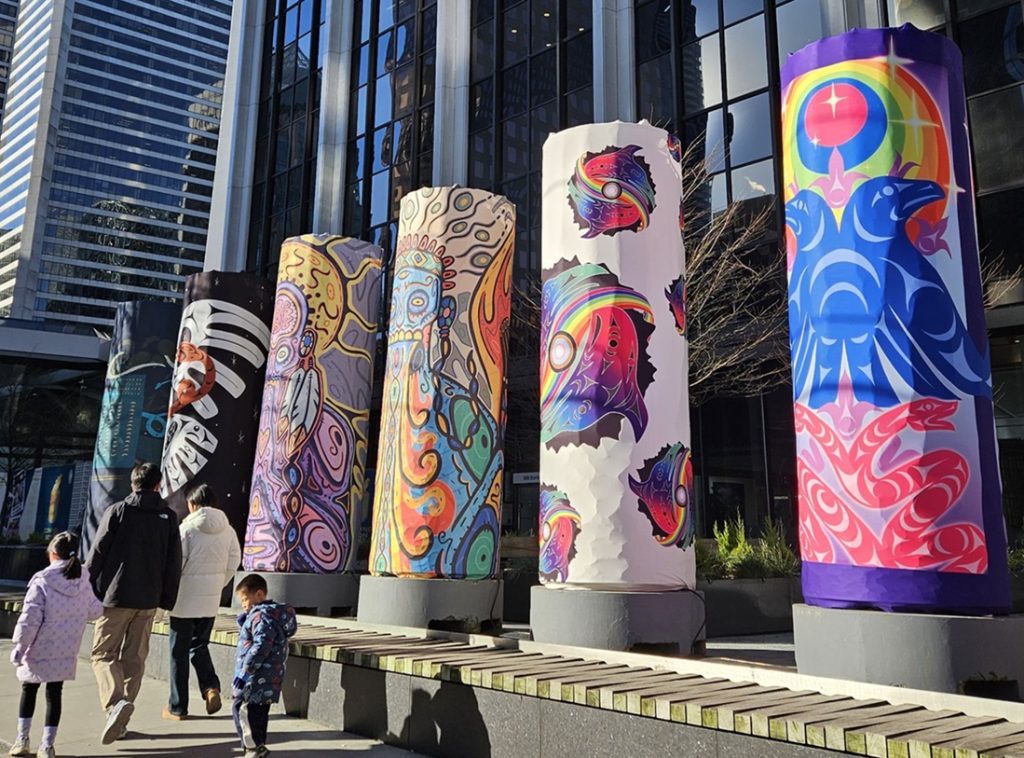
This year, the Lantern City is exhibiting White-Hill, Kwulasultun’s moody depiction of flying serpents to welcome the Year of the Wood Snake. Ts’inqwa’ (Lightning Snake) is part of Coastal Lunar Lanterns in front of the Bentall Centre until February 20.
“I did it after there was a huge lightning storm in the city,” White-Hill, Kwulasultun says of his piece. “I saw these images of lightning crawling through the sky amongst all the skyscrapers in downtown Vancouver. It was such a powerful scene.”
In his culture, lightning serpents are called Ts’inqwa’, which are very powerful beings.
“They’re associated with the Thunderbird,” White-Hill, Kwulasultun continues. “It’s been said that very lucky people can come upon their scales on the ground. They shine like rainbows and can make you very lucky throughout your life. It’s very auspicious.”
Kwulasultun design on second lantern
Snakes are not the only creature that Coast Salish and East Asian cultures have in common. The phoenix, also known as Fenghuang (鳳凰), is a mythological bird in Asia. It has a huge wingspan and is often shown attacking snakes.
Meanwhile, Coast Salish culture also has a magnificent bird-like spirit, the Thunderbird, which has large plume.
“Despite being on opposite sides of the ocean, we have such similarities in these really significant supernatural beings,” White-Hill, Kwulasultun says.
His second Lunar New Year lantern outside the Bentall Centre features a Thunderbird locked together with a two-headed serpent. He calls this Sxwuxwa’us’i’ Si:nlhqi’ (Thunderbird and Two-Headed Serpent), which he created as a work of art in 2020.
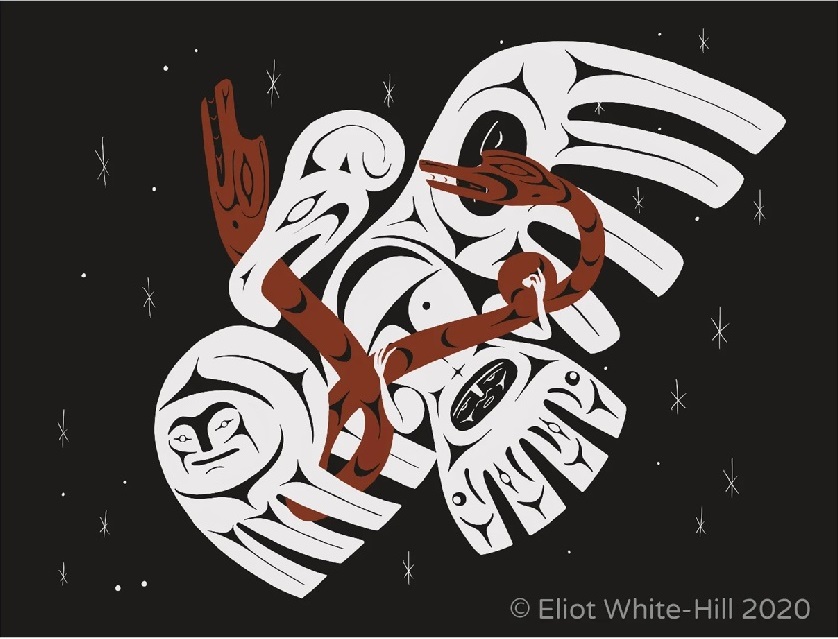
“Despite the image being kind of like a combat scene, it really transcends a predatory-prey relationship,” White-Hill, Kwulasultun emphasizes. “These beings exist alongside each other. They live together and it’s kind of a reciprocal relationship, like the way that an eagle and salmon have in our culture.”
For White-Hill, Kwulasultun, the lesson is that we shouldn’t take too much from the world.
He is highly conscious of his ancestry and culture, which he reflects through his art. His father is Doug White, a widely respected former chief of the Snuneymuxw First Nation on Vancouver Island. His dad is currently special counsel to the premier on reconciliation and is a former leader of the First Nations Summit.
“He’s been such a role model to me and so inspiring to me,” White-Hill, Kwulasultun says of his father. “And he’s always asking me if I’m going to go to law school yet.”
Working in economic development
White-Hill’s great-grandmother was the scholar Dr. Ellen White, Kwulasulwut, who died in 2018. She was an educator, social activist, Order of Canada recipient, and a key driver of the First Nations Studies program at Vancouver Island University.
For a while, it looked like White-Hill, Kwulasultun might follow his dad into the legal profession. The son is familiar with landmark court cases that have defined Indigenous legal rights so far. White-Hill, Kwulasultun also developed a passion for storytelling from his mother, Ilse Hill, who shared her love of reading with him. However, because he lacked the confidence to draw, White-Hill, Kwulasultun never imagined as a child that he would become an artist.
After graduating in 2018 with an undergraduate degree in philosophy and liberal studies at Vancouver Island University, he worked in economic development with the Snuneymuxw First Nation.
“I helped plan and get the construction through on our gas station,” White-Hill, Kwulasultun recalls. “I helped start a restaurant in Saysutshun on Newcastle Island. And I wrote all the food-safely planning. That was a crazy experience.”
But the death of his great-grandmother also propelled him to become an artist, even though he knew little at that time about perspective or colour. He became obsessed over creating Coast Salish art, which he describes on his website as “an existential statement of our beings as a people”. His first solo exhibition was in 2020, and he went on to create a set of murals in the campus library at Vancouver Island University.
“I read old ethnographies and anthropological texts,” White-Hill, Kwulasultun states on his website. “I read all of the traditional stories I can get my hands on.”
He also studied the Hul’qumi’num language. Then in 2023, White-Hill, Kwulasultun graduated from Emily Carr University with a master’s degree in fine arts.
Valuing Coast Salish art
On his website, he bluntly declares that Coast Salish art has been “historically misrepresented and disrespected within the territory of the Salish peoples”.
“It was seen as second class compared to other Northwest Coast styles,” White-Hill, Kwulasultun maintains. “Fortunately, a select group of Coast Salish artists, such as Susan Point, Charles Elliott, Simon Charlie, the Sparrow family of Musqueam, as well as others, preserved our style and advanced it; carrying it forth and providing the ground upon which it has been able to flourish.”
His goal is for “future generations of Coast Salish people to grow up surrounded by our art”. Furthermore, he aims to share it in ways that create connections and generate empathy. Hence, his keen interest in building bridges with the Asian community on Lunar New Year. This sentiment also underscores his gratitude to the Lantern City organizers for giving him this opportunity.
As he reflects on the long arc of history of Indigenous peoples in B.C., White-Hill, Kwulasultun appreciates that he is living in remarkable times.
“We are in a Renaissance right now of Indigenous culture across Canada, across North America,” White-Hill, Kwulasultun says. “It just makes me so proud to see all the people of all different ages telling our stories and doing work that is meaningful to them that helps our communities—whether it’s art or whether it’s any form of work.
“There is a real interest in learning about who we are right now in the general population, a real authentic desire to learn and to celebrate who we are,” he adds. “That’s just such an incredible thing. I think about how my great-grandparents would feel.”
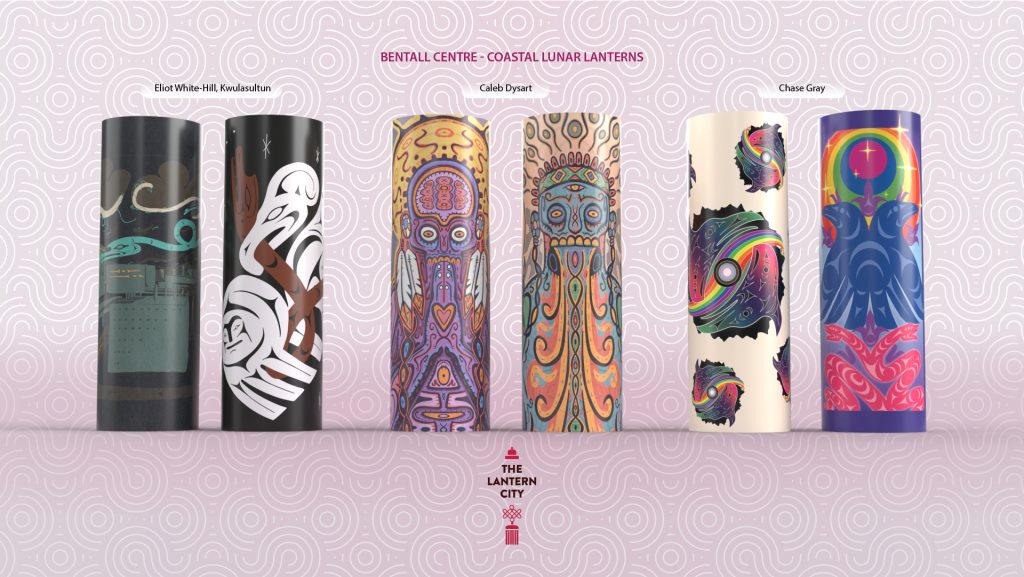
To learn more about Eliot White-Hill, Kwulasultun, visit his website or follow him on Instagram @kwulasultun. The Lantern City will present Coastal Lunar Lanterns outside the Bentall Centre until February 20.
Follow Pancouver on X @PancouverMedia, Bluesky @pancouver.bsky.social, and Instagram @PancouverMedia. Also follow Charlie Smith on Bluesky @charliesmithvcr.bsky.social.