
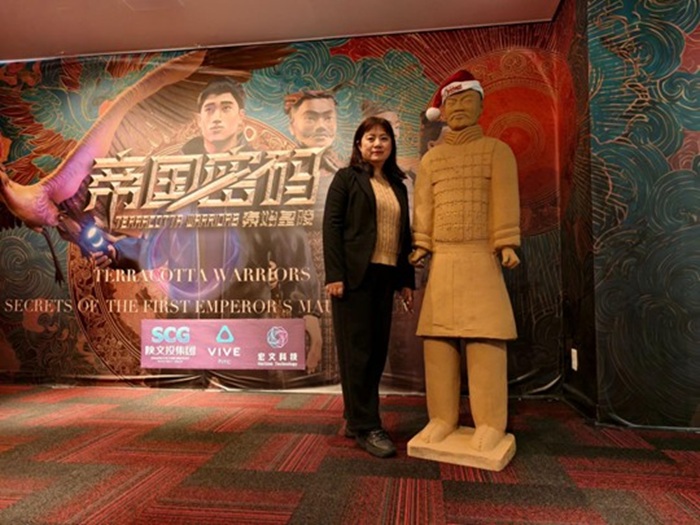
Exclusive Interview with Sunnie Li, organizer and CEO of Broadway Magic Wonders
Vancouver—a destination known as YVR in the world—has no shortage of innovative cultural programming, but few offerings manage to unite cutting-edge technology, artistic ambition, and historical authority as convincingly as Terracotta Warriors: Secrets of the First Emperor’s Mausoleum.
Launched on November 29 at Richmond’s Lansdowne Centre, this 40-minute immersive experience is far more than a virtual reality (VR) spectacle. Officially licensed by the Museum of the First Qin Emperor’s Mausoleum, it is a ground-breaking location-based entertainment (LBE) VR installation that invites audiences to step inside one of the most iconic and historically inaccessible sites in human civilization.
Positioned at the intersection of educational and experiential entertainment, the exhibition appeals not only to VR enthusiasts and gamers but also to families, tourists, students, and cultural history lovers. It offers a rare opportunity to experience ancient history not as a distant subject behind glass, but as a shared, walk-through world.
To understand the vision behind the project, I spoke with Sunnie Li, organizer of the VR show and CEO of Broadway Magic Wonders, about its origins, challenges, and cultural significance.
From inspiration to mission
Q: What first inspired this VR project? Why choose an authentic imperial mausoleum as the theme?
Li: The inspiration began in July 2024, when I experienced a VR exhibition in China for the first time. Watching the murals of the Mogao Caves come alive through a headset was a transformative moment. I realized then that VR is not just a technology—it is a new medium for cultural communication. I decided to invest in developing the Dunhuang VR project almost immediately.
When I returned to Vancouver in September 2024, I noticed there was nothing comparable here. That led me to explore bringing a world-class cultural VR experience to Canada. Although Dunhuang was an early option, the Terracotta Army’s global recognition made it the ideal starting point.
Often called the “Eighth Wonder of the World,” the Terracotta Army is famous, yet itsunderground mausoleum remains sealed. VR offers the first opportunity to break through physical barriers and let audiences enter this two-thousand-year-old world up close.

Authenticity as a core principle
Q: As an officially authorized VR experience, how do you ensure historical and cultural authenticity?
Li: Terracotta Warriors: Secrets of the First Emperor’s Mausoleum was developed over a period of two years by the Shaanxi Cultural Investment Group, HTC, and the Museum of the First Qin Emperor. It is the world’s first officially authorized XR large-space experience of the mausoleum. The project presents 50 years of archaeological discoveries through rigorous digital reconstruction, guided by three principles: archaeological authenticity, academic precision, and engaging interaction.
The underground palace is recreated at a 1:1 scale, incorporating recent findings such as the nine-tiered platform and the hundreds of opera figurines. Every scene, artifact, and narrative element was reviewed line by line by museum experts.
Dozens of expert consultations ensured accuracy in historical research, material textures, costume structures, and spatial layout. This is not merely a “spectacular experience”—it is a culturally rigorous, academically grounded project.
Emotion beyond immersion
Q: What emotions or reflections do you hope audiences take away from the experience?
Li: We hope visitors leave with more than excitement. We want them to feel a genuine emotional connection across time and culture.
Behind the Terracotta Army lies the Qin Empire’s vision of order, governance, and belief. When technology makes history visible again, it invites us to reflect on how we understand the past—and how we see the present and future.
If audiences walk away with awe and a deeper respect for Chinese civilization, then the project has fulfilled its mission. In a world where cross-cultural dialogue is increasingly important, VR can become a window that conveys the depth and humanity of history to diverse audiences.

Technology that you can walk into
Q: What is the biggest technological breakthrough of this VR experience?
Li: There are two aspects we are especially proud of. First is the upgraded LBE large-scale immersion technology. HTC’s system allows visitors to freely walk through a virtual environment with real-time tracking and multi-user synchronization. This kind of shared, full-space immersion simply isn’t possible with home VR.
The second is the next-generation mixed-reality headset with full hand tracking. Using the VIVE Focus Vision headset—with 5K resolution, a 120-degree field of view, and 26-point hand tracking—visitors can interact naturally without controllers. You can “open” the mausoleum, “touch” the Terracotta Warriors, and participate in Qin-era scenes as if you were truly there.
For the first time, cultural heritage has a digital form that people can physically walk into.
Why location-based VR matters
Q: How is a location-based VR experience fundamentally different from at-home VR?
Li: Home VR focuses on individual entertainment. Location-based VR emphasizes immersion, physical movement, and shared presence.
Visitors explore the virtual mausoleum together, supported by coordinated lighting, sound, spatial design, and narrative pacing. It feels less like a game and more like a guided cultural journey.
You are not watching a story—you are standing inside it.
A cultural experience for the whole city
Q: Beyond VR fans, who is this experience designed for?
Li: We want this to be a city-wide cultural event. It’s suitable for families as an intergenerational learning experience; for tourists as a unique cultural destination; for schools as a powerful supplement to history and art education; and for professionals in culture, technology, and tourism as a new model of cultural innovation.
We hope it becomes Vancouver’s window into Eastern civilization—a space where anyone curious about culture, storytelling, or immersive technology can find meaning.
Why Vancouver
Q: Why launch this show in Vancouver?
Li: Vancouver is a global centre for immersive content, with strong industries in film, computer graphics, and gaming. It is also deeply multicultural, which makes it naturally open to global narratives.
On a personal level, Vancouver is our home. Bringing Chinese culture into our own community—so our friends and neighbours can literally walk into history—carries a deep sense of purpose for us.
I also feel supported here by my family and friends. Some are my university alumni, and more are just locals with the same vision—when in Rome, do as the Romans do.
Precision in the details
Q: What was the biggest challenge during production?
Li: Balancing historical accuracy with an engaging experience was the hardest part.
Even details like the skin tones and eye shapes of the Terracotta Warriors required careful reference to pigment studies and archaeological reports. For example, the angle of descent into the underground palace—30 degrees or 45 degrees—sparked intense academic debate.
These details may seem small, but they reflect how seriously we treated the responsibility of recreating history.
Museums, and what comes next
Q: How did museum collaboration shape the project, and what’s next?
Li: Museum experts provided archaeological data, reviewed scenes and scripts, and validated the final content. Their involvement ensured credibility at every stage.
Looking ahead, we hope to develop VR experiences focused on the Silk Road, Dunhuang, ancient architecture, and even Indigenous cultures in Canada. Our long-term vision is to build a Digital Cultural Content Hub in Canada—one that allows civilizations around the world to be experienced through immersive technology.
A personal journey
Beyond technology and logistics, the project also carries deep personal meaning for Li. During the production period, her father was hospitalized in China following an accidental fall in November this year. After delivering remarks at the project’s news conference, she flew back immediately to be with him during his final days.
Shortly after the traditional seventh day of mourning following his passing, she returned to Vancouver to continue preparations for the show’s official launch.
“The work was intense, both physically and emotionally,” Li recalled. “But as the project lead, many things required my personal attention.”
The night before the opening ceremony, a colleague suggested she wear red for a celebratory tone. She chose not to.
“I had prepared a red traditional outfit months earlier,” she said, “but after my father’s passing, I wanted to remember him in the simplest, most
understated way.”

Walking into civilization
After the interview with Li, I put on the VR headset and stepped into the experience myself. What unfolded was not merely a reconstruction of ancient China, but a striking moment when history felt newly alive.
It was like witnessing a pivotal turning point in Chinese history—the moment when fragmented states gave way to a unified empire whose foundations continue to shape the nation today. A civilization long confined to textbooks and museum vitrines seemed to expand into a walkable, emotionally resonant world.
Audience reactions echo that response. One visitor wrote, “I felt like I was really standing among the Terracotta Warriors. The level of detail and atmosphere were incredible—both educational and breathtaking.” Another commented, “The experience transported me straight into ancient China. Everything felt remarkably real, from the sounds to the lighting. A perfect blend of history and technology.”
In an age when attention is fragmented and history often feels distant, Terracotta Warriors: Secrets of the First Emperor’s Mausoleum offers something rare: a chance to slow down, step inside time, and experience civilization from within.
The VR show Terracotta Warriors: Secrets of the First Emperor’s Mausoleum is open seven days a week at Lansdowne Centre, Unit 210-5300 Number 3 Rd, Richmond, B.C. Visits can be booked on the website at https://vrvr.show. Ban Zhang is the author of Going to the Grouse Grind – Collected Essays. The Chinese edition is available through the Harvard Book Store and other online booksellers. Follow Pancouver on X @PancouverMedia and on Instagram @PancouverMedia.


