“An injury to one is an injury to all.”
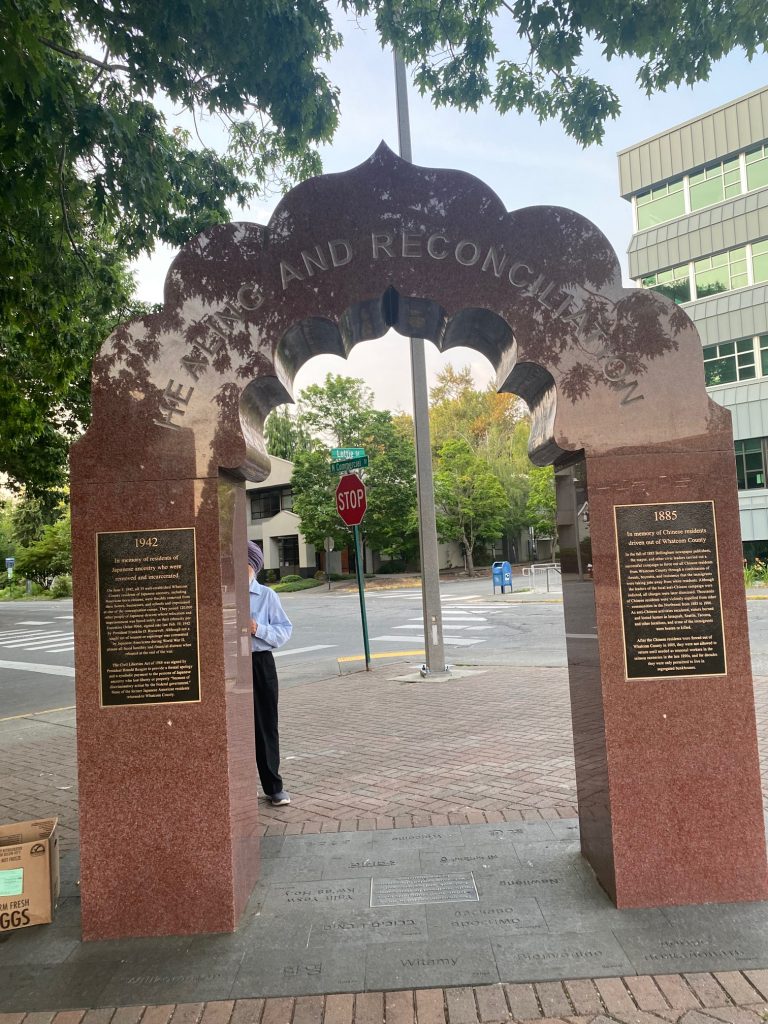
This trade unionist slogan—coined to bring international solidarity—is best represented by a memorial in Bellingham. The Arch of Healing and Reconciliation was installed in 2018 to recognize violent acts of racism against immigrants from India, China, and Japan.
Visitors are greeted by plaques acknowledging historic wrongs at different times committed against these communities at different times greet visitors. They stand on both sides of the arch.
One of them is about the ugly events of 1885 when Chinese people were driven out of Whatcom County. Another recalls the 1907 riots against Sikhs, Hindus, and Muslims from India. A third acknowledges the removal and incarceration of Japanese people in 1942.
Among the plaques is a 2007 proclamation recognizing the September 4, 1907 violence. Made by the City of Bellingham to mark the centenary of the riots, this memorial pillar laid the groundwork for the monument.

Arch has slabs with multilingual greetings
In fact, September 4 was recognized as a Day of Healing and Reconciliation. Although, the proclamation acknowledges the government policies’ impact on Native communities, a plaque dedicated to the Indigenous peoples of the U.S. would have made the arch even more meaningful, considering that we are all on their traditional lands and yet they continue to suffer systemic racism.
The floor of the structure has brick slabs with greetings in different languages. The ones in Punjabi, Hindi, and Urdu say welcome to everyone. The most remarkable part of the memorial is that it’s not just confined to any one particular community and has tried to include stories of diverse groups of people speaking different languages and following different religions and customs. That makes this place special and worth visiting for any newcomer who needs to know the racist history of the Pacific Northwest and understand how white supremacy doesn’t discriminate between people of colour. Everyone is vulnerable.

Gurpreet Singh is a B.C. author and co-founder of Radical Desi. Follow Pancouver on Twitter @PancouverMedia and on Instagram @PancouverMedia.