By Shanice Wang
“It’s not even Chinese food, not even Indian food, we are there in between.”
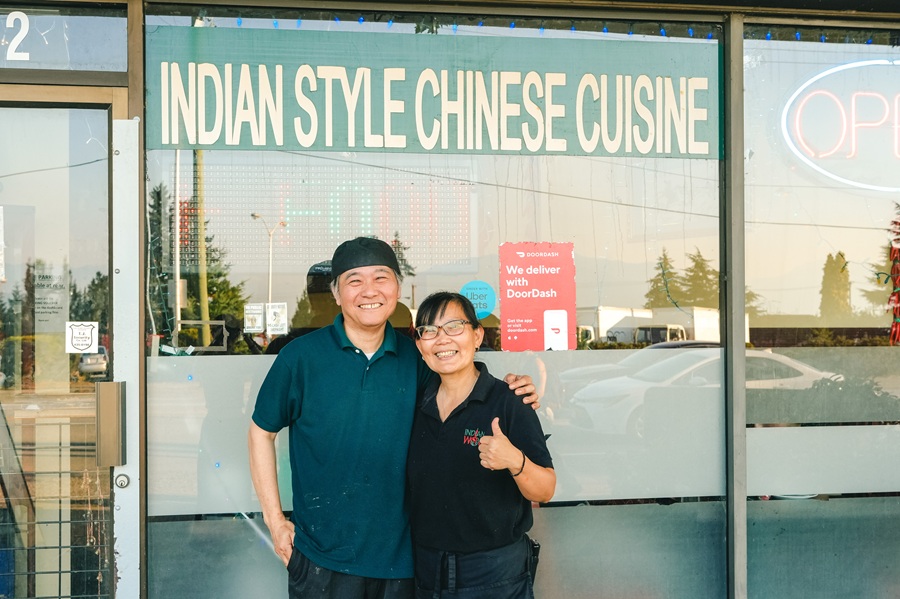
Walking down a street in Burnaby, it’s hard not to notice one restaurant’s name: Indian Wok. Its owners, Ian Chung and his wife Sophia, are both Hakka, born and raised in Kolkata, India.
Their blended identity shows up in the name itself. As Sophia explains, “it’s about the Indian style of Chinese food in a wok.” The name often confuses people, but the confusion makes them curious, and curiosity brings them through the door. In its own way, the name works as advertising.
Hakka technique, Indian spice
Sophia’s family ran restaurants in India, and Ian has been a chef his whole career. When Chinese cooking arrived in India, it slowly adapted to local tastes for bold spices and became what it is today.
The best-known Indian Hakka dishes are Manchurian chicken, chili chicken, and Hakka chow mein. For Sophia, Hakka chow mein is everyday food, yet here people treat it as a specialty. As younger generations in India came to love more heat, cooks made the noodles spicier and created Manchurian noodles and Szechuan noodles. Sophia laughs that the “Szechuan” in the name has nothing to do with the Sichuan peppercorns and numbing heat Chinese diners might expect.
Asked to pick the restaurant’s signature fusion dish, Ian names chili chicken. Traditional Hakka cooking isn’t especially spicy, but this dish brings in Indian spices and chilies. He also works the fusion in reverse, cooking paneer—the Indian cheese—in the Chinese salt-and-pepper style.
Sophia points to masala. The common Indian spice blend turns out to suit Chinese fried rice, fried fish, and stir-fried vegetables surprisingly well, and that became another branch of fusion cooking. Not every dish gets the fusion treatment, though. Sweet and sour chicken and sweet and sour fish keep their distinctly Chinese sweet-and-tangy flavour.

“Hakka” means guest
Their lives have long revolved around restaurants, and restaurants also set them on the move. In the 1980s, as Ian watched more and more of his friends leave India, and with many of his cousins already in Austria, he went there to work as a cook. They built a family and a restaurant life there. Later, Sophia’s family moved from India to Vancouver, and after Ian’s parents passed away, they decided to follow. In 2007, the family moved once more.
“If you ask me where I belong, frankly, I’d say I don’t belong anywhere,” Sophia says. “But India is my home. I grew up there, I have friends there, so that is my home.”
Ian answers in Hakka. The “Hak” in Hakka means “guest”, he explains. There is no piece of land Hakka people can point to and call their own, so wherever they go, they make that place home. And so Canada is home for them now, too.
Sophia adds that they are both proud to be Hakka, because it is what their parents passed down to them.
“But if you ask my sons, I bet they’d say they’re Canadian without a second thought,” she says with a laugh.

Even so, the younger generation still looks forward to the couple’s home-style Chinese cooking: steamed pork, stuffed tofu, red wine-lees pork. These everyday dishes keep them connected to the family.
Today, all of their family members have left India. Relatives are scattered across the globe, in Sydney, Vienna, and Toronto, and as far as Norway and Sweden. When they started a family in Austria, the couple thought they would stay there for the rest of their lives. They never imagined they would one day move to Canada.
Through blending and reinventing their cooking, they have carried the taste of Hakka from India to Austria and on to Canada. It has become their way of keeping family traditions alive.
“The children are losing the customs,” Sophia says. “But the food will always stay.”
To learn more about Indian Wok (5212 Kingway, Burnaby), visit the website or follow the restaurant on Instagram @indian.wok. Follow Pancouver on Instagram @PancouverMedia, on X @PancouverMedia, and on Bluesky @pancouver.bsky.social.