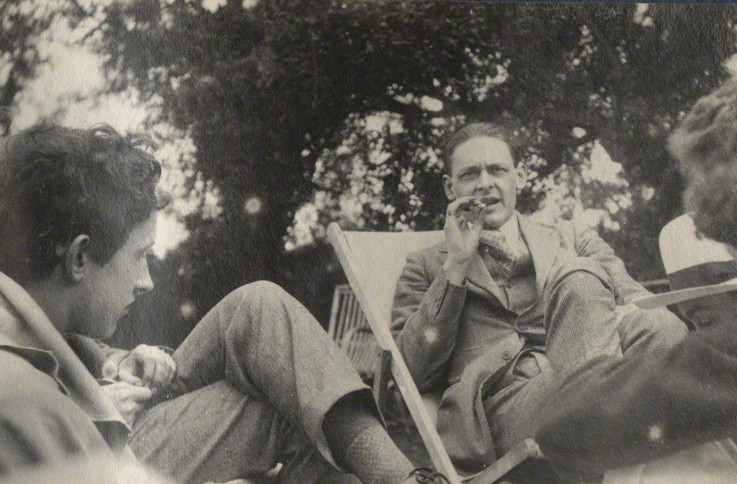
T.S. Eliot, Nobel Prize in Literature (1948) recipient, once declared that “Poetry is not a turning loose of emotion, but an escape from emotion; it is not the expression of personality, but an escape from personality,” which strikes at the very heart of Romanticism’s creed. Once a poem takes flight from the poet’s heart, it ceases to be a mere extension of its creator—it endures the blood and labour of gestation, survives the agony of birth, and greets the world with its own sovereign cry.
In “Tradition and the Individual Talent”, Eliot reveals his poetic revolution: great verse must break free from the chains of private sentiment to forge universal human resonance. It sheds the creator’s idiosyncrasies to awaken shared truths. True poetry thus becomes a distinct life-form, independent of its maker. The poet is merely a “shred of platinum”—a vessel, a pure medium—capturing and catalyzing emotional and imagistic particles until they fuse in an alchemical metamorphosis.
This “impersonal” theory shatters Romantic ideals. Where Wordsworth championed poetry as “the spontaneous overflow of powerful feelings”, Eliot maps an alternate path: poetry is not catharsis but transmutation. The poet sacrifices “the particular consciousness of the past”, refining raw experience in the crucible of art.
The manifesto of poetic independence reveals its tensions in Eliot’s own work. “The Waste Land” (1922) erupts like a spiritual volcano. Its fragmentation, civilizational decay, and spiritual desolation undeniably mirror his tormented marriage with Vivienne Haigh-Wood amid war and financial collapse. Private wounds bleed into the lines—“April is the cruellest month, breeding / Lilacs out of the dead land.”
Yet the genius of “The Waste Land” lies in crystallizing the particular into myth for an age. Eliot weaves his suffering into a tapestry of literary shards: Tristan’s lament, spectral crowds on London Bridge. The individual poet vanishes; intimate trauma becomes a key to a collective human crisis.
This “escape” isn’t erasure but alchemical distillation. Just as water transforms into wine through time, yeast, and vessel, the poet’s emotions undergo an inner chemical revolution. Initial sparks of personal feeling ignite the work—then collide, decompose, and recombine with cultural fragments, emerging as autonomous “art-emotion”.
Here lies Eliot’s paradox: only those who profoundly possess individuality and insight can fully grasp the necessity of transcending them. He praised Yeats as “the greatest poet of our time”, citing his “lucidity, honesty, and vigour”—a tribute to a formidable creative self. Impersonality demands not absence but sacrifice: placing one’s most vital insights into the furnace of poetry to forge gold that illuminates humanity’s shared darkness.
When a poem leaves its maker’s hand, it breathes independently. It moves among readers, refracting infinite meanings in the hall of mirrors that is collective consciousness. The poet’s emotion achieves its “escape”—yet endures eternally within this new life. This flight is not disappearance but metamorphosis: the self’s chrysalis burns in language’s fire to birth the poem-butterfly, bearing wings of universal truth.

An example: “Your Sorrow Rides the Flame”
As Eliot knew, those who surrender their deepest sorrows to the forge of language can birth verse that outlives them. In this poem, the individual’s sorrow escapes its creator—becoming a torch held not for oneself, but for all who sail the seas of human longing.
Here, solitude is purified into communal fire, and beauty emerges not as confession, but as a wave returning to the eternal sea.
The following poem by Cathy Xinman exemplifies this transformation. Born from individual feeling, it transcends individual emotion to touch on themes of love, resilience, elemental forces, and the spiritual act of offering. Once released, it no longer belongs solely to the poet—it lives wherever a reader breathes meaning into its lines.
Your Sorrow Rides the Flame
By Cathy Xinman
Full-bodied sorrow,
a voice rises from deep within.
My blurred eyes cannot make out the words,
but the feeling of this moment is more blissful than language.
When I come to your side,
I love that you love me—
as if life were given passion,
as if flames were right beside me.
Ah, poetry runs through my veins,
a fierce surging.
How you listen to my lines,
how you destroy those verses to be forgotten.
In the quiet morning,
weekend longing comes before my eyes.
When I awake, it is already summer—
it had been in my dreams,
stealing away for a long time.
I wish to prove to you
that sunlight has already illuminated it.
I was born in the north, you in summer;
we meet like this, before the gates of the sea.
You need not read the love poems I write—
I offer only waves to the ocean.
With you,
give me your softness
so I may write with strength;
let me cradle the waves for the sea.
Give me your delicate sorrow,
so I may speak with a fire-breathing tongue.
Let us together live through true poetry—
poetry that would die for life,
and at this moment,
you are reborn in love.
The waves will live their best selves.
O Captain, my Captain,
see how my eyes are full of smiles.
Your sorrow rides the flame—
a burning song
we surrender to the sea,
to the boundless years.
Life, I love the way you smile;
I will write for you the most intense verses.
I love you with my blood.
In the sun-scorched fields,
I even believe in the sound of stones shattering,
rising from the depths of my heart.
Long drowned in the mediocrity of mountains,
you must see—
the roaring, the running,
are the shouts that have broken free.
Summer, you cannot hide my flame.
In the morning, we are born into hope.
I cannot help but offer it to you—
offer it to the living blood,
offer it to the divine.
Cathy Xinman writes poetry in English and Chinese. Find her English-language collection, Where You Love Yourself, on Amazon. You can also hear her poetry on her TikTok page. Follow Pancouver on Instagram @PancouverMedia and on Bluesky @pancouver.