The Museum of Vancouver (MOV) has done something remarkable to advance reconciliation with First Nations. In recent decades, the 131-year-old institution in Vanier Park has been at the forefront of returning Indigenous belongings and ancestral remains to First Nations communities. This work began as far back as 1974 when the MOV repatriated a burial box from Quadra Island. And these efforts often went largely unnoticed outside of the museum world and individual First Nations.
According to Sharon Fortney, the MOV’s senior curator of Indigenous Collections, Engagement, and Repatriation, the museum traditionally removed records of objects from its collection database after repatriation had occurred. And that has sometimes frustrated community researchers.
“They may want to look at a photo and compare it to something else that they’re researching,” Fortney tells Pancouver on a tour of the museum “We’re talking about publishing some of our repatriated records so people can see them.”
In the meantime, a new exhibition, The Work of Repair: Redress & Repatriation at the Museum of Vancouver, goes a long way toward educating the public about what has occurred. Fortney says that the exhibition highlights three ways in which the MOV is advancing reconciliation: returning ancestral belongings, community engagement, and research that reconnects Indigenous belongings to their histories.

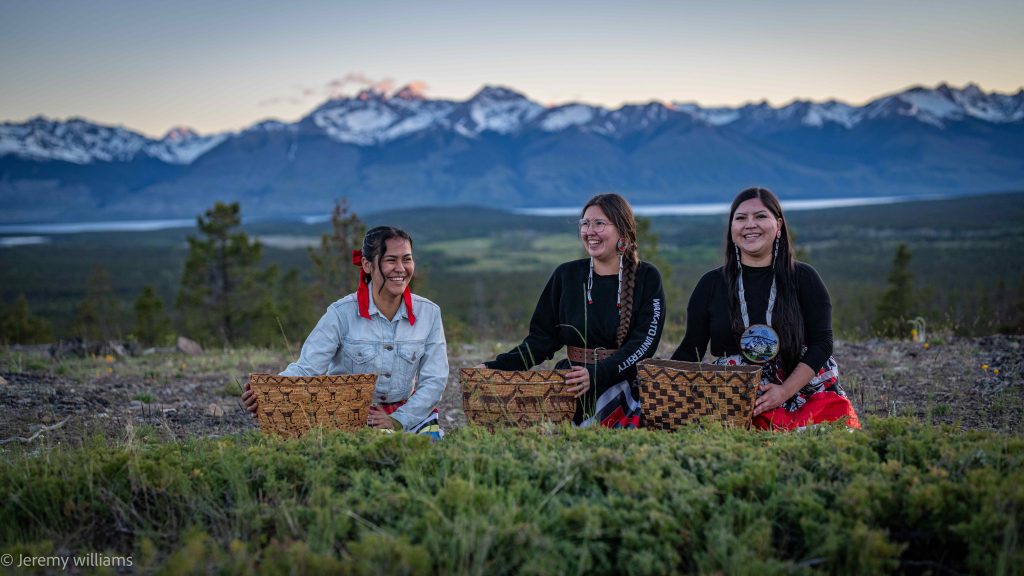
Upon entering the first section, entitled “Nexwenen Nataghelʔilh”, visitors are greeted with the sounds of wind, a river, and birds. Nexwenen Nataghelʔilh is actually a self-contained exhibition within the broader exhibition. It explores the emotional impact of the MOV repatriating more than 60 Tŝilhqot’in ancestral belongings.
“There’s a beautiful projection of different landscapes in Tŝilhqot’in territory with their belongings,” Fortney says. “You’ll hear some singing. You get a welcome from their chiefs and you get oriented to their territory.”
Film shows return of belongings
Nexwenen Nataghelʔilh includes baskets, contemporary jewellery, historical information, and a heartfelt film showing the reactions of Tŝilhqot’in people to the return of belongings to their territory. Videos in the exhibition are captioned so that people with hearing difficulties can read subtitles. In addition, visitors can touch certain objects, such as a handmade cradle.
Fortney is the MOV’s curatorial lead, working with the Tŝilhqot’in National Government’s curatorial team of Shane Doddridge, Caroline Butler, and Aaron LaMaskin. They designed Nexwenen Nataghelʔilh as a travelling exhibition, which means that it will be presented in smaller venues in other B.C. communities.

The Work of Repair: Redress & Repatriation at the Museum of Vancouver also includes a section called “Knowledge Repatriation”. Fortney says that this reflects the museum’s goal of community engagement. Here, visitors can see materials used in baskets and nets that were harvested locally. This includes cherry bark from the Jericho Lands, canary grass from Stanley Park, and cedar roots and spalting wood from the Seymour Demonstration Forest.
Meanwhile, film clips show decorative materials being harvested for basketry. Master basket maker Ed Carriere demonstrates on film how to work with cedar.
“We went to his home studio, so we spent two days with him,” Fortney says. “I took people from the host nations there.”
Correcting misidentified belongings
Another section of The Work of Repair: Redress & Repatriation at the Museum of Vancouver resulted from a collaboration with academic Hannah Turner. She is an assistant professor in the UBC School of Information. From 2021 to 2024, Turner’s Social Sciences and Humanities Research Council–funded project, “The Work of Repair”, enabled museum staff to investigate older belongings without accurate documentation.
“She gave us some funding to allow us to go through our accession ledger and match collections that had been detached from their history,” Fortney says.
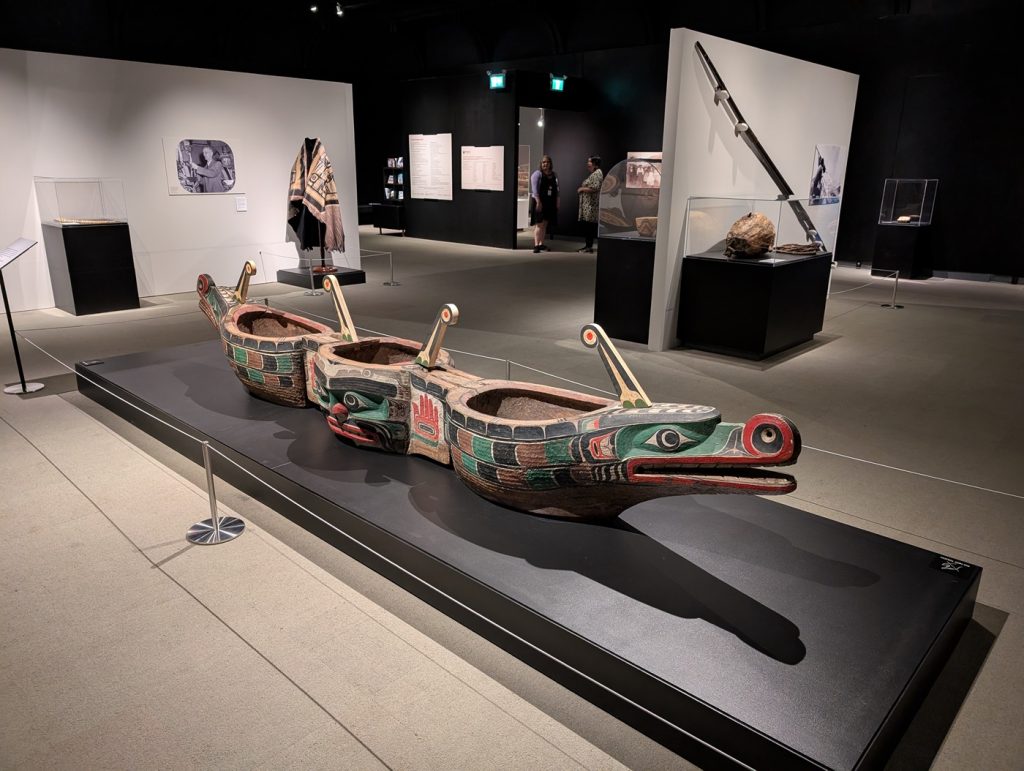
One such belonging is Chief John Scow’s sisiutl feast dish. It had been misidentified as the work of famed Kwakwaka’wakw carver Mungo Martin. The Royal British Columbia Museum hired Martin in 1952 to create works of Northwest Coastal Art, including totem poles that still stand in Thunderbird Park. In fact, Scow (c. 1870 – 1934) commissioned the bowl from Yakuglasima Wadagha at the turn of the 20th century.
“There is a success story of matching some pieces in the collection,” Fortney states. “That, in turn, facilitates repatriation.”
Following the return of the burial box from Quadra Island in 1974, the MOV made another repatriation the following year. It transferred an Ancestor, whose remains were excavated from a local site, to the SFU Museum of Archeology and Ethnology. This ensured that it would remain with other materials from the same site.
“Indigenous agency was being recognized by the 1980s,” Fortney says, “and the task force report on museums and First Nations began driving the MOV’s in-house repatriation policies.”
Fortney documents repatriation history
In the early 1990s, the MOV removed ancestral remains from the main storage area to a more secure vault. Then in 1993, the museum’s director repatriated 16 belongings to the Secwepemc Native Heritage Park for its opening. As a result, the Royal British Columbia Museum and the Canadian Museum of Civilization expressed concerns that the MOV had set a precedent by returning belongings without a formal letter of request.
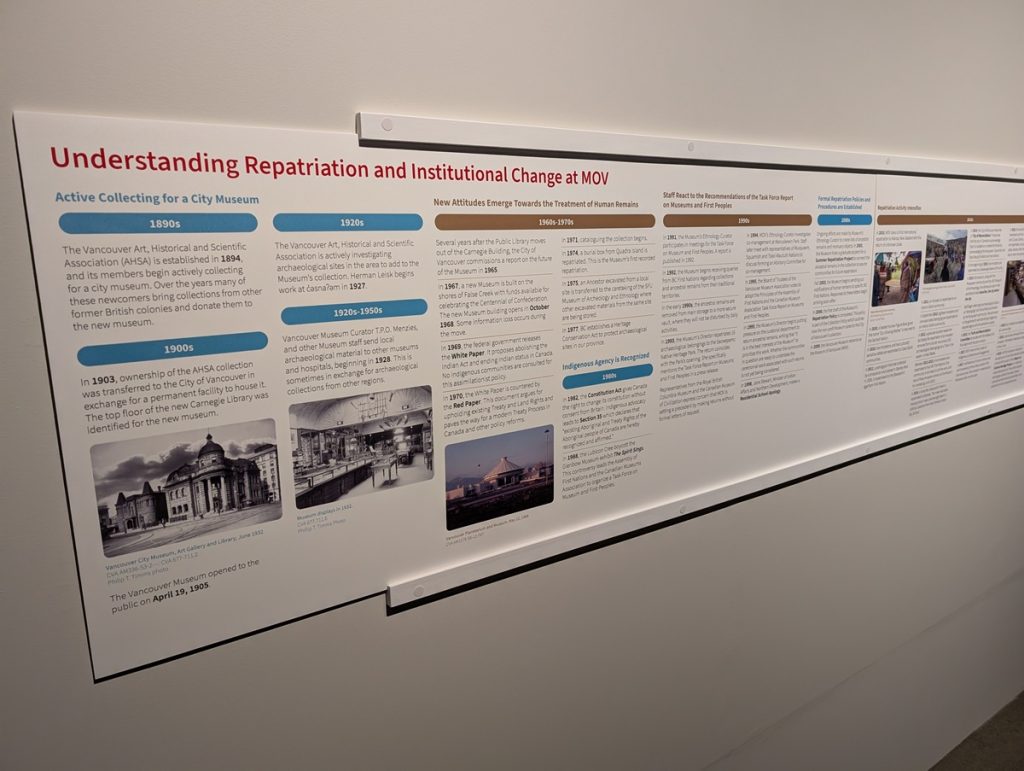
There have been more milestones since. In 2010, the MOV conducted its first international repatriation by returning a Korowai cloak to Wairoa, New Zealand. The same year, two Ancestors and two culturally sensitive rattles were repatriated to Coast Salish communities and a seated human figure bowl was returned to the Sechelt Nation.
More repatriations occurred in subsequent years, which are documented in text in the exhibition. (See photo above.)
“I have a larger timeline of my own research,” Fortney reveals.
Then with a smile, she adds that in a public exhibition, readers probably aren’t in the mood to read an entire book.
The Work of Repair: Redress & Repatriation at the Museum of Vancouver exhibition opened on June 20. For more information, visit the MOV website. Follow Charlie Smith on Bluesky @charliesmithvcr.bsky.social. Follow Pancouver on Instagram @PancouverMedia and on X @PancouverMedia. In addition, find Pancouver on Bluesky @pancouver.bsky.social.