
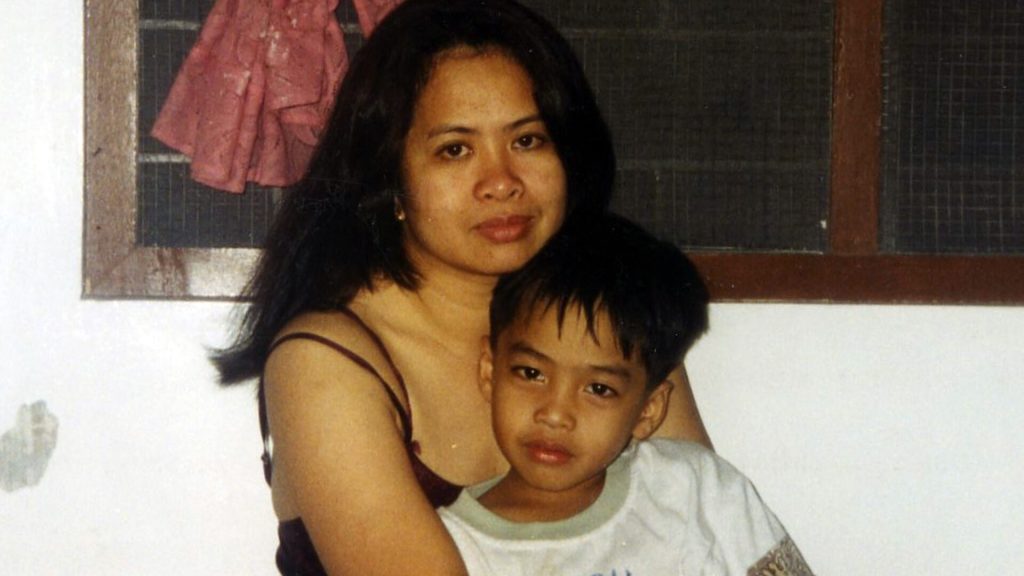
When Thea Loo set out to produce and direct a documentary about Canada’s live-in caregiver program, she had two things in mind. First off, she had a personal motivation—helping her husband, cinematographer Jeremiah Reyes, cope with his depression. If the two of them made Inay (Mama) together, Loo wondered if Reyes might develop a healthier relationship with his mother, a former live-in caregiver.
“Then, the byproduct of that, hopefully, would have been some improved sense of his mental health,” Loo tells Pancouver over Zoom. “Although, of course, you can’t make a film and expect someone’s depression to go away.”
Through much of the 1990s, Reyes was separated from his mom, Elvira. In those days, he was spending his childhood on the northern Philippines island of Luzon while Elvira worked as a live-in caregiver in Canada. She would then send remittances back home.
Secondly, Loo knew that many other Filipino Canadians had been touched by the live-in caregiver program. It required women to work in people’s homes as indentured labourers for two years before they could apply for permanent residence. Therefore, these Filipino Canadians also endured lengthy separations from their mothers, just like her husband.
“I wanted the Filipino Canadian community to realize that what is happening to them might feel very personal and isolated,” Loo explains. “But really, everyone was experiencing something similar—and that it was a product of migration pathways created by governments.”
Moreover, the Canadian government fostered the separation of Filipino mothers and children to build up the economy by enabling more Canadian mothers to enter the workforce. And the Philippines economy also benefited from exporting women to Canada and other countries as a source of foreign exchange.
Inay (Mama) named Best B.C. Film at VIFF
Loo admits that the couple felt some trepidation embarking on their potentially distressing project.
“The part that we were scared about the most was Jeremiah feeling, like, ‘What if I just ruin everything with my mother by doing this? What if I just further distance myself from her because she doesn’t want to do it?’ ”
Yet Loo and Reyes succeeded brilliantly as filmmakers by turning the camera on themselves and their parents. The North Vancouver husband-and-wife team also filmed their friend Shirley Langman and her mother Alma, a former live-in caregiver, discussing their convoluted family history.
At last year’s Vancouver International Film Festival, the couple’s 56-minute documentary—a journey of reconciliation and mental wellness across generations—won the Arbutus Award as the Best B.C. Film. And on Thursday, GEMFest 2025 will screen Inay (Mama) at 4 p.m. at the VIFF Centre.
Another critical voice in Inay (Mama) belongs to Charlene Sayo, a Vancouver transnational feminist whose mother co-founded the Philippine Women’s Centre in 1990. The non-profit community-based organization documented the dreadful impact of the live-in caregiver program. Community activism helped convince the federal government to halt applications in 2014.
According to Loo, Sayo played an instrumental role in not only legitimizing her film, but also in helping her understand the history of migration from the Philippines.
“She was willing to sit and be interviewed for the demo version of the film, which I used to pitch to the Knowledge Network to get funding for the whole film,” Loo reveals. “So, before we even shot the actual film, she was already teaching me so much and telling me about the history of Filipino Canadian activism in Canada.”
Watch the trailer (above) for Inay (Mama).
Loo pleased by audience reactions
Surprisingly, Loo says that the couple’s biggest obstacle was not traversing the painful emotional terrain revealed in Inay (Mama). Rather, it was the challenge of making a feature-length documentary dealing with several big issues, including transnational migration, mental health, the history of the Philippines, and family reconciliation.
“We hadn’t made a film that large before,” Loo acknowledges. “I was producing and directing it, but I was also in the film. For me, personally, it was very difficult to balance because I just worked way too much.”
She has been thrilled by the reaction to Imay (Mama) from within and outside the Filipino Canadian community. And she believes that the heartwarming response speaks to universal themes present in the film.
“We’ve had people come to me and Jeremiah saying, ‘I’m in the middle of this; I just migrated here. Me and my mother are not getting along. This is my story. I thought I was alone,’ ” Loo says. “Literally, someone said that to me.”
On another occasion, a woman approached Loo and said that the film taught her that Filipino parents should ask permission from their children to speak about their migration to Canada.
“That was not at all my goal,” Loo states. “But I’m so glad that was a takeaway for her.”
GEMFest 2025 will present Inay (Mama) along with the short film “Ask the Plantain: at 4 p.m. on Thursday (March 6) at the VIFF Centre. For tickets and more information, visit the GEMFest 2025 website. Follow Pancouver on X @PancouverMedia and Bluesky @pancouver.bsky.social. Pancouver is also on Instagram @PancouverMedia. In addition, follow Charlie Smith on Bluesky @charliesmithvcr.bsky.social.




