
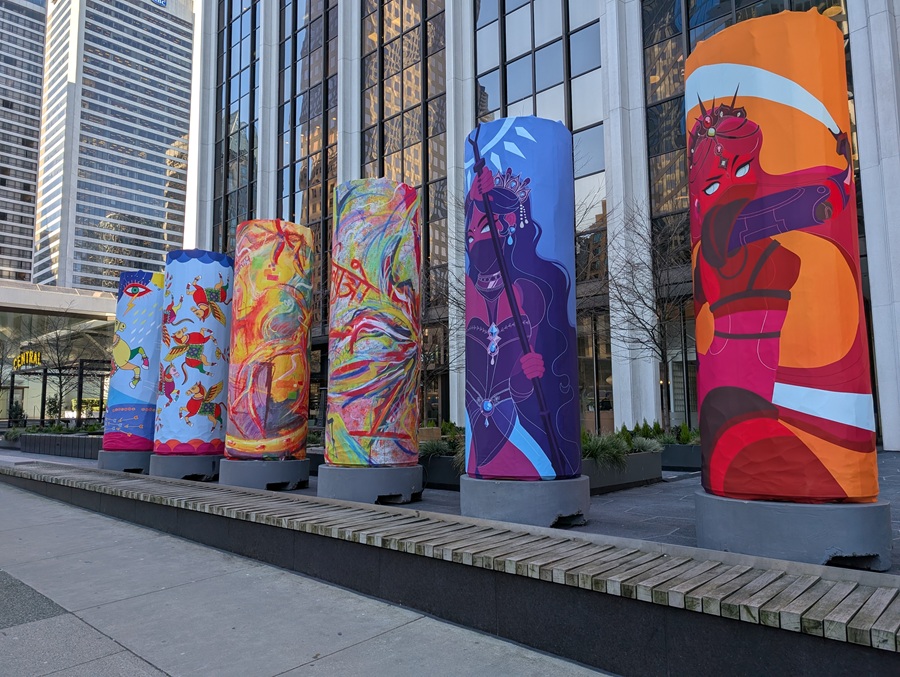
This will be the final weekend of The Lantern City exhibitions around Vancouver welcoming the Year of the Horse. Presented by the Asian-Canadian Special Events Association with various partners, these free public art displays will remain standing through Sunday (March 8) at Granville Island and continue until Monday (March 9) at šxʷƛ̓ənəq Xwtl’e7énḵ Square, the Bentall Centre, and Robson Plaza.
There is a lengthy list of artists whose work appears on these Lunar New Year lanterns. We’ve already written about some of them in Pancouver over the past month.
Below, you can learn about two high-profile Punjabi Canadian illustrators from Sikh families whose work embodies the Bentall Centre exhibition’s name, Brave the Wind. Punjabi Sikh culture is defined by a peaceful warrior tradition, merging spirituality with physical and moral courage. Along with this comes eternal optimism, selfless service, and a duty to fight injustice.
Therefore, it’s highly appropriate that the curatorial team invited two artists with this cultural background to an exhibition honouring the Year of the Horse. Around the world, these animals also demonstrates remarkable courage, selfless service, and an ability to continue moving forward when challenged by their environments.
Anu Chouhan
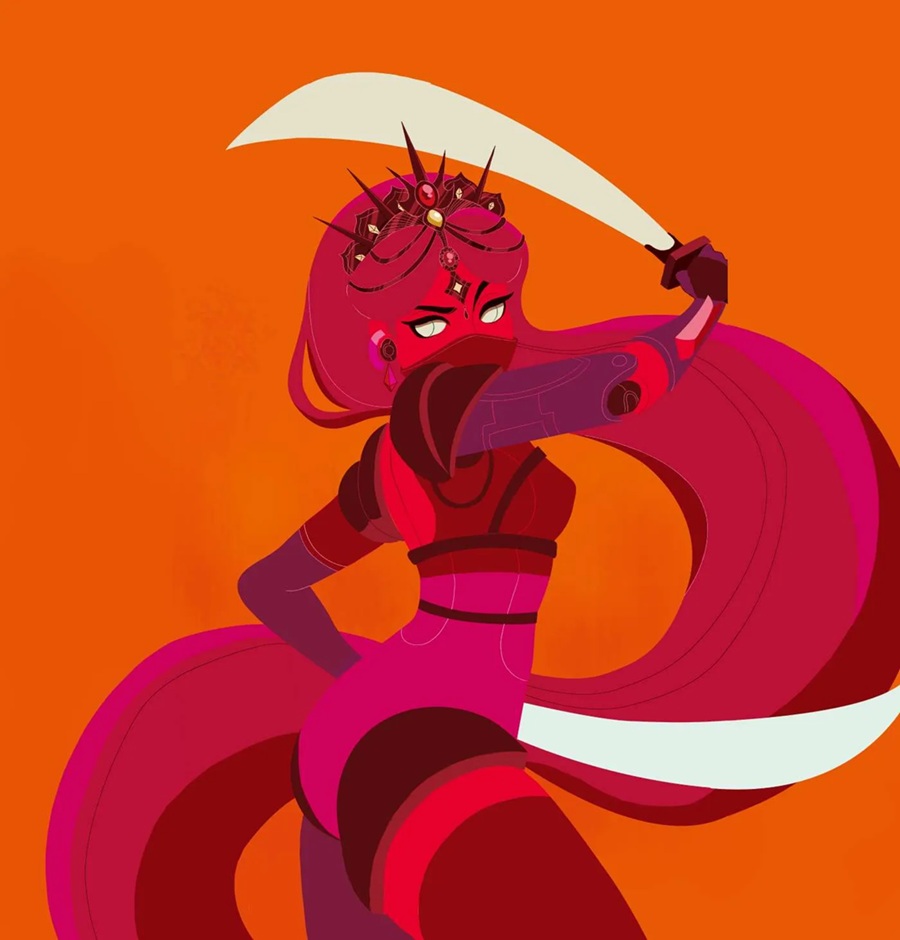
Animator, author, and video game artist Anu Chouhan, a.k.a. Anumation, has designed two powerful female characters, Cinnabar and Lapis Lazuli. They express their muscular vigour on lanterns at the northern end of Brave the Wind.
On the Lantern City website, Chouhan declares that these figures “represent beauty, strength, and balance”.
“They are a rejection of subservience, and encourage a desire to be bold and courageous,” she notes. “This includes asserting our boundaries, speaking out against injustice, and standing up for those who need help. In these ways, these two figures act as guardians who Brave the Wind in the new year.”
Chouhan’s work has already been featured by major media outlets. They include CBC, BBC, The Times of India, and The Times of London.

In addition, she has illustrated graphic novels and children’s books offering positive role models for kids and promoting appreciation for diverse cultures. She created the art for the first graphic novel adaptation of the New York Times bestselling book series Whatever After. Moreover, she is the author and illustrator of the Hair Oil Magic picture book.
Last year, Chouhan revealed to Darpan magazine that she draws inspiration from goddesses, warriors, and queens of the past.
“I find it empowering to create characters that reflect my ethnicity because I never saw that while growing up (unless it was a stereotype),” Chouhan told reporter Natasha D’Souza.
Her father is Raj Chouhan, speaker of the B.C. legislature.
“She has more followers than I have,” Raj Chouhan quipped in an interview on the Heritage Burnaby website.
To learn more about Anu Chouhan, visit her website or follow her on Instagram @anumation.

Jag Nagra
Jag Nagra, a queer Punjabi artist, has designed Forward (1) and Forward (2) at the southern side of Brave the Wind.
“Inspired by my culture and lived experience, my lanterns reflect the South Asian community’s determination to withstand racism, societal pressure, and institutional barriers while continuing to move forward with resilience and dignity,” she states on The Lantern City website.
She adds that this diptych responds to the Brave the Wind theme “by exploring what it means to confront turbulence head-on, individually and collectively”.
The first is a singular winged horse with its front legs lifted to demonstrate its strength and resistance to shooting arrows.
“Above it, an eye releasing lightning captures the weight of prejudice and scrutiny directed toward South Asians,” Nagra explains. “In recent years, anti-South Asian rhetoric has grown louder across the country, placing communities—particularly international students—in harm’s way and under increasing judgment. This artwork is meant to represent the strength to continue pushing forward and carving out a space for belonging.

The second shows a repeating pattern of winged horses. According to the artist, this references traditional Punjabi embroidery patterns.
“The placement of the horses transforms individual strength into collective resilience, emphasizing the power of coming together rather than fragmenting under external forces,” Nagra maintains.
Nagra’s portfolio includes a permanent street sign for Guru Nanak Jahaz (Komagata Maru) Place, the first artist-commissioned Vaisakhi bus wrap, and the first artist-commissioned Diwali jerseys for the Vancouver Canucks.
To learn more about Jag Nagra, visit her website or follow her on Instagram @jagnagra.

Exhibition details
The Asian-Canadian Special Events Association is presenting Brave the Wind at the Bentall Centre until March 9. Learn about the third artist in the exhibition, Miles Saraswat, in this Pancouver article.
To discover more about The Lantern City exhibitions, visit the website. Follow Pancouver on X @PancouverMedia and Instagram @PancouverMedia.




