Elizabeth “Biz” Nijdam has an unusual title for an academic. She is the director of the Comic Studies Cluster in UBC’s Public Humanities Hub.
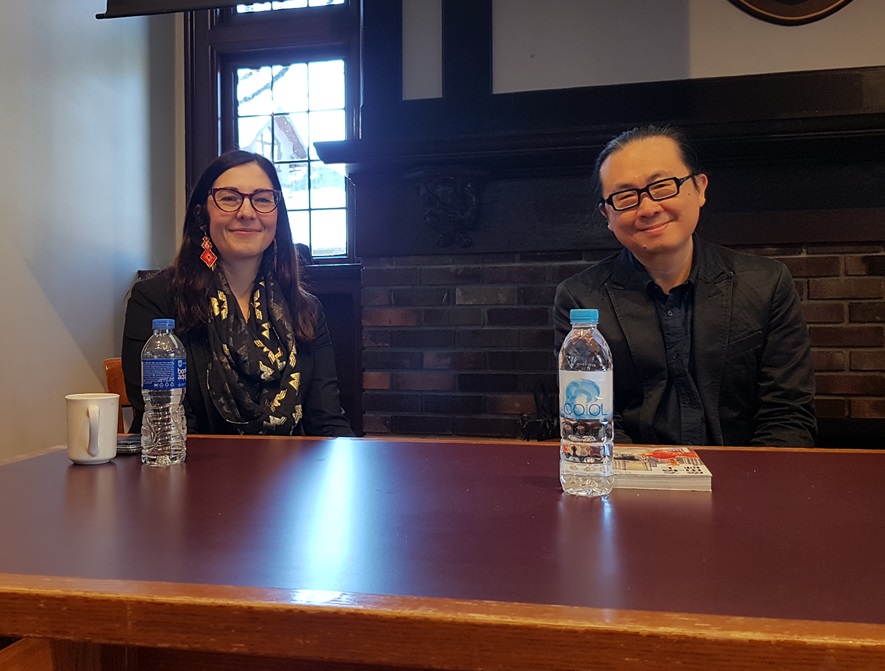
On February 12 at Green College UBC, Nijdam spoke about her research into comics and graphic novels in a presentation with Taiwanese graphic novelist Ruan Guang-min. Nijdam emphasized that comics can play a significant role in how people remember history through storytelling.
“Comics can present not [only] history, but how you remember history,” said Nijdam, an assistant professor in the Department of Central, Eastern and Northern European Studies at UBC. “How you think back to history. How that history is meaningful to people.”
She contrasted that with textbooks and documentary films, which sometimes empty the humanity out of the histories that shape us. She maintained that comics, on the other hand, offer opportunities to honour the humanity of people’s stories.
“You see the people that populated these places—and not just an objective history that focuses on numbers and facts and using the narrative that was told by whoever was in charge at that moment,” Nijdam stated.
“They say that history is the history of the victors,” she continued. “Memory is the intervention into that history—with a story that might otherwise not be told. The work that I do is often looking at how comics intervene in other discourses of memory culture.”
Other discourses in which memories proliferate include museums, archives, and photography, whether it’s personal, or in newspapers or documentary images.

Nijdam cites importance of Maus
According to Nijdam, comics and graphic novels about the Holocaust had a pivotal impact on academic perceptions of these artforms. She stated that a major turning point came when cartoonist Art Spiegelman won the Pulitzer Prize in 1992 for Maus, which shared his parents’ story of surviving the Holocaust. He had been telling this story as a long-running comic dating back for more than a decade before the book was published.
“All of the sudden, people recognized that comics can do important things,” Nijdam said.
Moreover, academics began considering what comics bring to the relationship between memory and history.
“In particular, very early on in this process, Marianne Hirsch theorized comics as a form of post-memory,” Nijdam stated.
The UBC professor defined post-memory as a category of memory that has a relationship to the past. However, she added, post-memory isn’t even remembered by the generation that is producing and reading these comics.
“So, when you look at Art Spiegelman’s Maus, it’s remembering a Holocaust that Art Spiegelman never experienced,” Nijdam explained. “But through the memories of his own father, he re-creates it. It’s a kind of memory that postdates the memory itself.”
She also highlighted that comics can honour certain features of memory, such as ways in which a child experiences something traumatic. Artists can achieve this by creating a sense of claustrophobia generated by composition or juxtapose architectural lines to create a sense of anxiety.
Nijdam also spoke about how comics give meaning to static objects from the past that reside in museums and archival spaces. She examines how historical comics and graphic novels return a sense of story to these pieces by showing how they add meaning to characters’ lives.

Nora Krug interrogates memory
In addition, Nijdam praised German-American Nora Krug’s graphic memoir, Belonging: A German Reckons with History and Home. Nijdam highlighted how Krug made use of the medium of comics to interrogate memory.
“We see her looking at objects and thinking about how scrapbooks are an archive of memory,” Nijdam noted. “We also see her filling in the gaps of memory with cartooning.”
For example, if there is no document to support a story that Krug had heard about, she turned to comics.
“But then she also really grapples with what it means to remember and what it means to have your memory change over time with new information,” Nijdam added.
Furthermore, the UBC professor pointed out that photography might present an image of history that belies reality.
“So, for me, comics do amazing work in preserving our memories as people with complex history.”
The presentation by Elizabeth Nijdam and Ruan Guang-min was made possible through a collaboration between UBC’s Asian Studies Department, LunarFest Vancouver, and the Hong Kong Studies Initiative.
Follow Pancouver on X @PancouverMedia, Bluesky @pancouver.bsky.social, and Instagram @PancouverMedia. Also follow Charlie Smith on Bluesky @charliesmithvcr.bsky.social.