Vancouver city council has voted unanimously to move one step closer to creating a cultural land trust in partnership with an independent nonprofit group. According to a motion passed by council on July 15, staff must report back with a framework for accomplishing this by the first quarter of 2027.
A cultural land trust holds real estate on a permanent basis to preserve affordable spaces for artists, arts organizations, and community groups.
“This model has been successful worldwide in cities like Helsinki, San Francisco, and London,” COPE councillor Sean Orr said in introducing the motion on July 15. “The city [Vancouver] has faced catastrophic loss of affordable artist spaces—something to the tune of over 400,000 square feet of artist studio space since the 2010s.”
Orr has personally felt the impact of the decline of artist studio spaces.
“As a musician, I can say this: I have had at least 10 different jam spaces in a few years that were lost because of this,” Orr told council.
Orr’s motion states that federal and provincial governments have expressed interest in supporting the creation of a cultural land trust model. Moreover, both senior levels of governments have raised this specifically in connection with Vancouver.
In addition, the motion cites “significant philanthropic interest in the creation of a cultural land trust, including from the Metcalf Foundation, the InSpirit Foundation, private landowners, and real estate developers”.
221A executive director Brian McBay makes the case for a cultural land trust to Vancouver city council.
Bequest launches cultural land trust
ABC councillor Peter Meiszner emphasized that in 2024, council approved a different motion on a cultural land trust introduced by then OneCity councillor Christine Boyle. It directed staff to recommend how the city can support such a model.
As a result of Meiszner’s friendly amendment, council also set parameters around any consideration of City-owned lands or buildings within an independently established cultural land trust. These arrangements “should generally utilize long-term lease or similar arrangements that retain public ownership”. The only exceptions would be for properties voted on by council after undergoing a separate public process.
ABC councillor Sarah Kirby-Yung stated that the city has embraced long-term leases in the past to preserve cultural spaces. She cited the Dance Centre and this year’s funding for the purchase of the Eastside Arts Society building as two examples.
For several years, the nonprofit group 221A has been advocating for a cultural land trust in response to the precarity and excessive cost of artists’ spaces.
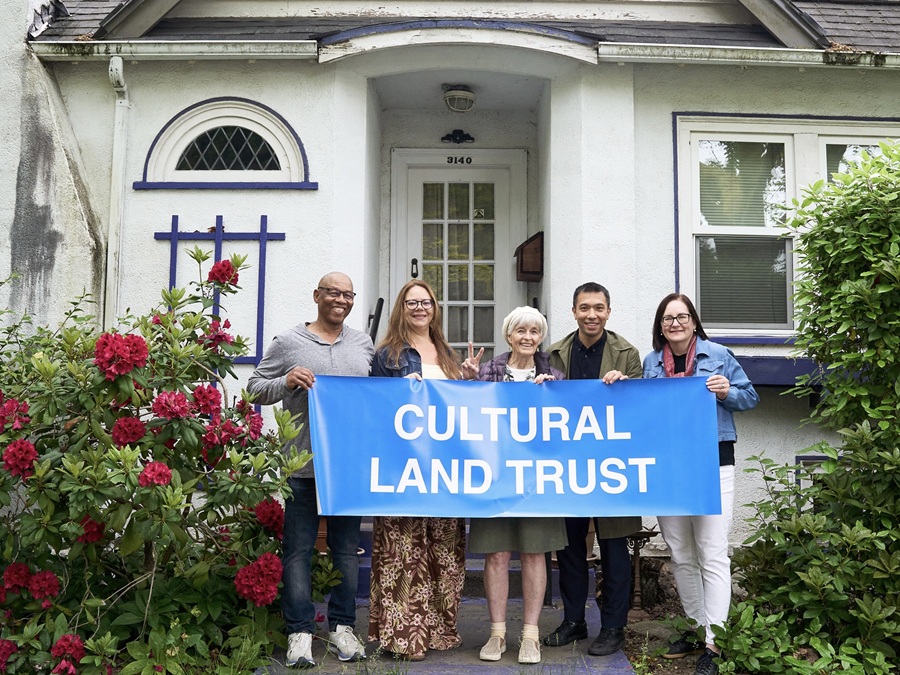
Last month, 221A announced the launch of a cultural land trust with its first asset. It came from a generous gift from the estate of former Simon Fraser University professor Evelyn Pinkerton.
The Co-operative Housing Federation of BC and 221A arranged the bequest: a West Side house assessed at $2.77 million.
@solomonxyk Vancouver needs to stop pricing out the artists who make our city worth living in. @CopeVancouver city councillor Sean Orr’s motion just created a cultural land trust, which will make art spaces more affordable. #vancouver #vanpoli #vancouverartist ♬ original sound – Solomon Yi-Kieran
A platform for community control
221A executive director Brian McBay told council before the vote that a cultural land trust can also drive strategic investments.
“For us, we see it as a permanent platform for community control, enabling arts organizations to access opportunities that otherwise remain out of reach,” McBay said in the council chamber.
He also pointed out that senior governments have been investing in arts and culture across Canada. As one example, he cited a recent $40-million joint investment from the federal and provincial governments in the City of Calgary’s Centennial Planetarium. It’s operated by Contemporary Calgary.
As for the future of a cultural land trust for Vancouver, McBay said: “It’s ultimately about the city trying to unlock and leverage more investments from senior governments and philanthropy.”
For more information on cultural land trusts, visit culturallandtrust.ca. Follow Pancouver on Instagram @PancouverMedia, on X @PancouverMedia, and on Bluesky @pancouver.bsky.social.