

When interviewing Sammy Chien 簡上翔, it’s hard to know where to begin. A queer immigrant from Taiwan, Chien has completed more than 500 collaborative artistic projects. They’ve included mixed-media, film, dance, visual arts, music, and theatre—all in the interest of storytelling. And often, these projects empower underrepresenting communities.
Chien’s work has been presented in the Centre Pompidou in Paris and the National Centre for the Performing Arts in Beijing, among other venues. His company, Chimerik 似不像, once designed the official opening show at Taiwan’s Taichung Light Festival for an audience of more than 30,000.
In light of all of this, Chien (he/she/they) starts by defining their artistic practice.
“I’ve been describing myself as an interdisciplinary artist,” Chien says over Zoom. “I would then tend to expand that by saying: artist, creator, director, researcher, mentor, and beyond.”
As co-founder and co-artistic director of Chimerik, he also integrates technology and spiritual practice with the company’s intercultural work.
“It’s always fun to attempt to describe what that is in words,” Chien says with a chuckle.
In Chimerik’s Inner Sublimity duet, for example, Chien and co-artistic director Caroline MacCaull engaged in energetic channelling with spirits. Through dance, they also created a dialogue between Eastern and Western philosophies. According to Chien, all of this occurred inside a “ritualistic kind of architecture through projection and light”.
Inner Sublimity won the Chrystal Dance Prize 2023/24. In the past, Chimerik also received the B.C. Museums Association Changemaker Award and two Jessie Richardson Awards.
Chien offers new perspectives, which audience members can expand upon in the future.
“We go through a journey and let the audience experience something,” he explains. “Some people say that they felt like they’re going through a deep meditation without any guided voice.”
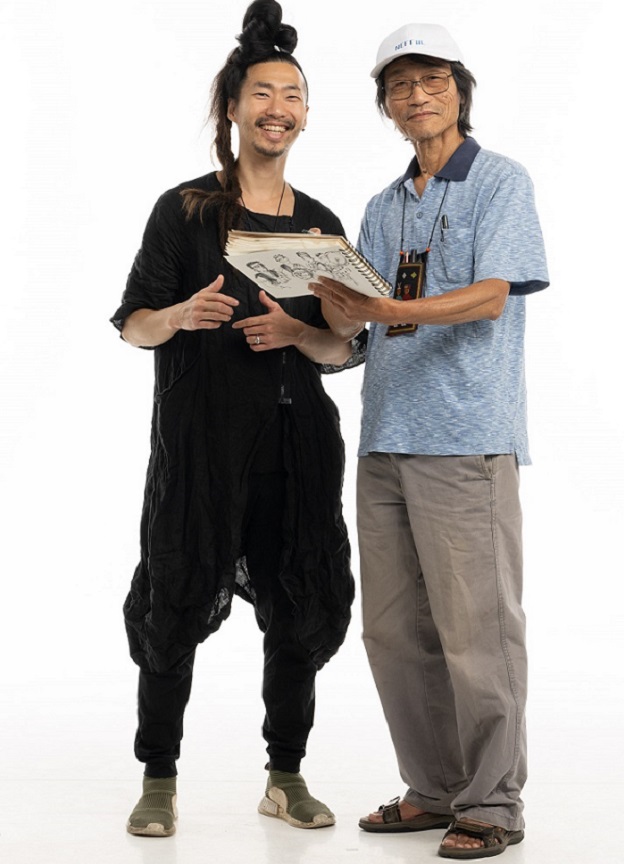
Chien collaborates with his father
He points out that MacCaull is a white, queer female. In Inner Sublimity, they aimed to work through misunderstandings between East and West in connection with spiritualism, as well as anger linked to gender, race, and culture. Layered on top of that is the intergenerational fallout associated with being colonized or being the colonizer.
“Working through the anger and trauma really helps us to be in the place where we can talk about what is the next step,” Chien says. “What is the deeper connection between human beings? Why are we on Earth in this time together having this kind of conversation? Why do we make art to spark those conversations?”
For Chien, his artistic voyage began at a young age in Taipei. His father, Jackson Chien, is an art educator, as well as a visual artist. According to Chien, his dad researched the role of the right side of the brain in spatial thinking. His mom was a music teacher.
“I grew up in a more creative kind of environment,” Chien states. “I feel really lucky that both my parents were encouraging me to do what I want to do.”
Chien says that his dad intentionally left a camera in his room when he was a kid. It enabled Chien to play with different ways of making art.
“It came naturally at a young age,” he says. “Then, I wanted to figure out ways for me and other artists to intuitively create.”
Chimerik’s Ritual-Spective–RE: turning 迴融: 迴歸, is a collaborative media-art project with Chien’s father. Dreamwalker Dance Company and plastic orchid factory partnered on Ritual-Spective, which will be presented at the Downtown Eastside Heart of the City Festival. It’s billed as an “intergenerational dialogue around artistic, cultural, and spiritual legacy”.
“The project also explores love during the unspoken times of colonial oppression, Western globalization and diaspora,” the festival states.
Watch Pancouver editor Charlie Smith’s interview with Sammy Chien 簡上翔.
Projection leads to misunderstandings
Chien’s life story is as varied as the artforms he embraces. He left home at the age of 14 to attend school in Nova Scotia, where he experienced a great deal of racism. On the Chimerik website, Chien reveals that he dyed his hair red, grew dreads, and had a skateboard. When his mom visited, she worried that he would turn into one of those “bad white hippies” derided by his grandfather. She wanted Chien’s dad to punish him.
However, his father merely looked him in the eye, nodded, and walked away. Chien interpreted that as “a moment of silent permission and trust”.
“Later, I thought about the risk that he was bearing by that silent permission, as a young immigrant, potentially breaking traditional rules,” Chien continues. “His permission, his legacy and arts education to me later plays an important role, of who I became today, as an experimental new media artist still innovating and breaking boundaries today.”
As a young man, Chien embraced filmmaking, wanting to embrace the joy of collaboration and storytelling. He also developed an interest in revisiting political and social messages, as well as values, through his art
“Of course, you get certain pushback from either reviewers, critics, or just the general audience that were not ready to see or hear this kind of topic for discussion,” Chien notes.
As he looks back now, he recognizes that there’s a lot of projection, generalization, and stereotyping in connection with race and culture. He also thinks that his experiences made him a stronger person, even though the pushback was hard to take at the time.
Isadora opens door for experimentation
Around 2008, Chien discovered Troika Ranch, which marked another turning point. Founded by media artist Mark Coniglio and choreographer Dawn Stoppielo, the New York-based group integrated music, dance, and theatre with interactive digital media.
“They made this software called Isadora, which is a technology that’s very accessible for anyone without programming language,” Chien says.
Isadora enabled him to bring sound, video, movement, lights, and interactivity together. That opened up a new portal for him to connect different interdisciplinary narratives.
In 2009, Chien co-founded Chimerik in Vancouver. His grandfather passed in Taiwan away that year, so he returned to his homeland, where he added a secondary base for Chimerik.
“It was a very wild journey, actually, in being back and going through grief,” he states.
In those days, Chien connected to Taipei’s underground DJ scene and met some Taiwanese celebrities. Eventually, that led to the huge balloon-lighting project in Taichung in 2015.
Chien also participated in the Sunflower Student Movement, which gripped Taiwan in the spring of 2014. It emerged in response to the Kuomintang government’s attempt to prevent legislative debate on the Cross-Strait Service Trade Agreement with the People’s Republic of China.
Chien insists that the media broadcast exaggerated reports of violence at the time. According to him, it was actually very peaceful, highly educational, and almost utopian. As protesters congregated inside and outside the national legislature, he recalls therapy and counselling sessions taking place. Moreover, professors offered free education and there were poetry-reading sessions.
“I wish more people got to experience them in real time,” Chien says.
Chien sees complexity in the word “Chinese”
The Sunflower Student Movement shone a spotlight on Taiwan’s often troubled relationship with China. Chien actually views the word “Chinese” as being very complicated. He wishes there was an alternative that better captures the nuances of East Asia.
Chien attributes some of the tension between West and East to people in the western world making generalizations or misrepresentations about East Asian people. That’s because westerners project them as being “Chinese”. In other words, they are from China, which is ruled by the Communist Party of China. But that’s not always the case, even if they have Chinese lineage.
He thinks the play Salesman in China, which recently closed at the Stratford Festival, reflects some of these misunderstandings between East and West. Chien and MacCaull were co-projection designers on the show. It was inspired by playwright Arthur Miller’s 1983 collaboration with a Chinese theatre troupe o Death of a Salesman.
“This play was the perfect example of what we’re talking about—this dialogue of complexity of different Chinese-speaking groups,” Chien says. “The outcasts are people from Singapore and people from Hong Kong.”
It reflects that there are, in fact, many Chinese-speaking communities. According to Chien, not all will identify as coming from China. In the early days of his career, he actually believed that being Taiwanese might put him at a disadvantage because China wouldn’t even accommodate the word Taiwan.
However, he also suggests that characterizing people from Taiwan as Chinese is akin to referring to Mexican people as Spanish.
“There is a lot of misunderstanding between countries and histories and all that stuff,” Chien acknowledges. “I’m not here to promote any hate between any culture, any religion, any country.”
Watch the trailer for Salesman in China.
Event details
The Downtown Eastside Heart of the City Festival will present Ritual-Spective—RE: turning 迴融: 迴歸 for free from 6 to 9 p.m. on November 1 at Chimerik 似不像 Chinatown Art Space (155–288 East Georgia Street), with a Chinatown Stories Audio Tour special opening at 7 p.m. The festival will also present Ritual-Spective—RE: turning 迴融: 迴歸 at the same location for free from 1 to 5 p.m. on November 2 and from 11 a.m. to 3 p.m. on November 3. Meanwhile, at 5 p.m. on November 2, there will be a free artist talk with Sammy Chien 簡上翔 and Andrea Nann at Left of Main (211 Keefer Street). For more information, visit the festival’s website.
Follow Sammy Chien 簡上翔 on Instagram @soar55, Jackson Chien on Instagram @chienartsstudio, and Chimerik 似不像 on Instagram @chimerikco. The Ritual-Spective project is @ritualspective on Instagram.
This article is part of “Beyond Chinese”, a joint initiative of Pancouver and the Asian-Canadian Special Events Association. Through interviews with artists and cultural workers, Beyond Chinese offers a nuanced view of people with Chinese ancestry. Pancouver and the Asian-Canadian Special Events Association gratefully acknowledge the support of Canadian Heritage.




