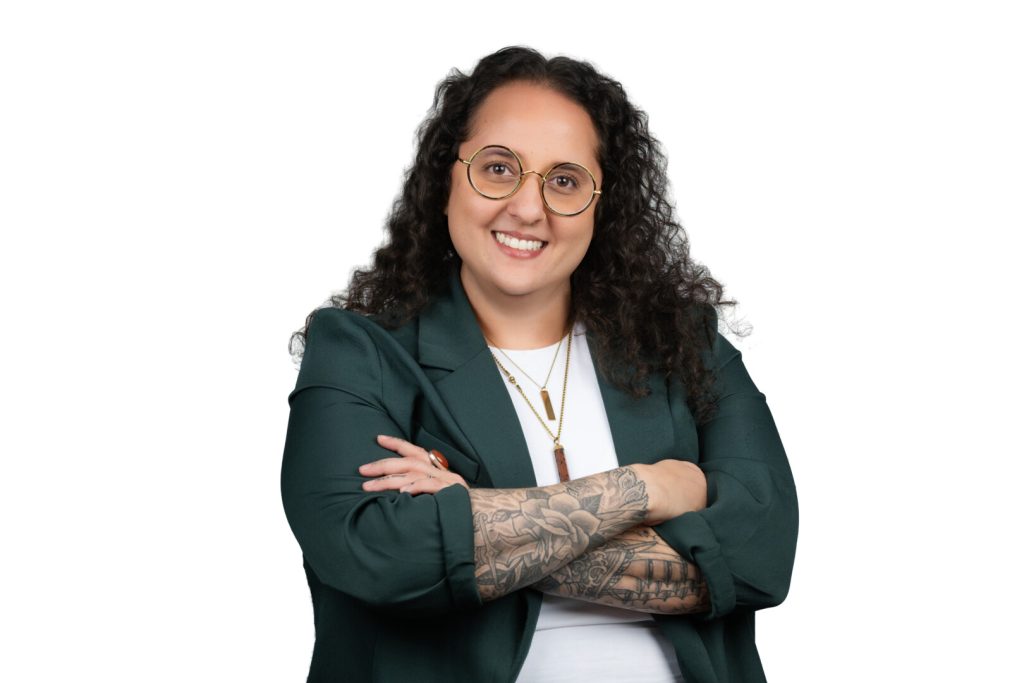
People like to say that the grass is always greener on the other side of the street. Inclusion advocate Payvand Gonzalez, on the other hand, has a different take on this common expression.
“I believe the grass is greener where you water it,” said Gonzalez, director of people, culture, and inclusion at the nonprofit settlement organization MOSAIC.
She made the comment during a January 19 online panel discussion on bicultural identity and belonging, which was presented by Ruby Slippers Theatre. Gonzalez maintained that that a sense of belonging doesn’t occur organically. This feeling must be created, nurtured, and shared.
“It’s not about making a seat at the table,” noted Gonzalez, whose parents were Iranian refugees to Canada in the 1980s. “It’s about creating a table with us in mind. And that’s the difference.
“It’s not about saying I’ve made a temporary opportunity for you—to just kind of experience this,” she continued. “It’s ‘I’ve made a table for you to exist in all of your fullness, and all of your humanity, and all of who you are.’ ”
Gonzalez was one of six speakers at the 90-minute event. It was conducted in association with MOSAIC, S.U.C.C.E.S.S., Pancouver, the Asian-Canadian Special Events Association, and rice & beans theatre with support from Canadian Heritage.

Bicultural people can be reduced to fractions
Another panelist, Ava Jung, is a community engagement officer with S.U.C.C.E.S.S., one of Canada’s largest social-service agencies. She spoke eloquently about misconceptions faced by people with bicultural and multicultural identities.
“One of the biggest in my own life—and with other multicultural or bicultural individuals—is the idea of having to choose your culture,” Jung said. “Or having to be more like one culture over another.”
She pointed out that bicultural people sometimes face judgment from others if they gravitate to one of their cultures. And while being of mixed ancestry can expose a person to wonderful cultures, Jung believes that there is sometimes “a lot of gatekeeping” from the closest people in their lives, as well as from strangers, regarding their identity.
“I find that a lot of bicultural people—specifically in the biracial sense or multiracial sense—can sometimes be reduced to percentages or fractions,” she added. “And then people like take these numbers and…think, ‘Okay, well that’s how much you’re allowed to be part of that culture.’ ”
Playwright creates comedies with multiracial characters
A triracial writer and actor on the panel, Faly Mevamanana, said that she often gets pigeonholed into being of one race because people don’t understand how she can be of Malagasy, Chinese, and British ancestry at the same time. She revealed that she became a writer precisely because she didn’t want to pretend to be someone whom she wasn’t. And Mevamanana felt that no one was going to write her ethnicity in an authentic way apart from her.
“For so long, so many of the stories that I would hear as a person of mixed race about people who looked like me were so sad and tragic—and about the trauma and the difficulties that we would face just being humans in the world,” Mevamanana said. “I wanted the opposite of that. I wanted to showcase the joy and the love and the care. And so, my work, specifically, is comedy.”
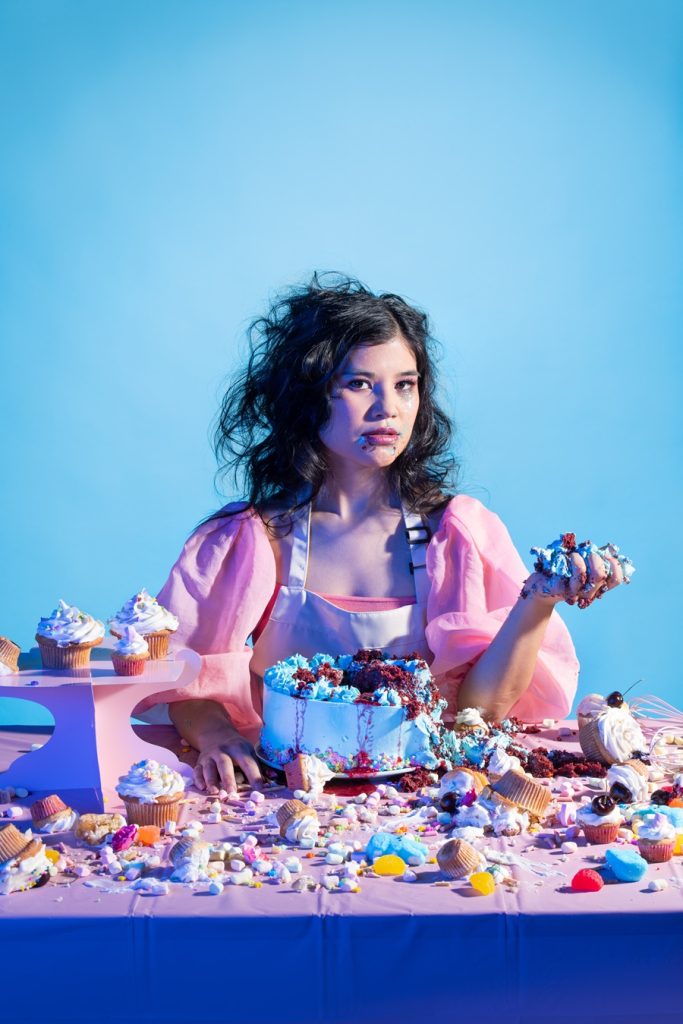
One of her goals is to write stories with diverse characters but which are not about their diversity. A prime example is The Baking Baking Show: The Play, which Mevamanana wrote and stars in. She plays a multiracial contestant in a Reality TV cooking show. Ruby Slippers Theatre will present the world premiere at the Shadbolt Centre for the Arts from February 5 to 7 and at Presentation House Theatre from February 12 to 15.

Chamale presents Canadian-born Latinx perspective
Three other writer-actor-directors—Pedro Chamale, Abi Padilla, and Tricia Trinh—offered their own heartfelt comments.
Chamale, the Latinx artistic director of rice & beans theatre, also didn’t see himself reflected in theatre productions. He mentioned that he was born and raised in Chetwynd, B.C. and has Guatemalan ancestry.
He recalled that when he would talk about himself, teachers would ask if he had read Guillermo Verdecchia’s Fronteras Americanas, which had won the Governor-General’s Award for Drama. Then, these teachers would tell Chamale that he was just like Verdecchia.
Chamale, however, didn’t feel that this was an accurate statement because he is Canadian-born whereas Verdecchia immigrated from Argentina. Moreover, Chamale wasn’t a journalist, unlike Verdecchia.
“Yes, we’re both Latinos—I get it—but it’s also a very different experience,” Chamale said.
He wrote Peace Country, in part, because he had never seen characters like the people he grew up in northeastern B.C. It married his environmental activist side with his history of growing up in a resource-dependent community alongside a diverse group of friends.
Chamale created two Latina sisters as characters in Peace Country, along with an Indigenous friend, a white European settler, and the son of a Chinese restaurateur. According to him, most published work by Latinx writers has been written by immigrants and refugees. So, he deliberately wrote a monologue for a character named Julia through the voice of a second-generation person.
“There is so much that excites me about the next generation of bicultural artists because they’re doing it so fearlessly,” Chamale said. “I was so scared to to be me because of fear of rejection.”

Padilla celebrates Pinoy heritage
Padilla, on the other hand, writes from the perspective of first-generation immigrants from the Philippines. During the discussion on bicultural identity and belonging, she shared insights into interactions between first- and second-generation Filipinos in Metro Vancouver.
She noted that people who grow up in the Philippines use gender-neutral pronouns in Tagalog. Yet Canadian-born Filipinos eagerly embrace pronouns related to gender.
“Sometimes, the second generation would feel like, ‘Oh, you’re being disrespectful to me because you’re not respecting my pronouns,’ ” Padilla said. “But I think we should actually also give each other some patience. Because if you have grown up with the Tagalog language, we never really use ‘she’ or ‘he’. We’re only thinking about singular or plural.”
Padilla is best known for her play Grandma, Gangsta, Guerrilla, which premiered last year. She played the lead character, an immigrant Filipina grandmother who escapes from a care home. Ruby Slippers Theatre presented a stage reading of Padilla’s Far and Free (Tagalog title: Malayo at Malaya) on January 27 as part of the Advance Theatre Festival.
Through her plays, Padilla includes authentic representations of her homeland through the dialogue, language, singing, and other references.
“It’s been a very fun journey, for sure,” she stated.

Bicultural belonging linked to care
Some of the most moving words in the discussion about belonging came from Trinh, a queer, genderfluid, nonbinary Chinese-Vietnamese-Canadian theatre artist. Trinh wrote the play Attachments, which is about six queer characters from immigrant/refugee families navigating through a polyamorous relationship. Trinh equated “belonging” with care.
“So much of what it means to care for and to be cared for shows up as consideration: to consider and be considered,” Trinh said. “It comes down to consideration of who is in the room on a daily basis, taking the time to learn, and understand what makes up their identity, and in turn, their reality.”
Trinh elaborated on this point. They declared that this entails taking time to gain empathy for others’ cultural backgrounds, creation backgrounds, access needs, communication style, and how they receive feedback. And it’s become a cornerstone of Trinh’s artistic practice.
“All of that is an act of care that hopefully fosters a sense of belonging,” Trinh emphasized.
Pancouver editor Charlie Smith facilitated the panel discussion.
Watch the Ruby Slippers Theatre panel discussion on bicultural identity and belonging.
Ruby Slippers Theatre is presenting the Advance Theatre Festival at the Shadbolt Centre for the Arts until January 30. Follow Pancouver on X @PancouverMedia and Instagram @PancouverMedia.