In an unpredictable world, film festivals have a way of fostering empathy for people halfway around the world. A case in point is the Vancouver International Film Festival’s decision to screen Factory, an enlightening documentary that takes viewers inside a huge electronics manufacturing facility in Wuhan, China.
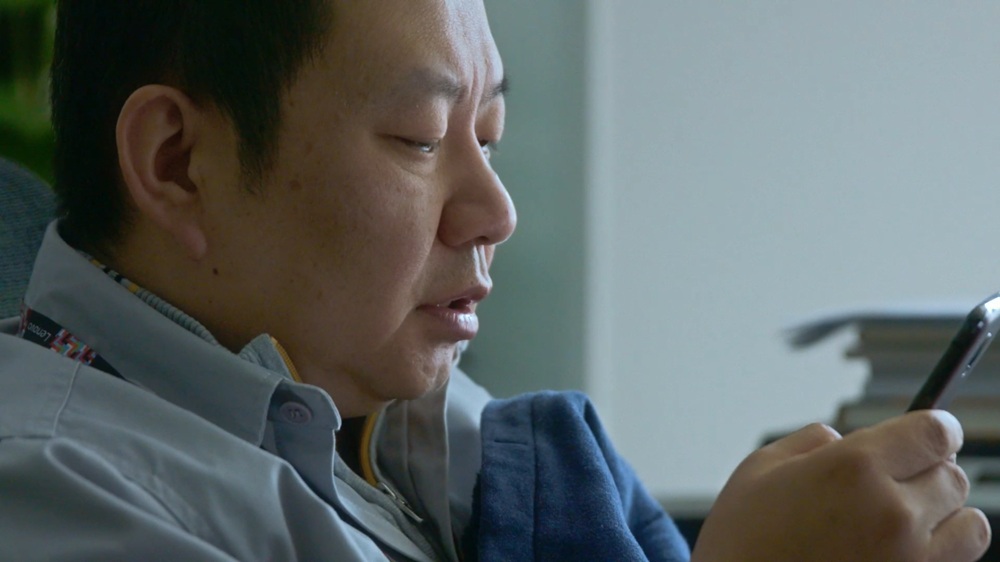
Director Zhou Hao opens his film just as Wuhan is under lockdown following the world’s first outbreak of COVID-19. Lenovo, a Hong Kong-based electronics company, has given general manager MT (Qi Yue) the unenviable task of getting more than 7,000 employees back to work.
“We are the largest exporter in Hubei Province,” the good-natured MT declares on-camera.
But workers are confined to dormitories on the company’s sprawling campus. They line up to receive company take-out food delivered outside their buildings. Virtually everyone is wearing a mask, with the one exception immediately chastised. Shuttle buses stand vacant and immobile on the side of the road. And everywhere in Wuhan, including at the factory, machines test people’s temperatures to ensure they’re not developing a fever.
MT has a monumental challenge on his hands, given that 40 percent of Lenovo’s Chinese workforce is in Wuhan.
Factory highlights deeper issues
Lenovo appears to be taking great precautions when masked workers are eventually allowed back on the crowded factory floor. There are stacks of boxes of masks and N95 respirators in a cupboard. A competent and caring female physician, Dr. Chen, is based at the factory’s health clinic. At times, Factory feels like a polished propaganda film demonstrating that Lenovo is a highly trustworthy company, notwithstanding the factory’s location at ground zero of the worst pandemic in a century.
But over time, the director’s camera reveals deeper issues at play. Front-line supervisors keep close tabs on employees, forcing them to complete a specific number of tasks per minute. This drives 200 to 300 hourly workers to quit their $3.30 per hour jobs every week
Meanwhile, middle managers face intense pressure to meet production targets. Then there is the prospect of intense competition from new manufacturing plants in India and Vietnam.
In the midst of this, the likeable workers and their agreeable bosses seem like little sailboats being tossed around at sea in a globalized economic hurricane. It’s easy to feel sympathy for all of them, especially given the tumult of the pandemic.
Exposing complexity of manufacturing
To his credit, director Zhou eschews tabloid-style exaggeration, preferring to present the unvarnished, on-the-ground reality. The former Xinhua News Agency photojournalist is a sophisticated filmmaker who capably weaves several themes together, creating an all-encompassing picture.
Two of his previous films, Cotton (2014) and The Chinese Mayor (2015), each won the Best Documentary prize at the Golden Horse Film Festival. The Chinese Mayor also won the Special Jury Award for Unparalleled Access at the 31st Sundance Film Festival, as well as Best Documentary at the 9th Asian Film Awards.
Factory is a long film, running 148 minutes, and delivers unparalleled access to the inner workings of one of Lenovo’s major operations. This offers viewers a chance to appreciate the complexity of the manufacturing process in a large Chinese electronics plant.
In the process, Zhou reveals why it’s not so simple finding a qualified workforce to build error-free cellphones and tablets at scale. Yet this is precisely what U.S. president Donald Trump expects Apple to do in America as part of his grand scheme to reshore manufacturing. Through the voices of workers and managers, Factory reinforces the folly of the president’s plan while noting that virtually no one over the age of 45 can even do this difficult, repetitive, and often dreary work.
The Vancouver International Film Festival will present Factory at 2:30 p.m. on Thursday (October 2) and 8:30 p.m. on Monday (October 6) as part of its Insights series. Both screenings will be at International Village. For tickets and more information, visit the festival website. Follow Pancouver on Instagram @PancouverMedia and on Bluesky @pancouver.