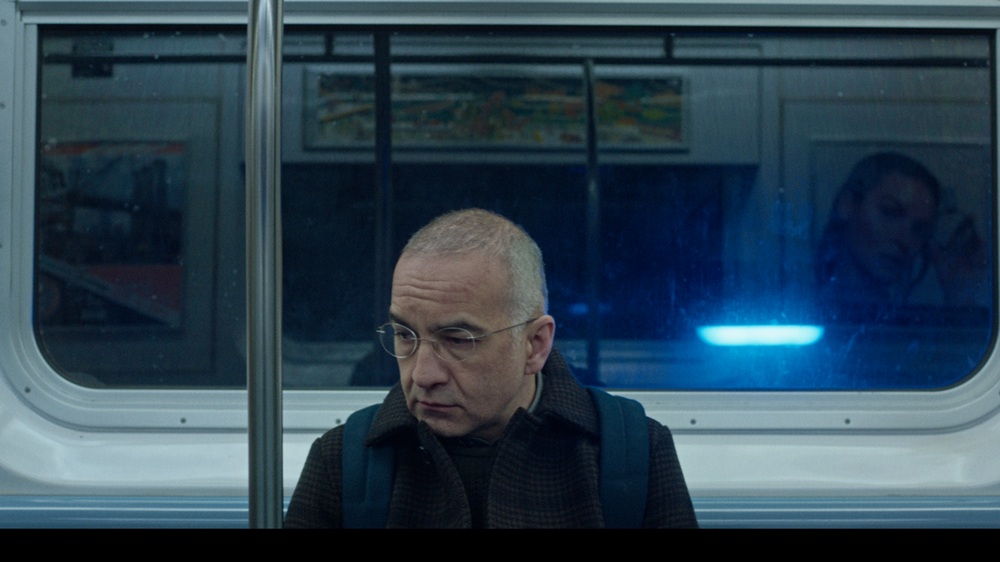
In the last two decades, numerous films have delved into the challenging decisions people make to leave their country and loved ones to escape political persecution. Gazelle follows this theme through the story of Yakup, a doting father and a beloved music teacher, who is compelled to leave his wife and five-year-old daughter behind in Türkiye to seek asylum in New York.
The film opens in a mosque in New York, where an imam narrates the parable of a gazelle—a tale of hardship and faith—to the congregation. As he preaches, we hear a cacophony of overlapping voices echoing in Yakup’s head, reflecting the trauma of his harrowing journey aboard an overcrowded, illegal boat from Türkiye to Greece.
Gazelle spares us the graphic horrors of his experience; instead, we focus on Yakup’s expressive face and feel the weight of his struggles. The story of the pregnant gazelle facing predators serves as a powerful metaphor for the immense emotional and physical challenges Yakup endures. This foundational scene offers profound insight into the character’s plight.
The subsequent scene establishes the stakes involved: Yakup is consumed by the separation from his daughter. Within the cramped confines of the kitchen where he works in New York, he videocalls her, rehearsing the American folk song “You Are My Sunshine” for her school concert. Like the parable of the gazelle, the song is a thread that weaves the story and frames the plot beautifully, encapsulating Yakup’s longing as well as the prospects and illusions of “the American Dream”.

Gazelle depicts immigrants’ struggles
Working two jobs, one at a kebab restaurant, Yakup finds solace and camaraderie among the close-knit community of fellow immigrant workers who live together under the watchful eye of the business owner, a formidable yet compassionate matriarch from a Levantine country. He stands out among his peers, portrayed as quietly charismatic and educated, with a resolute determination to bring his family to live with him.
However, when legal avenues for immigration prove too slow, Yakup’s patience wanes, and frustration mounts with each passing day. Reluctantly, he turns to a dubious people-smuggler. One might wonder if the long spiral staircase leading to the immigration office in New York serves as a metaphor for his experiences.
The film’s greatest strength lies in lead actor Nadir Sarıbacak‘s nuanced and compelling performance, which carries the story from start to finish. He delivers a powerful portrayal, capturing every subtle layer of pain and exhaustion. Sarıbacak is recognized for his award-winning roles in films as Winter Sleep (Palme d’Or, Cannes 2014), Ivy (Sundance 2015), and Leylak (Special Jury Mention, Tribeca 2021). He has earned multiple Best Actor awards from the prestigious Antalya Golden Orange and Istanbul Film Festival.
The ensemble cast, including the second lead, Ayhan Hulagu, delivers solid performances. A minor downside in the film is the casting of the five-year-old Turkish girl, who, when singing in English, sounds like a native-born American rather than reflecting her background.
Gazelle is also Sarıbacak’s and Samy Pioneer’s co-directorial debut for a feature. Samy Pioneer is also the editor, and he is skillful in ensuring tight pacing and seamless transitions between scenes while maintaining a deliberate yet engaging rhythm throughout.
Watch the official teaser for Gazelle.
Cinematography conveys helplessness
Sarıbacak co-wrote the screenplay with Ayhan Hulagu, who is also the supporting actor playing Adem, Yakup’s former student from Türkiye and his immigration lawyer and confidante in New York. While largely well-crafted, the screenplay occasionally falters with minor disjointed dialogues and passages. However, the thoughtful framing of the plot gives the narrative a sense of wholeness that evokes strong emotions. Apart from a few minor clichéd conflicts among the friends and the swapping banter about “kebab and kardeş”, the script remains tight.
Another strength of the film lies in the colour palette and visual atmosphere created by the cinematographer Lasse Ulvedal Tolboll. The greyness of New York, even the Statue of Liberty in mist, and the depiction of confined spaces, such as the cramped kebab kitchen and living areas, convey a sense of helplessness and unease. Conversely, this very same small environment brings the characters closer, fostering a sense of deep connection and intimacy, all of which complements the story.
Gazelle vividly captures the personal account of a Turkish asylum seeker, depicting harsh realities faced by those who flee one trauma only to encounter another upon arrival. It also prompts us to reflect on global political shifts toward more authoritarian and more conservative governments that complicate the lives of refugees and immigrants.
In a world where racist rhetoric too often shapes perceptions of refugees and migrants, the film stands as a reminder of their humanity and their need and right not only for work and safety, but also for their family and dignity.
The Vancouver International Film Festival will present Gazelle as part of the Vanguard program. Screenings will be held at 8:30 p.m. on Friday (October 3) and 1:15 p.m. on Sunday (October 5) at VIFF Cinema. A third screening is schedu October 12 at International Village.
Screening details
The Vancouver International Film Festival will present Gazelle as part of its Vanguard program. Screenings will be held at 8:30 p.m. on Friday (October 3) and 1:15 p.m. on Sunday (October 5) at VIFF Cinema. A third screening is scheduled for 9:15 p.m. on October 12 at International Village 8. For tickets and more information, visit the Vancouver International Film Festival website.